

Competitor Backlink Checker Tools: the 8 We Use for Client Campaigns

Listen to this article
Browser-native voice. No account required.
Your competitor is ranking on links you have never seen. A competitor backlink checker is how you see them, then decide which ones you can win for yourself.
I have run client campaigns on most of these tools, so this is the working comparison, not an affiliate roundup. The tool is only step one, though. Finding the links is easy; deciding which are worth pursuing is the real work, which is why this pairs with our competitor backlink discovery process.
A quick orientation before the list. There is no single best backlink checker, only the one that fits your scale, your budget, and how often you actually do this. I have grouped the eight by exactly that, so you can skip to the tier you are in.
What a Competitor Backlink Checker Does
A competitor backlink checker pulls the list of external sites linking to a domain you do not control, using a tool's crawled link index. It lets you see who links to a rival, how authoritative those links are, and which referring domains you could realistically earn yourself.
It matters because links remain one of the strongest ranking signals. Backlinko's analysis of 11.8 million results found the #1 result has 3.8 times more backlinks than positions two through ten. Competitor backlink analysis turns that gap into a target list instead of a guess.
The strategic value is the shortcut. Your competitor has already spent months testing which sites in your niche give links, which pitches land, and which placements move rankings. Their backlink profile is that research, sitting in public, waiting for you to read it with the right tool.
What to Look for in a Competitor Backlink Checker
The tools differ less on interface than on the things that actually decide the work. Five factors separate them.
Index size and freshness. A bigger, more recently crawled link index finds more of the real profile. This is the single biggest differentiator.
Gap analysis. The ability to compare several competitors at once and surface the domains linking to them but not to you.
Filtering and quality metrics. Dofollow status, domain authority scores, anchor text, and traffic, so you can sort signal from noise.
Export and scale. Clean exports and reasonable row limits, because real prospecting happens in a spreadsheet, not a dashboard.
Price against use. A solo site and an agency tracking 40 clients need very different tiers.
Monitoring and alerts. Ongoing tracking of new and lost links, so you catch a competitor's fresh placements while they are still fresh.
Index disagreement is the factor newcomers find unsettling. Run the same domain through three tools and you get three different referring-domain counts, sometimes off by thousands. Neither is lying; each crawls the web independently and finds a different slice. The practical response is not to pick the tool with the biggest number, but to treat the overlap between two tools as your reliable core and the rest as upside.
No single tool wins every category. We run more than one, cross-reference the indexes, and treat any single tool's number as an estimate, not gospel. Google's own SEO guidance will not tell you a competitor's links, which is exactly why these tools exist.
The Competitor Backlink Checker Tools We Use
Eight tools earn their place in real campaigns. They are ranked by how often we reach for them, not by sponsorship, because there is none.
1. Ahrefs
Ahrefs is the tool we open first for competitor backlink work. Its link index is among the largest and freshest, and the Site Explorer plus Link Intersect workflow is built precisely for finding the domains linking to rivals but not to you.

In practice, Link Intersect is where we start most campaigns: drop in three competitors and it returns the domains linking to all of them but not to the client. That list becomes the backbone of the outreach plan.
Strengths. Best-in-class index, excellent gap analysis via Link Intersect, clean exports, trustworthy metrics.
Watch-outs. No meaningful free tier beyond a limited checker; the learning curve is real for new users.
Price. Plans start around the mid hundreds per year; standard tiers run higher for agency row limits.
Best for. Agencies and serious in-house teams that live in backlink data daily.
2. Semrush
Semrush rivals Ahrefs on index size and adds a broader marketing suite. Its Backlink Gap tool compares up to five domains at once, which makes multi-competitor analysis fast.

In practice, we lean on Semrush when a client already pays for it or when the campaign needs keyword and backlink data side by side. The five-domain Backlink Gap comparison is faster than Ahrefs when the competitor set is wide.
Strengths. Huge dataset, strong Backlink Gap feature, all-in-one suite covering keywords and ads alongside links.
Watch-outs. The interface is dense, and the full feature set costs more than teams that only need backlinks will want to pay.
Price. Comparable to Ahrefs at the standard and agency tiers.
Best for. Teams that want backlinks plus the wider SEM toolkit in one subscription.
3. Moz Link Explorer
Moz pioneered Domain Authority, the score half the industry still quotes. Link Explorer is clean and approachable, and the Link Intersect view handles competitor comparison well.

In practice, Moz is the tool we hand less technical clients who want to read the report themselves. The DA score travels well in a pitch deck, even when we are quietly cross-checking the real index in Ahrefs.
Strengths. Friendly interface, the familiar DA metric, solid spam-score flagging for toxic-link work.
Watch-outs. Its link index is smaller than Ahrefs or Semrush, so it surfaces fewer links on deep profiles.
Price. Mid-range monthly plans, with a limited free Link Explorer for occasional checks.
Best for. Teams that value usability and DA scoring over raw index depth.
4. Majestic
Majestic is the link-data specialist, with one of the longest-running indexes and its own Trust Flow and Citation Flow metrics. It does links and only links, deeply.

In practice, Majestic is our second opinion. When Ahrefs and Semrush disagree on a profile, Majestic's separate index and Trust Flow break the tie, and its historic data is unmatched for auditing a long-lived domain.
Strengths. Massive historic index, unique Trust Flow / Citation Flow quality signals, strong for link auditing.
Watch-outs. No keyword or rank features, and the interface feels dated next to Ahrefs and Semrush.
Price. Lower entry price than the all-in-one suites, billed monthly.
Best for. Link purists and anyone who wants a second opinion on a profile's quality.
5. SE Ranking
SE Ranking has closed the gap on the incumbents while staying cheaper. Its backlink checker and competitor comparison are now genuinely usable for client work, not just a budget compromise.

In practice, SE Ranking is what we recommend to smaller clients running their own checks between engagements. It does most of what the top two do at a fraction of the cost, which is enough for a single-site owner.
Strengths. Strong value, growing index, competitor comparison and monitoring at a lower price point.
Watch-outs. Index depth still trails Ahrefs and Semrush on the largest profiles.
Price. Notably cheaper than the top two, with flexible tiers.
Best for. Smaller agencies and budget-conscious teams that need a capable all-rounder.
6. Serpstat
Serpstat is another value-driven all-in-one with a competent backlink module and a competitor comparison view. It punches above its price for teams that do not need the deepest index.

In practice, Serpstat shows up when budget is the hard constraint and the client still wants a full suite. It will not match Ahrefs on a deep profile, but for a modest site it surfaces enough to act on.
Strengths. Affordable, broad feature set, decent backlink and gap analysis for the cost.
Watch-outs. Smaller link index and occasionally slower data refresh than the premium tools.
Price. One of the cheaper full suites, with a low entry tier.
Best for. Freelancers and small teams wanting suite features on a tight budget.
7. SEO SpyGlass
SEO SpyGlass, part of the SEO PowerSuite desktop apps, takes a different model: a one-time license rather than a subscription, pulling from multiple link sources on your own machine.

In practice, SpyGlass suits the consultant who does occasional deep audits and resents a monthly bill for a tool used twice a quarter. The desktop model is a trade-off, but the one-time cost wins over a few years.
Strengths. One-time pricing option, aggregates several link sources, strong for deep one-off audits.
Watch-outs. Desktop software rather than cloud, so it is less convenient for ongoing monitoring and team access.
Price. A one-time license or annual plan, cheaper long-term than monthly SaaS for solo users.
Best for. Solo SEOs and consultants who prefer owning software over a recurring bill.
8. Ubersuggest
Ubersuggest is the budget entry point. Its backlink data is lighter than the specialists, but for a small site checking a competitor occasionally, it is the cheapest way in.

In practice, we point beginners and small business owners here, not clients paying for managed campaigns. It is the on-ramp: cheap enough to learn on, light enough that you outgrow it once the work gets serious.
Strengths. Very affordable, including a lifetime plan, simple enough for beginners.
Watch-outs. The smallest and least fresh index here; not built for deep agency-grade analysis.
Price. Low monthly cost, with a one-time lifetime option.
Best for. Beginners, small business owners, and anyone testing the waters before paying for a specialist.
Which Competitor Backlink Checker Should You Pick?
There is no single best tool, only the best fit for your scale and budget. The honest mapping:
Deepest data, agency-grade. Ahrefs or Semrush. Pick Ahrefs for pure link depth, Semrush if you want the wider suite.
Best value all-rounder. SE Ranking, with Serpstat close behind.
Link-quality second opinion. Majestic, for Trust Flow alongside whatever else you run.
One-time cost. SEO SpyGlass, if you would rather buy than subscribe.
Cheapest start. Ubersuggest or Moz's free Link Explorer for occasional checks.
Most free trials last long enough to run one real competitor analysis. Use them. The tool that fits your workflow is worth more than the one that wins a feature checklist.
One more rule from running these daily: do not buy on index size alone. The biggest index is wasted if the filtering, gap view, or export gets in your way, because the time cost of fighting a clunky tool outweighs the few extra links a deeper index surfaces. Pick the one you will actually use every week.
Free vs Paid Competitor Backlink Checkers
Free tools have a real place, but they have a hard ceiling. Knowing where that ceiling sits saves you from either overpaying or expecting too much from a free checker.
Free checkers, including Ahrefs' and Moz's limited versions, show a capped sample of a competitor's strongest links. That is enough to confirm a gap exists and to grab a handful of obvious targets. It is not enough to build a full prospecting list, because the cap hides the long tail where most winnable links actually live.
Paid tools remove the cap and add the filtering, gap comparison, and export that make the data usable at scale. The honest rule: if you are checking one competitor once, a free trial covers it. If competitor analysis is an ongoing part of your growth, a paid plan pays for itself in the first campaign. Google Search Console, worth noting, shows only your own backlinks, never a competitor's, so it complements these tools rather than replacing them.
How We Run Competitor Backlink Analysis
The tool is step one of four. Pulling a competitor's links is the easy part; the value is in what you do with the list. Our process runs discovery, qualification, prioritization, then outreach.
Discovery is the tool work above: pull the profiles, dedupe to referring domains, export. Qualification scores each domain for topical relevance, real authority, and whether it links editorially or sells placements. Prioritization sorts the survivors by winnability, the mid-authority relevant sites we can realistically earn, not the unreachable trophies. Outreach is the campaign that actually goes and gets them.
We pull profiles from more than one index, dedupe to referring domains, score each for relevance and winnability, then build the outreach list. The full method, with the filters and the scorecard we use, is in how we find competitor backlinks, and the acquisition side runs through our link-building campaigns.
A clean comparison also depends on a clean starting point. If your own profile is full of toxic or broken links, the gap analysis is distorted, which is where a technical SEO audit and a backlink audit come first.
The qualification step is where most DIY efforts stall. A competitor with a strong profile can have thousands of referring domains, and the instinct is to chase the highest-authority ones. In practice the winnable links are usually the mid-authority, topically relevant placements a competitor earned through outreach, not the news mentions or scholarship links you will never replicate. Reading the list correctly is the skill the tool cannot supply.
Frequently Asked Questions
What Is the Best Free Competitor Backlink Checker?
For occasional checks, Ahrefs' free backlink checker and Moz's free Link Explorer are the most useful, both capped at a small number of results. Google Search Console shows your own backlinks free but not a competitor's. Free tiers are fine for a quick look, not for real prospecting.
How Accurate Are Competitor Backlink Checkers?
Each tool reports from its own crawled index, so the numbers differ, sometimes widely, between tools. None sees every link. That is why we cross-reference at least two indexes and treat any single count as an estimate rather than a precise figure.
Can You Check a Competitor's Backlinks Without a Paid Tool?
Partly. Free tiers and limited checkers show a sample, and you can find some links through search operators, but neither gives the full, exportable, filterable profile a paid tool does. For one competitor, a free trial is enough; for ongoing work, a paid plan pays for itself.
Which Tool Has the Biggest Backlink Index?
Ahrefs, Semrush, and Majestic consistently report the largest and freshest link indexes, and which leads shifts over time. For deep competitor profiles, one of those three will surface the most links. The budget tools trade index depth for price.
How Many Competitor Backlink Tools Do I Actually Need?
For most owners, one paid tool is enough. Agencies and serious in-house teams benefit from two, because cross-referencing indexes catches links any single tool misses and breaks ties on quality scores. Beyond two, you hit diminishing returns fast; the time is better spent on outreach than on a third dataset.
Should I Check My Own Backlinks Too, Not Just Competitors?
Yes. The gap analysis only makes sense relative to your own profile, and a clean baseline matters. Use Google Search Console for the free view of your own links, and the same paid tool to spot toxic or broken links dragging you down before you start chasing new ones.
Do I Need a Tool, or Just the Analysis?
You need both, but the analysis is where results come from. A tool that lists 5,000 backlinks is useless until someone decides which 50 are worth pursuing and why. The tool is the cheapest part of competitor backlink work; the judgment is the expensive part.
Want the Analysis Done for You?
Picking a tool is the easy decision. Turning a competitor's backlink profile into links your site actually earns is the work we run for clients every month. If you want a read on where your backlink gap sits against your real competitors, start with a free growth audit and we will map the links worth pursuing first.
Pick whichever tool from this list fits your budget, run a competitor through it, and you will have a list of links. What happens next, turning that list into rankings, is the part that decides whether the subscription was worth it. That is the part we run.

About Bart Magera
Bart Magera is the founder of Mojo Links and SEO Director at Profit Engine. Ten years across YMYL verticals (legal, medical, finance, supplements, crypto, gambling) and 300+ growth campaigns. Trained under Koray Tuğberk Gübür's Topical Authority framework. Author of two SEO books and international speaker.
More about Bart Magera →Related posts
Keep reading on adjacent topics.
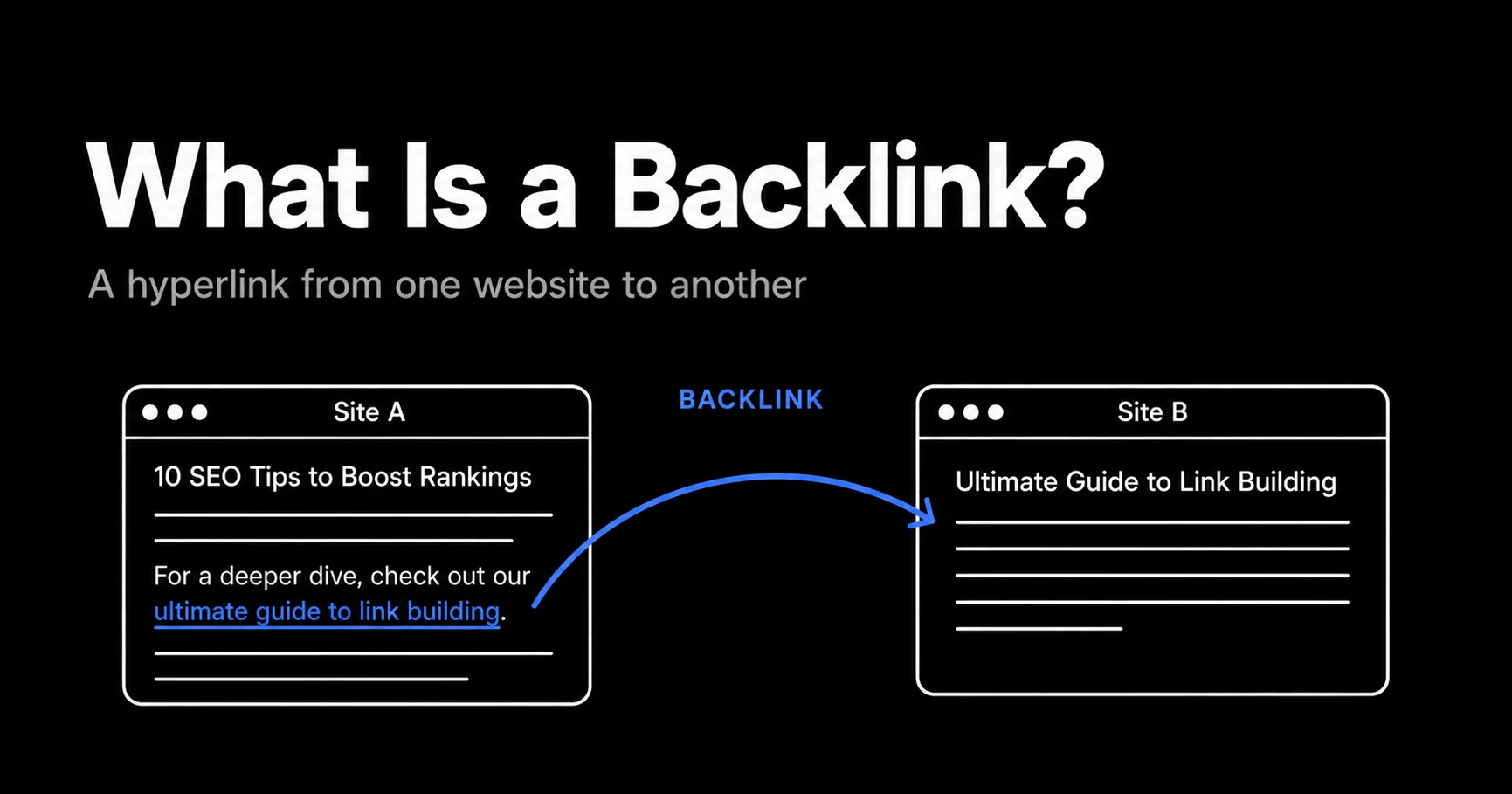
What Is a Backlink? the SEO Pillar Explained for Operators and Beginners
A backlink is a hyperlink from one website to another. Backlinks remain the strongest single ranking signal in 2026 and now feed AI Overview citations as well. The definitional pillar with the full operator reading list.
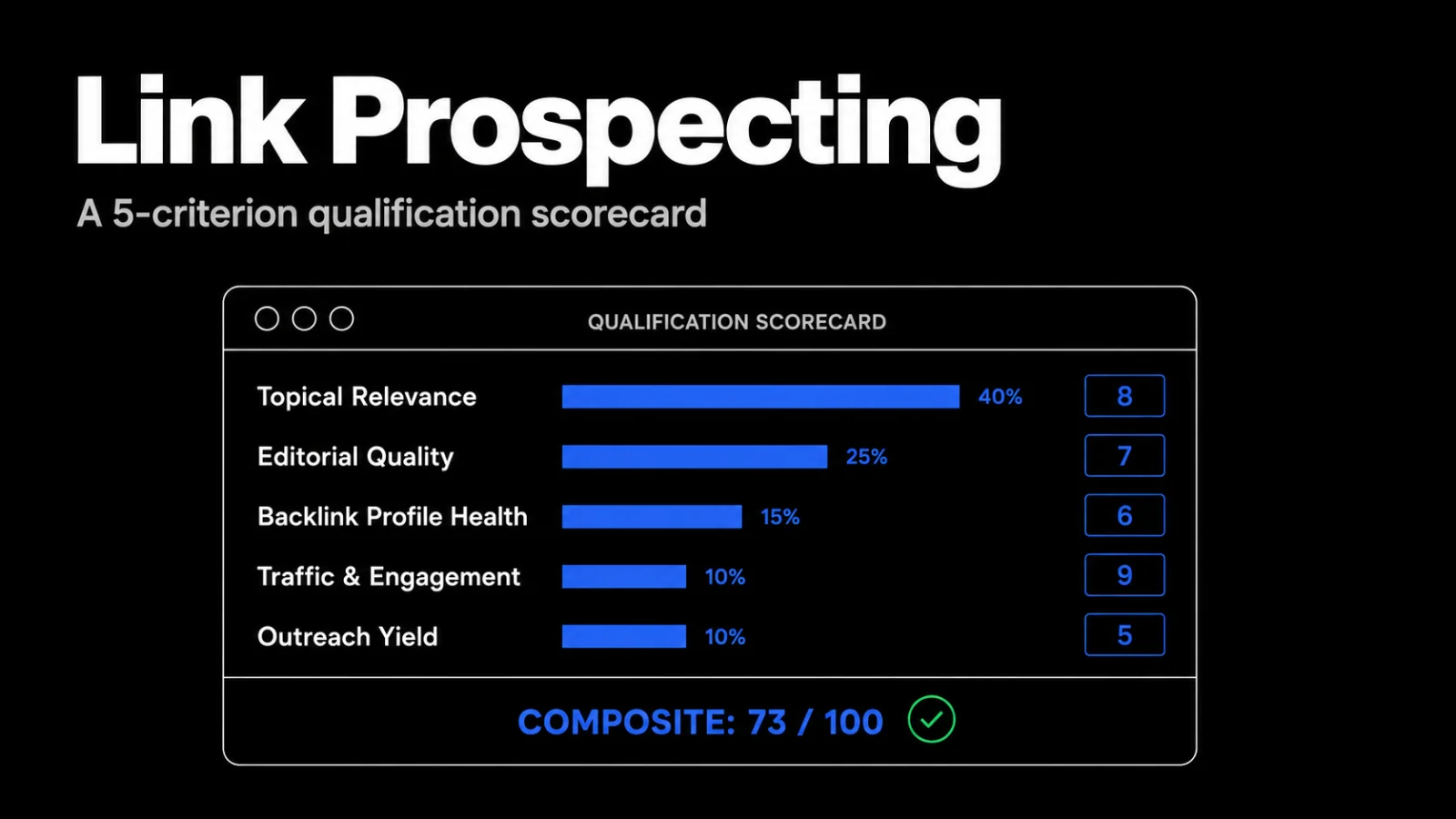
Link Prospecting: the Qualification Scorecard We Run for Clients
Link prospecting decides 80% of a campaign's outcome before a single outreach email goes out. This post documents the 5-criterion weighted scorecard we use to qualify (or kill) every candidate, the kill thresholds we apply on the spot, and the 300 to 60 to 8-12 funnel math from real client engagements.
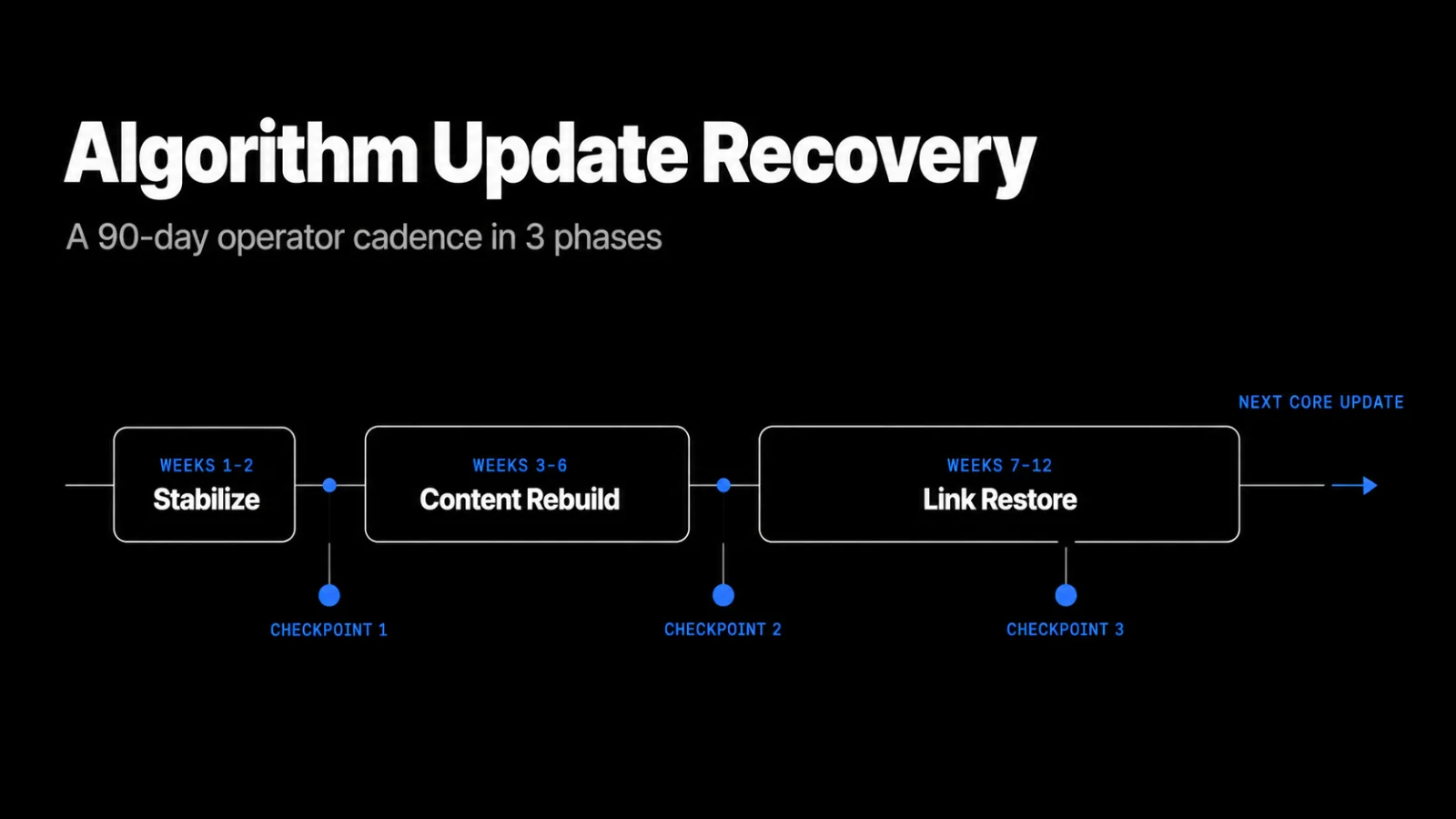
Google Algorithm Update Recovery: the 90-Day Operator Cadence
Recovering from a Google algorithm update is a 90-day operation, not a weekend fix. This post documents the 3-phase operator cadence we run after a confirmed algorithmic cause, with weekly deliverables and 3 checkpoint metrics at week 4, week 8, and week 12.
Want this kind of analysis on your site?
Get a free video walkthrough within 48 hours covering technical health, backlinks, content gaps, and AI visibility.