

Google Algorithm Update Recovery: The 90-Day Operator Cadence
Listen to this article
Browser-native voice. No account required.
Recovering from a Google algorithm update is a 90-day operation, not a weekend fix. The Google systems that demoted your site re-evaluate on a fixed cycle, and the window you have to influence that re-evaluation closes faster than most operators realize. This post documents the operator cadence Mojo Links runs after a confirmed algorithmic cause: 3 phases, weekly deliverables, 3 checkpoints, one stakeholder-facing dashboard.
If you have not yet confirmed that an algorithm update caused your drop, this is the wrong post for you. Start with the sudden traffic drop diagnosis triage which diagnoses the cause and routes you into this workflow only when the cause is confirmed algorithmic. Recovery work without a confirmed cause is an expensive guess.
Why Algorithm Recovery Needs a Cadence, Not a Sprint
Algorithm recovery is a cadence problem, not a sprint problem. The Google systems that demoted the site re-evaluate on a fixed cycle: roughly every 3 to 6 months at the next core update. Sprinting fixes inside a 4-week window misses the re-evaluation window entirely.
Google publishes confirmed core and spam updates on the core updates documentation page. The pattern is consistent across 2022-2026: 3 to 4 core updates per year, 2 to 3 spam updates per year, plus continuous sub-update adjustments that do not get a press release. A site demoted in update N typically does not re-rank until update N+1 ships and the new evaluation overrides the previous one.
This timing dictates the operator approach. If you ship every fix in the first 30 days then sit and wait, the algorithm does not "see" the work as fresh signal because no major re-evaluation runs in that window. If you spread the work across 12 weeks with new shipped output every single week, the re-evaluation when it finally arrives reads a continuously improving site rather than a one-shot patch.
Anyone who tells you they recovered a site from a core update in 30 days is selling you a story about a site that was barely affected to begin with. The consensus across documented core-update recovery work is the same: recovery follows update cycles, not calendar months.
The methodology behind which cause triggered your drop in the first place lives at the 9 causes of search ranking drops. This post assumes you have already identified yours as algorithmic.
The 90-Day Recovery Cadence at a Glance
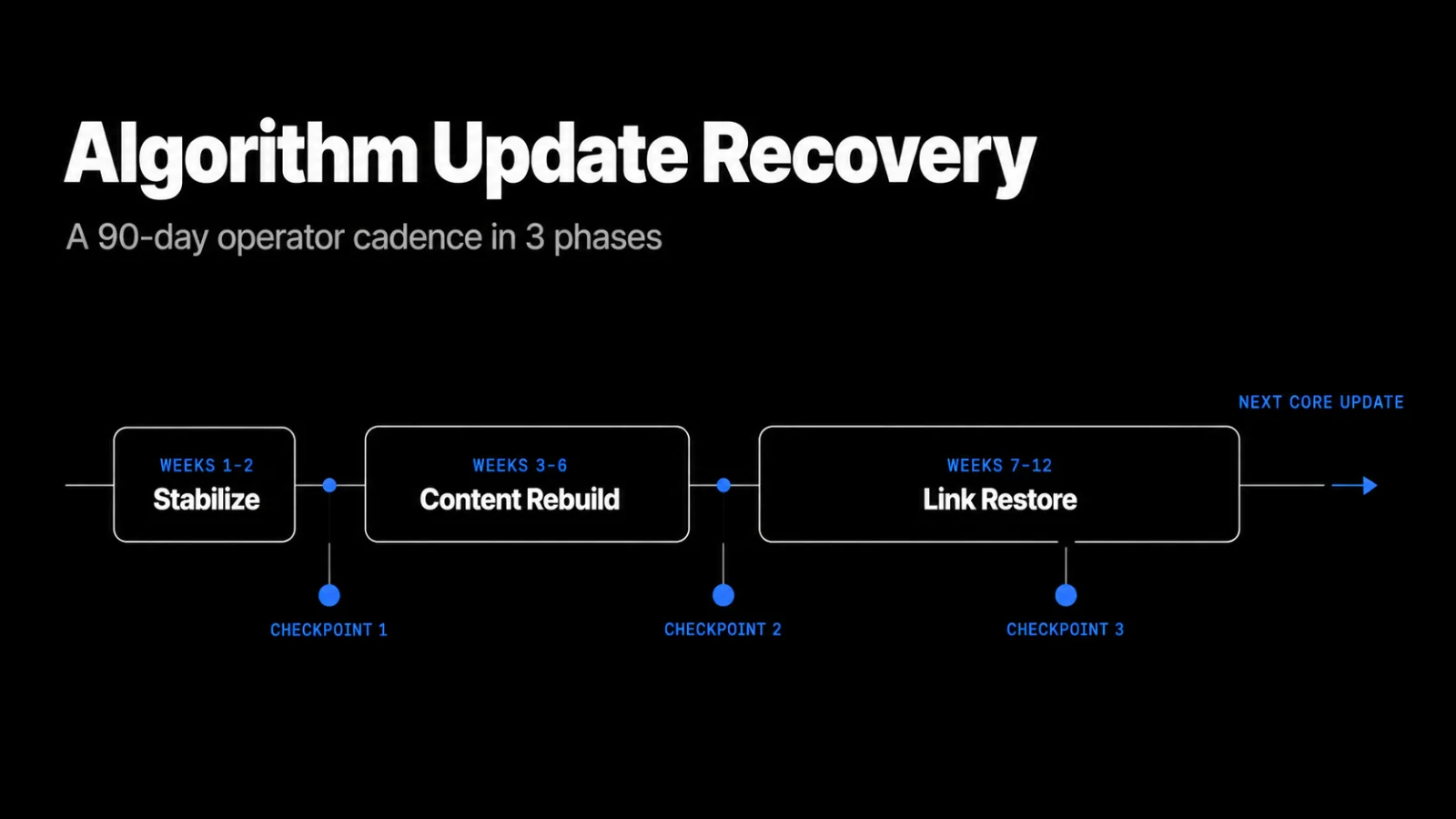
The 90-day cadence runs in three phases: weeks 1-2 (triage and quality signal stabilization), weeks 3-6 (content quality rebuild), weeks 7-12 (link velocity and authority restoration). Each phase has fixed deliverables and a checkpoint metric reported weekly.
Weeks 1-2: Stabilization. Thin-page removal, surface technical fixes, baseline documentation. Deliverable: cleaned signal floor and a baseline report.
Weeks 3-6: Content Rebuild. Topic consolidation, entity expansion, page rewrites. Deliverable: 6 to 12 rebuilt pages per week.
Weeks 7-12: Authority Restoration. Lost-link rebuilding, new editorial acquisition, velocity restoration. Deliverable: 4 to 8 new editorial links per week.
Checkpoints. Week 4 (signal floor restored), week 8 (impressions trending up), week 12 (link velocity restored). Position recovery lands at the next confirmed core update.
Each phase has hard deliverable counts. Not soft "we worked on it this week" updates. The output is a weekly dashboard showing exactly what shipped against the cadence target, and a monthly written summary that the CMO can forward up the chain without re-summarizing.
Weeks 1-2: Triage and Quality Signal Stabilization
Weeks 1-2 stabilize quality signals before any creative work begins. Remove or noindex every thin page, fix the surface-level technical regressions algorithm updates often expose, and document the baseline. The site needs a clean signal floor before content or link work compounds.
Why this comes first: algorithm updates that demote sites usually expose pre-existing weakness rather than introducing new criteria. The same thin pages that survived the previous update are the ones the new update penalizes hardest. Removing or no-indexing them removes the negative signal the update is pricing in.
Specifically, week 1 covers the thin-page audit. Pull every URL on the site, sort by GSC impressions over the prior 12 months, and flag anything in the bottom quartile with under 50 impressions and a word count under 300. Those go to a removal queue. Never delete blindly; check for inbound links first and redirect any URL that holds external authority.
Week 2 covers technical regressions and baseline documentation. The Google Search Console Coverage report often shows errors that accumulated quietly before the update and were never load-bearing until the update made quality signals matter more. Fix those (404s linked from internal nav, canonical chains, accidental noindex tags on templates) and ship a baseline performance snapshot: top 50 ranking pages, top 50 by impressions, link profile state, current Core Web Vitals.
At the end of week 2, the site has a clean signal floor and a documented baseline. Nothing has shipped to the SERP yet beyond removal-driven shifts. The metric that matters at this checkpoint is not ranking; it is the cleaned-page count.
Weeks 3-6: Content Quality Rebuild
Weeks 3-6 rebuild content quality at the page level. Consolidate fragmented topics into pillar pages, expand entity coverage on the highest-value URLs, and rewrite (not just update) the pages whose query intent has drifted. The deliverable is 6-12 rebuilt pages per week.
Per Google's helpful content documentation, the system rewards content that demonstrably serves the user better than alternatives. The operational translation: a rewritten page has to beat the current top 10 SERP for its target query on entity coverage, depth, and freshness. Not just update the headline and call it new.
Work in priority order: pages that ranked top-10 pre-drop go first because they have the most signal to restore. Pages that ranked 11-30 go second because they have proven query relevance. Pages that ranked 30+ go last or get consolidated into a stronger sibling page.
The consolidation work is where most recoveries actually live. A site with 5 thin pages each ranking for slightly different versions of the same query is competing against itself. Merging those 5 into one authoritative pillar page that covers all 5 query variations restores the signal concentration the algorithm rewards.
The deliverable cadence is fixed: 6 to 12 rebuilt pages per week. Shipping under 6 means falling behind. Shipping over 12 means cutting depth corners. The work is typically scoped through the semantic audit which maps the entity gaps before rewriting begins.
Weeks 7-12: Link Velocity and Authority Restoration
Weeks 7-12 restore link velocity and replace authority lost during the demoted period. Rebuild lost high-DR links where possible, acquire new equivalent-authority placements, and re-establish a consistent acquisition cadence. The deliverable is 4-8 new editorial links per week.
Link work runs last in the recovery sequence for a specific reason: links pointing at thin or broken pages do not transfer signal effectively. If link acquisition runs in week 2 against pages that get removed in week 4, those acquired links lose their target. The link work has to follow the content work, not run alongside it.
Phase 3 splits into rebuild and acquire. Rebuild: every DR-50+ referring domain that dropped during the demoted period gets a recovery attempt. Sometimes the link was edited out and a polite email restores it. Sometimes the publisher migrated CMS and the link 404s; a redirect on the publisher side often works. Sometimes the page was removed entirely and no recovery is possible.
Acquire: 4 to 8 new editorial placements per week, targeting referring domains with topical relevance to the rebuilt pages from phase 2. Acquired links pointing at the strongest rebuilt pages compound fastest. Do not chase DR for its own sake; relevance and editorial context outperform raw authority numbers in post-update recovery.
The link work is typically scoped as a dedicated link campaign running alongside the content phase rather than after it ends. The 4-week overlap (weeks 3-6 content + early phase 3 prep) lets phase 3 hit the ground at full velocity.
The Checkpoints That Tell You Recovery Is Working
Three checkpoints track recovery: week 4 (signal floor restored, thin-page removal complete), week 8 (rebuilt pages showing impression growth in GSC), week 12 (link velocity back to pre-drop baseline). Position recovery typically lands at the next confirmed core update, 3 to 6 months out.
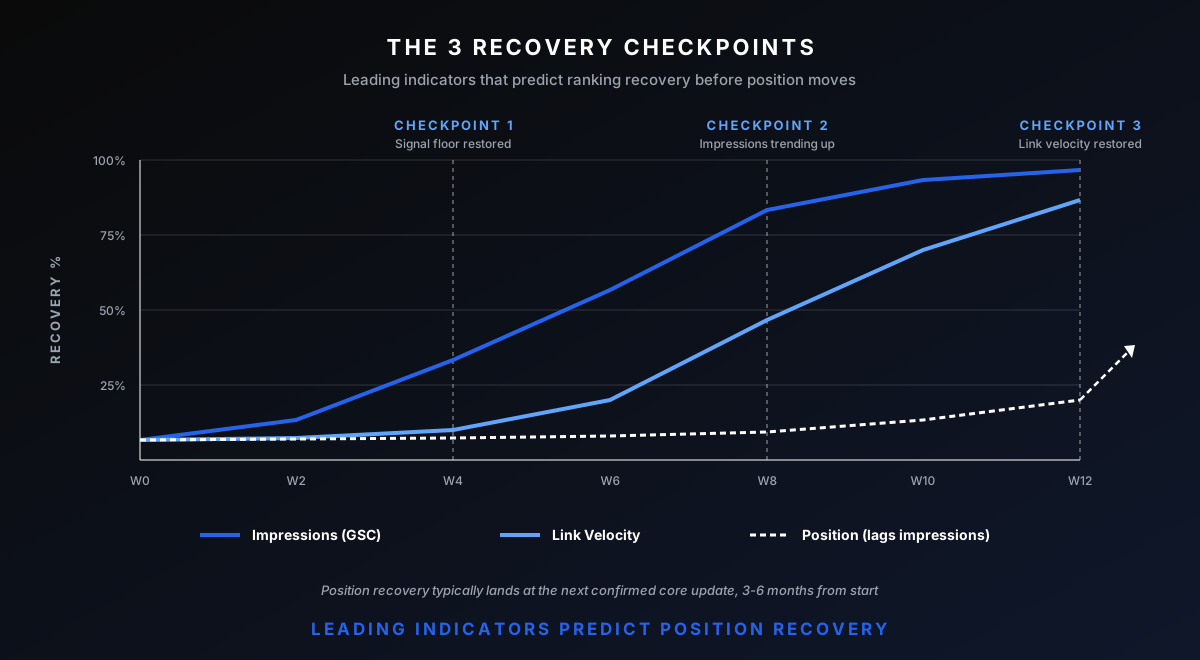
The reason these checkpoints matter is that ranking position itself is a lagging indicator. Position will not move during the 90-day cadence because Google has not yet re-evaluated. If the work were measured against ranking alone, every recovery would look like a failure through week 12. So measure the work against the leading indicators that predict ranking recovery.
Week 4 checkpoint. Cleaned-page count matches the audit target. GSC Coverage shows no new errors. Baseline report signed off. If this checkpoint slips, phase 2 starts late and the whole cadence compresses.
Week 8 checkpoint. Rebuilt pages show impression growth in GSC even before position growth. Impressions rising while position holds flat means Google is testing the rewritten content against more queries; this is the early signal that ranking recovery will follow.
Week 12 checkpoint. Link velocity matches or exceeds pre-drop baseline (referring domains per month). Position recovery still trailing by 4-8 weeks at this point; the cadence has done its job and the algorithm now does its.
Past week 12, the work shifts from execution to monitoring. Watch GSC daily for impression and position movement, watch the Google Search Status Dashboard for the next confirmed core update, and ship targeted reinforcement work where the SERP shows partial recovery.
Who Runs This with Us (and Why DIY Recoveries Stall at Week 4)
The sites that run this with us are usually ones that already wasted 30-90 days trying single-channel fixes (content-only, links-only, technical-only). The DIY pattern stalls at week 4 because operators run out of bandwidth, pivot to short-term tactics, and lose the cadence.
The pattern repeats across every DIY recovery Mojo Links has inherited from a previous attempt. Week 1: the operator reads up on the update, makes a list of suspected causes, ships 2 or 3 fixes. Week 2: ships 2 or 3 more. Week 3: shipping slows because the operator has a day job. Week 4: nothing ships because the operator is now panicking about ROI on the time invested. Week 6: a new tactic gets tried because the previous tactics "didn't work." Week 8: confidence collapses, the project goes on hold.
What kills the DIY attempt is not the difficulty of any individual fix. It is the bandwidth required to sustain a weekly deliverable cadence for 12 consecutive weeks while the day job keeps happening. Algorithm recovery is a sustained throughput problem, not a knowledge problem.
Mojo Links intake shows two profiles: (1) marketing directors who tried the DIY path and stalled, now reaching for an outside operator; (2) CMOs who skipped the DIY phase entirely because they understood the bandwidth math. Both arrive via the 60-minute triage which confirms the algorithmic cause before this recovery cadence starts. Or via the complimentary growth audit which runs the triage and scopes the recovery in one call.
The follow-on engagement is typically scoped against the topical authority audit for phase 1-2 work and a separate link campaign for phase 3.
What Derails Algorithm Update Recovery
Algorithm update recovery derails for predictable reasons: stopping at the first plausible fix, panic-publishing thin "freshness" content, hiring multiple agencies whose work conflicts, and underestimating the timeline. The biggest single derailer is changing direction at week 6 when results have not yet materialized.
Stopping at the first plausible fix. Recovery requires all 3 phases. A site that ships only phase 1 (removal) without phase 2 (rebuild) sits on a cleaner floor with no upward push. A site that ships phase 1 and 2 without phase 3 (links) under-recovers because the link signal stays demoted.
Panic-publishing thin freshness content. "Update the publish date and add a paragraph" is not a rewrite. Google does not score freshness on a date stamp; it scores it on whether the new version meaningfully outperforms the SERP. Thin freshness content makes the quality signal worse, not better.
Multi-agency conflict. A content agency on phase 2 and a separate link agency on phase 3 without coordination produces links pointing at the wrong pages, rewrites that miss the link-targeted entities, and reporting that contradicts itself. One operator runs the cadence or the cadence breaks.
Underestimating the timeline. Stakeholders who expect ranking movement at week 4 lose confidence by week 6 when nothing has visibly moved. The timeline conversation in H2-9 is the structural prevention for this derailer.
Changing direction at week 6. The rebuild work has shipped but not the link work. The algorithm has not yet re-evaluated. Nothing has had time to compound. Pivoting to a new approach here erases the cadence and resets the clock.
If the diagnostic triage surfaces a manual action alongside the algorithmic cause, the recovery sequence changes. Manual actions route into the Google penalty recovery service which runs the reconsideration cycle in parallel rather than within this 90-day cadence. See the reconsideration request workflow end to end separately.
What To Tell Your CFO About The Recovery Timeline
Tell your CFO that ranking recovery from a confirmed Google algorithm update takes 3 to 6 months end-to-end and the cost compounds across content, technical, and link work simultaneously. Show the 90-day cadence with weekly checkpoints. Anchor against the cost of doing nothing.
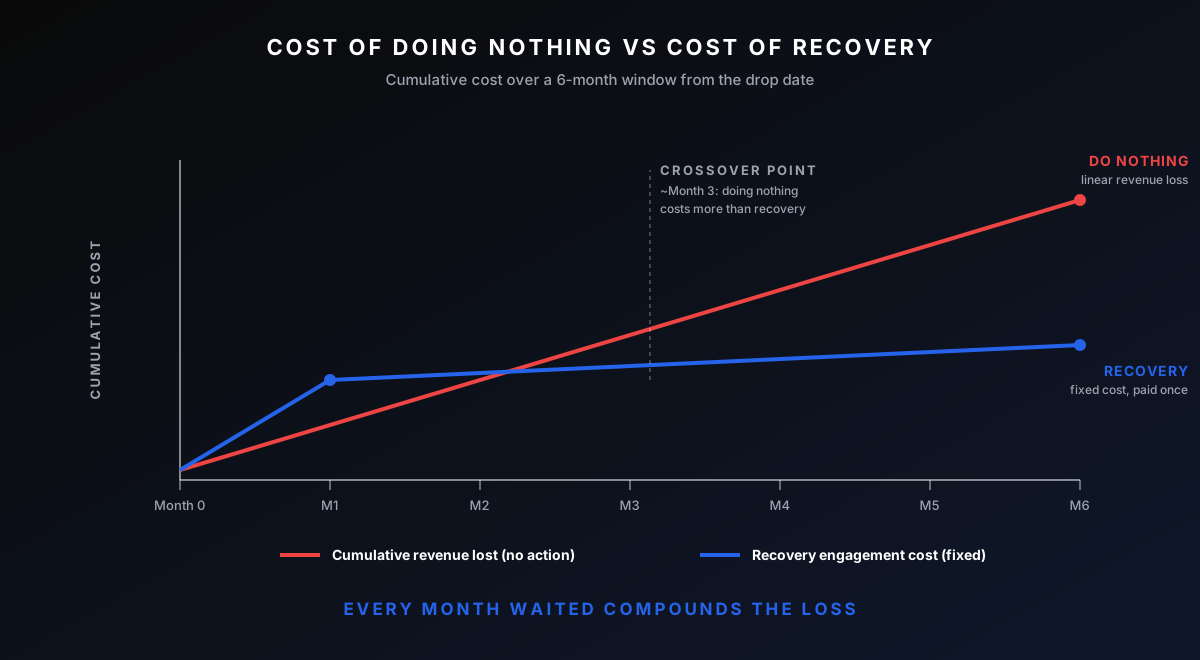
The CFO conversation breaks where the operator tries to be optimistic. "We think rankings will recover in 6 weeks" is the wrong frame because it sets up a 6-week credibility cliff. The right frame is the cadence document plus the checkpoint metrics, plus the explicit statement that position recovery trails the work by another 4 to 8 weeks past week 12.
The cost-of-doing-nothing anchor matters more than the cost of the recovery itself. A site with $500K in monthly organic revenue that has dropped 40% is bleeding $200K per month. A 6-month recovery costing $60K total is paid back in under 2 weeks of restored revenue. The CFO does not need optimism; the CFO needs the math.
For sites with longer-term protection needs after recovery, the follow-on engagement is the monthly SEO retainer which monitors for the next update cycle and runs preventative content + link work between updates so the next algorithmic event lands on a stronger baseline.
Algorithm Update Recovery FAQ
How long does it actually take to recover from a Google core update?
3 to 6 months end-to-end. The 90-day cadence ships the work; position recovery typically lands at the next confirmed core update, which arrives 60 to 120 days after the cadence completes. Sites in YMYL verticals or affected by the Helpful Content System should expect the long end of this range.
Can rankings come back without the next core update?
Partial yes. Pages that re-rank without an algorithmic event are usually pages whose content rebuild restored relevance signals or whose link rebuild restored authority signals. Sitewide ranking recovery generally requires the algorithmic re-evaluation; page-level recovery sometimes happens earlier.
What if the cause was a Helpful Content System update rather than a core update?
Same cadence, longer timeline. Helpful Content System recovery typically requires 6-12 months minimum because the system evaluates sites holistically rather than at the page level. The 90-day cadence is phase 1 of a longer engagement in these cases, not the end state.
Do we need to remove pages or can we just improve them?
Both. Pages with no recoverable query relevance get removed or no-indexed; pages with ranking history get rebuilt. The mix is roughly 30% removal, 70% rebuild on a typical post-update site. Removal is faster and cheaper; rebuild compounds longer.
What if we are still ranking for some queries but dropped on others?
Partial drops still respond to the 90-day cadence, but the work concentrates on the affected page clusters rather than the full site. Phase 1 work compresses, phase 2 work targets only the affected pages, phase 3 work focuses links on the rebuilt cluster. Total timeline shortens by roughly 30%.
Is the recovery work included in the free growth audit?
No. The free 20-minute growth audit runs the diagnostic triage and scopes the recovery. The 90-day cadence is a separate paid engagement because the deliverable cadence requires dedicated weekly throughput across 3 service tracks.

About Bart Magera
Bart Magera is the founder of Mojo Links. Ten years across YMYL verticals (legal, medical, finance, supplements, crypto, gambling). Trained under Koray Tuğberk Gübür's Topical Authority framework. Author of two SEO books and international speaker.
Want this kind of analysis on your site?
Get a free video walkthrough within 48 hours covering technical health, backlinks, content gaps, and AI visibility.
Related posts
Keep reading on adjacent topics.
- Link Building
 Bart Magera10 min read
Contextual Backlinks: What They Are, Why They Win, and How To Earn Them
A contextual backlink sits inside the body of an article, surrounded by relevant text, not in a footer or author bio. That placement is what gives it weight. Here is what contextual backlinks are, what makes one high quality, how to earn them, and how to spot the cheap fakes.
- Link Building
 Bart Magera12 min read
What Is White Hat Link Building? Techniques That Work in 2026
The Problem: Why Most Link Building Fails Your SEO You wrote great content. It’s relevant. It’s useful. It even has infographics. But guess what? Crickets. Nobody’s linking. Google’s not ranking. And your “ultimate guide” is buried somewhere on page 7 under a recipe blog and a…
- Link Building
 Bart Magera10 min read
Tiered Link Building: How It Works and How To Do It Safely
Tiered link building layers weaker links behind your strongest ones to pass more authority to your money pages. Here is how the pyramid works, how to build one, which links are worth tiering, the risk SpamBrain introduced, and the lower-risk path I use on client sites.