

Sudden Traffic Drop Diagnosis: The 60-Minute Triage Process
Listen to this article
Browser-native voice. No account required.
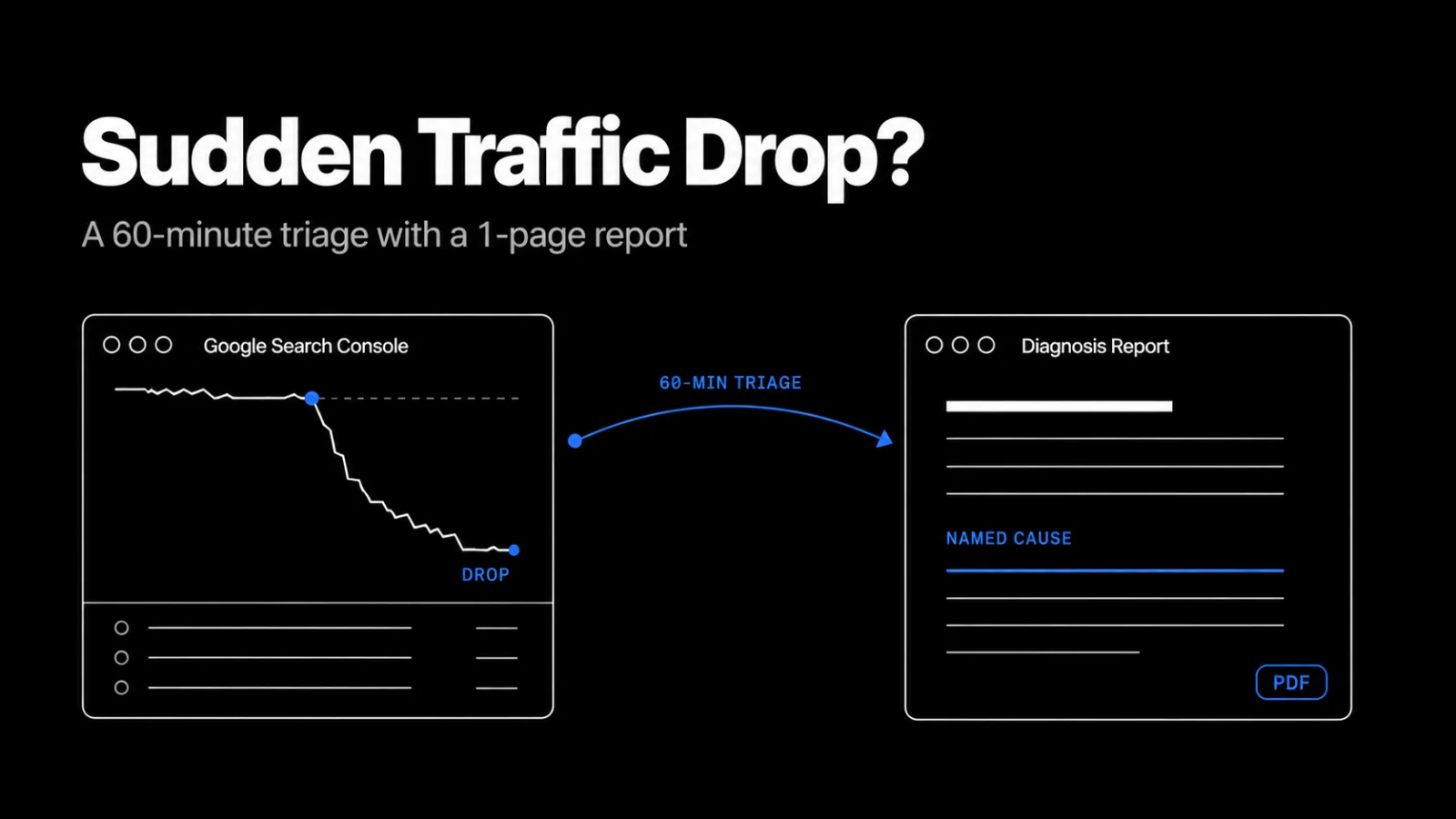
A sudden drop in organic traffic costs revenue on a 30-90 day lag. The diagnostic window is short. The conventional response of opening a 10-item checklist and working through it linearly burns a full day and arrives at "probably an algorithm update" with no evidence. Which is the diagnosis SEO has been shipping since 2012. Mojo Links built a 60-minute triage to replace that pattern.
This post documents the SOP Mojo Links runs when a CMO emails at 8am with "our traffic just collapsed and we don't know why." Four phases, four fixed outputs, one 1-page diagnosis report delivered within 2 business hours. It runs alongside Google's own process for debugging search traffic drops, and the methodology behind why ranking drops happen lives at the 9 causes of search ranking drops. This post is how Mojo Links runs it.
Why a Triage Beats a Checklist When Traffic Drops
A 10-item checklist takes a full day and points at every cause equally. A 60-minute triage runs a decision tree first, narrowing 9 causes to 1 in the first 10 minutes, then spending 50 minutes confirming and ruling out adjacent causes.
The checklist approach treats every cause as equally likely until tested. That premise is wrong. Ranking and traffic drops cluster into a small number of cause shapes. Sitewide sudden with no recent changes is almost always algorithmic. Single-page sudden with a recent content edit is almost always a content quality regression. Sudden de-indexation with crawl errors is technical, full stop. The shape of the drop reveals the cause before any deep investigation.
A decision tree exploits this prior. Sort the drop into a 1-of-9 bucket using 4 attributes anyone can read off Google Search Console in under 10 minutes, then open only the tool that confirms the suspected bucket. The other 7 buckets stay closed unless cross-checks force you back.
The 60-Minute Triage at a Glance
The 60-minute triage runs in four phases: minutes 0-10 (decision tree), minutes 10-25 (confirm most-likely cause), minutes 25-45 (rule in/out adjacent causes), minutes 45-60 (write the 1-page diagnosis report). Each phase has a fixed tool and fixed output.
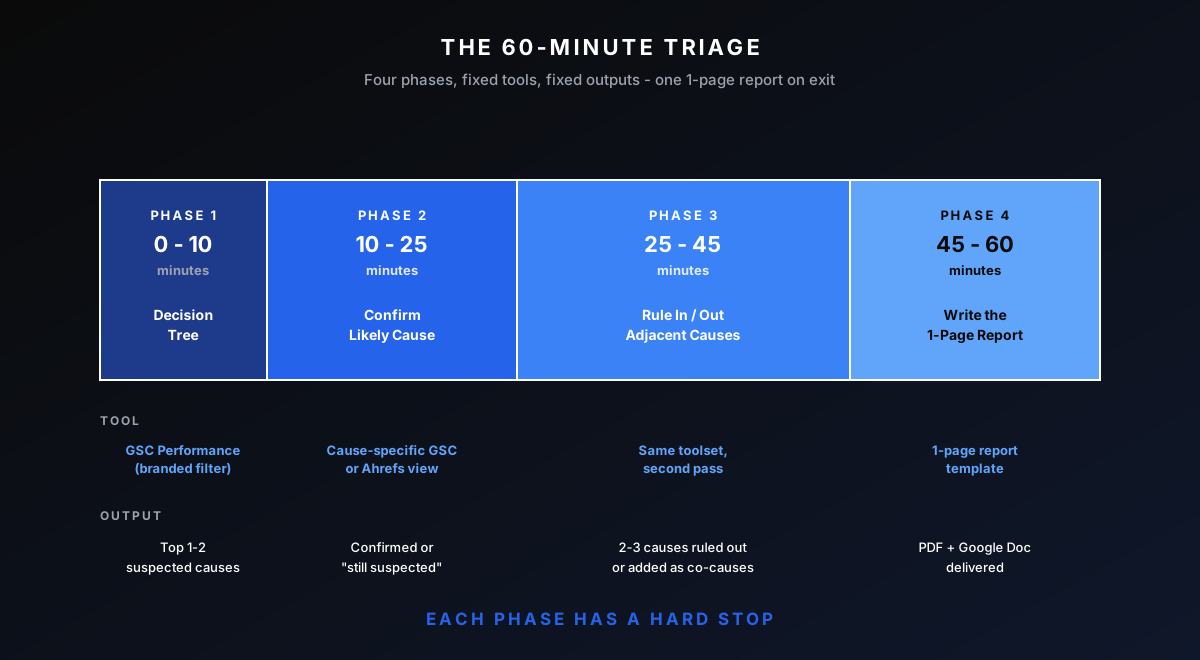
Minutes 0-10: Decision tree. Tool: GSC Performance with branded query filter. Output: top 1-2 suspected causes.
Minutes 10-25: Confirm. Tool: cause-specific GSC or Ahrefs view. Output: confirmed or "still suspected" status.
Minutes 25-45: Adjacent causes. Tool: same toolset, second pass. Output: 2-3 ruled out OR added as co-causes.
Minutes 45-60: Report. Tool: 1-page template. Output: PDF + Google Doc delivered.
Each phase has a hard stop. If minute 10 arrives and the decision tree is inconclusive, extend phase 1 by 5 minutes and compress phase 3. Never extend the total because report quality drops once the operator has been head-down for over 90 minutes.
Minutes 0-10: The 4-Axis Decision Tree
Minutes 0-10 run the 4-axis decision tree from the methodology hub: scope (page vs sitewide), timing (sudden vs gradual), recent changes (yes vs no), branded query performance (preserved vs hit). The combination narrows the cause from 9 categories to 1 or 2.
Open GSC Performance for the affected property, set the date range to 28 days, and run the four axes in order. Scope first. It eliminates the most cause space. Sort the Pages tab by impressions delta. If 80%+ of the lost impressions concentrate on one URL or template, scope is page-level. If the loss spreads across most ranking pages, scope is sitewide.
Then timing. The daily chart shows whether the drop is a single-day cliff (24-hour drop) or a gradual descent over 4-12 weeks. Most site owners describe their drop as "sudden" even when the data shows a 6-week slide. The chart settles it.
Then recent changes. Anything shipped within 30 days of the drop start? Deploys, content edits, redirects, schema changes, a JavaScript framework migration, link cleanups. The site owner either knows or pulls up the deploy log.
Then branded query performance. Filter GSC to branded queries only. Branded queries are the algorithmic control variable. If they also dropped, the cause is domain-level. If they held, the cause is relevance or content.
By minute 10, you have a 4-attribute fingerprint that maps to 1 or 2 of the 9 cause categories. Move to phase 2 with a confirmed suspect.
Minutes 10-25: Confirming The Most-Likely Cause
Minutes 10-25 confirm the most-likely cause using the specific Google Search Console report or Ahrefs view that matches the cause type. Manual action goes to GSC Manual Actions. Algorithmic goes to GSC Performance plus Semrush Sensor calendar. Technical goes to GSC Coverage plus Page Indexing.
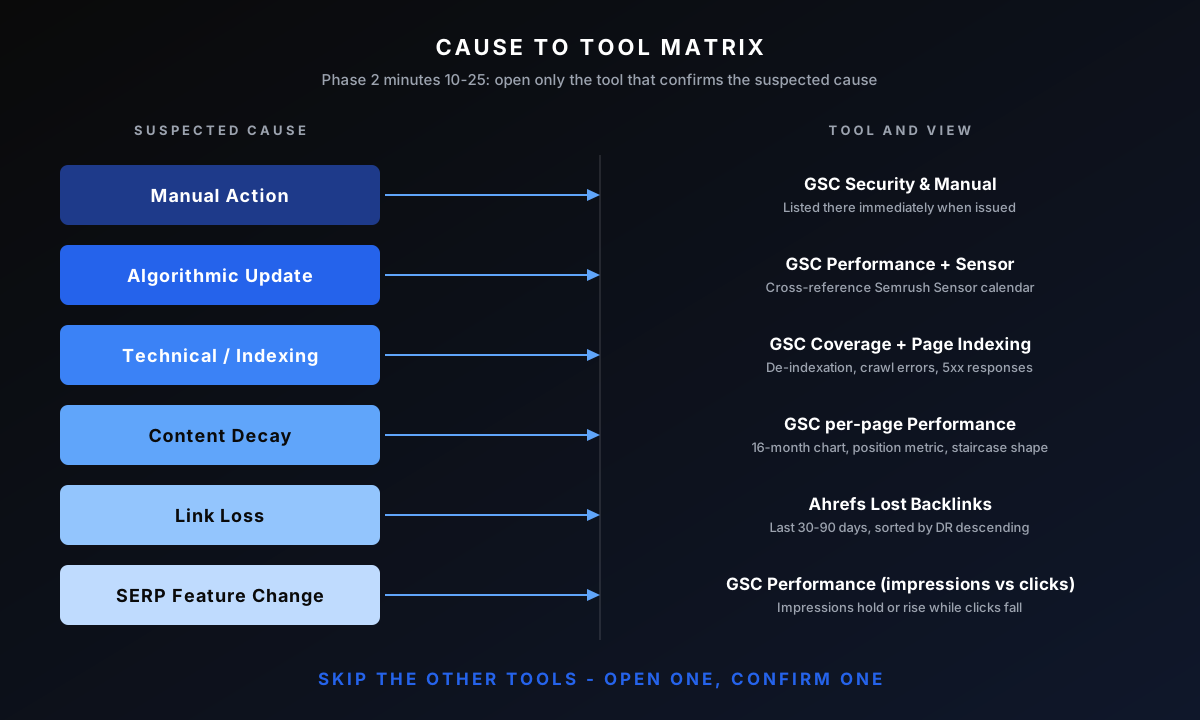
Manual action suspect: open GSC Security and Manual Actions. If it lists an action, the cause is confirmed and phase 3 gets skipped (manual actions don't co-occur with other causes; they explain the whole drop). Move directly to phase 4 and the report routes into the Google penalty recovery service. The full manual action recovery sequence runs separately.
Algorithmic suspect: cross-reference the drop date with the Google Search Status Dashboard and Semrush Sensor's daily volatility scores. A 9.0+ Sensor reading on a confirmed core update day matching the drop start equals confirmed algorithmic. Anything weaker stays at "suspected" status and adjacent causes stay open.
Technical suspect: GSC Coverage for spike in errors, Page Indexing for pages flipped from indexed to not indexed, Crawl Stats for Googlebot anomalies. A robots.txt change, accidental noindex, or canonical pointing at a 404 all show up here within minutes. If one shows up, the report routes into the technical SEO audit.
Content decay suspect: per-page GSC Performance for the affected URL, 16-month chart, position metric. A staircase decline over 6-18 months confirms decay. A flat line with a cliff is not decay; back to phase 1.
By minute 25, the suspected cause has a status: confirmed (the cause is known), suspected (evidence exists but wants corroboration), or ruled out (back to phase 1).
Minutes 25-45: Ruling in or Out The Adjacent Causes
Minutes 25-45 rule in or out the 2-3 second-most-likely causes the decision tree did not eliminate. Never stop at the first plausible answer because traffic drops with two simultaneous causes recover on the longer timeline, not the shorter one.
Mojo Links has seen this pattern enough to make it a rule: a site that suffered an algorithmic downgrade and a technical regression in the same window appears to recover when the technical fix ships, then sits flat for 6 months waiting on the algorithmic side to reverse. Diagnosing only the technical issue produces a report that promises 4-12 weeks of recovery and delivers 6 months of waiting. The client loses confidence in the audit. The agency loses the client. The algorithmic half of that recovery follows its own sequence, covered in the Google algorithm update recovery playbook.
Phase 3 is mandatory. The 2-3 adjacent causes most likely to co-occur with the confirmed primary:
Algorithmic primary: check content decay (HCU often piggybacks on core updates), check CTR collapse on top queries (did an AI Overview launch in the same window?).
Technical primary: check link loss (migration losses get masked by indexation issues), check cannibalization (new canonical tags can switch ranking URLs).
Content decay primary: check link velocity (decay accelerates when link velocity stalls), check cannibalization (sibling pages capturing the same query).
Manual action primary: no adjacent causes. The action explains everything.
Link loss check uses the Ahrefs Site Explorer Lost Backlinks report, filtered to the last 30-90 days, sorted by Domain Rating descending. Any DR-60+ losses correlating with the drop date go into the report. If the primary cause is content-related and link loss surfaces as a co-cause, the report routes into a link-building campaign alongside the content fix.
If content decay or HCU is the primary, the next-step recommendation is the semantic audit for the topical authority rebuild work.
By minute 45, the report has a primary cause and 1-2 co-causes if any. If two causes are confirmed, the report scopes both fixes and quotes the longer recovery timeline. If no cause is confirmed by minute 45, extend phase 3 by 10 minutes and compress phase 4. The report ships with "suspected" status and a recommended deeper audit.
Minutes 45-60: The 1-Page Diagnosis Report
Minutes 45-60 produce a 1-page diagnosis report: named cause, cited evidence (GSC/Ahrefs screenshots), confirmed or suspected status, recommended fix path, realistic recovery timeline, and the next Mojo Links service that owns the fix. One page so a stakeholder reads it in 3 minutes.
The 1-page constraint matters. A stakeholder who cannot read the diagnosis in 3 minutes will not read it at all. Mid-crisis CMOs don't have 20 minutes for a methodology lesson. They need the named cause, the evidence, the fix, and the ETA.
The six sections of the report:
Named cause. One of 9 categories from the hub taxonomy, with confidence: confirmed, suspected, or co-occurring.
Evidence. 1-3 annotated screenshots from GSC and/or Ahrefs. The data, not interpretation.
Confidence level. Confirmed equals smoking gun found. Suspected equals strong signal, weak corroboration.
Fix path. The specific action: deploy fix X, file reconsideration, rewrite page Y, build N links.
Recovery ETA. The realistic window per the cause taxonomy. No optimism padding.
Recommended next service. The Mojo Links engagement that owns the fix, with scoping note.
Format: shared Google Doc for live edits, PDF export for the CFO. Turnaround: delivered within 2 business hours of the triage call ending. The triage itself is included in the free video audit. The deliverable is the same whether the engagement continues into remediation or not.
Who Calls Us with a Sudden Traffic Drop (and What They Actually Have)
The people who call us with a sudden traffic drop are usually CMOs, marketing directors, or agency owners running someone else's site. The drop is operationally urgent because revenue follows traffic on a 30-90 day lag. Most arrive convinced of the wrong cause.
Three intake patterns repeat:
Pattern 1: "We just got hit by an update." The caller read about the latest Google update on Search Engine Land yesterday and assumed it's the cause. Half the time the calendar matches and they're right. Half the time the calendar doesn't match and the actual cause is technical or content-related. The decision tree settles it in 10 minutes.
Pattern 2: "Someone changed something." The caller suspects a recent deploy or content edit. Frequently correct directionally but wrong about which change. A deploy that "just updated the footer" can ship an accidental noindex on every product page. Check the deploy log against the GSC Coverage report.
Pattern 3: "We have no idea." The caller opened analytics, saw the drop, and called us. Often the cleanest intake because there's no preconception to unwind. The triage runs cold.
The buyer is rarely the SEO. The buyer is the person upstream of SEO: a CMO under pressure from a CFO, or a marketing director under pressure from a CMO. They need a 1-page deliverable they can forward up the chain, not a 40-page audit they have to summarize.
When To Run This Yourself vs Hand It To Us
Run the triage yourself when the drop is single-page, sustained under 14 days, and you have obvious recent changes to suspect. Hand it to us when the drop is sitewide, sustained past 30 days, or you have already spent more than 4 hours guessing at causes.
The framework in this post is enough for an operator running their own site to diagnose 80% of drops. You have GSC. You have Ahrefs or Semrush. You have 60 minutes. Run it.
The cases where DIY fails: multi-cause drops (you find one cause, ship the fix, expect 6 weeks of recovery, get 6 months of flat), sitewide algorithmic drops where the "fix" is a content strategy rebuild, and any drop on a site where you lack baseline historical data to compare against.
Agency context changes the calculation. If you're the marketing director responsible to a CFO, "I think it's the algorithm update" without documented evidence is not a defensible diagnosis. You need a written 1-page report with screenshots and a named cause. That report is what the free growth audit produces.
The 4-hour rule: if you've spent 4 hours guessing and still don't have a confident named cause, stop. Every additional hour past 4 has compounding opportunity cost. Hand it to someone who can close the loop in 60 minutes.
What Happens After The Diagnosis
After the diagnosis, the named cause routes into the matching Mojo Links service: technical SEO audit, Google penalty recovery, semantic SEO audit, or link-building campaign. The diagnosis is included free in the 20-minute growth audit; remediation is scoped separately.
The routing matrix:
Technical cause: technical SEO audit (full crawl, GSC cross-reference, remediation deploy).
Manual action: Google penalty recovery (fix plus reconsideration cycle).
Algorithmic / HCU / content decay: semantic SEO audit (quality signal rebuild, topical authority repair, per-page rewrite).
Link loss: link-building campaign (targeted replacement of lost authority).
Cannibalization or CTR collapse: monthly SEO retainer (consolidation deploy plus ongoing query monitoring).
SERP feature change: semantic SEO audit (content rework for AI Overview citation inclusion).
Scoping happens on a separate call after the diagnosis. We don't try to upsell on the triage itself. That's the wrong place to introduce friction with a site owner who is mid-crisis. The follow-on engagement is usually our monthly SEO retainer for ongoing protection, or a one-off audit for surgical remediation.
Sudden Traffic Drop Diagnosis FAQ
How fast can the diagnosis happen after I call?
Same business day under a monthly SEO retainer. Within 24-48 hours for prospects via the free growth audit. The triage itself takes 60 minutes; the scheduling is the variable.
Do you need Google Search Console access?
Yes. We can run the triage with read-only GSC access; we send the user-add link. Ahrefs we can use our own subscription against your domain; you don't need to add us.
What if the drop is older than 30 days?
The triage still works but the recovery timeline lengthens by however many days you waited. Older drops also accumulate co-causes (content decay piggybacking on an algorithmic event, etc.) which makes the diagnosis longer but no less valuable.
What if you can't confidently name the cause in 60 minutes?
Rare but it happens. The 1-page report ships with "suspected" status across the top 2 causes, with a recommended deeper SEO audit to confirm. We never invent a cause to fill the deliverable.
Is the diagnosis included free?
Yes. The triage is included in the free 20-minute growth audit. The 60-minute scope is reserved for the deeper engagements; the 20-minute version runs the decision tree and confirms phase 1-2 only. Phase 3-4 ship with paid engagements.
Can you diagnose a traffic drop without ranking changes?
Yes, but it's a different workflow. Traffic drop without ranking drop is usually CTR collapse, SERP feature change, or seasonality. The 4-axis decision tree in this post is calibrated for ranking-driven traffic drops. Tell us upfront and we calibrate accordingly.

About Bart Magera
Bart Magera is the founder of Mojo Links. Ten years across YMYL verticals (legal, medical, finance, supplements, crypto, gambling). Trained under Koray Tuğberk Gübür's Topical Authority framework. Author of two SEO books and international speaker.
Want this kind of analysis on your site?
Get a free video walkthrough within 48 hours covering technical health, backlinks, content gaps, and AI visibility.
Related posts
Keep reading on adjacent topics.
- Link Building
 Bart Magera10 min read
Contextual Backlinks: What They Are, Why They Win, and How To Earn Them
A contextual backlink sits inside the body of an article, surrounded by relevant text, not in a footer or author bio. That placement is what gives it weight. Here is what contextual backlinks are, what makes one high quality, how to earn them, and how to spot the cheap fakes.
- Link Building
 Bart Magera12 min read
What Is White Hat Link Building? Techniques That Work in 2026
The Problem: Why Most Link Building Fails Your SEO You wrote great content. It’s relevant. It’s useful. It even has infographics. But guess what? Crickets. Nobody’s linking. Google’s not ranking. And your “ultimate guide” is buried somewhere on page 7 under a recipe blog and a…
- Link Building
 Bart Magera10 min read
Tiered Link Building: How It Works and How To Do It Safely
Tiered link building layers weaker links behind your strongest ones to pass more authority to your money pages. Here is how the pyramid works, how to build one, which links are worth tiering, the risk SpamBrain introduced, and the lower-risk path I use on client sites.