

Link Prospecting: How To Qualify Link Targets That Convert
Listen to this article
Browser-native voice. No account required.
Link prospecting decides 80% of a campaign's outcome before a single outreach email goes out. Get the candidate list wrong and the best outreach copy in the world cannot save you. Get it right and even mediocre outreach converts because the targets actually fit. This post documents the SOP Mojo Links runs when an engagement begins: the 5-criterion weighted scorecard, the kill thresholds applied on the spot, and the 300-to-60-to-8-12 funnel math from real campaigns.
This workflow is the first deliverable of every link-building campaign. The methodology behind why topical fit beats Domain Rating lives at the linguistic anatomy of link relevance on bartmagera.com. This post is the operational version: what actually gets scored, in what order, with what weights.
Why DR Alone Is Not Link Prospect Qualification
Domain Rating measures the strength of a domain's backlink graph. It does not measure whether the domain is the right place to link from. A prospect with DR 80 and zero topical overlap with your site passes signal at maybe 5% of a relevant DR 40 prospect.
The Ahrefs documentation on Domain Rating is honest about this. DR is a 0-100 logarithmic score weighted by referring-domain quantity and the referring-domain quality of those referring domains. The recursion captures graph strength. It does not capture topical alignment, anchor coherence, source context, or target relevance. None of those are inputs.
Referring-domain volume correlates with ranking: pages in the top 10 carry far more referring domains than positions 11-20. But those same top-10 pages also show stronger topical relevance, faster page speed, and tighter content depth. The link signal is necessary; the topical signal is what converts the link into ranking.
Operators who run DR-first prospecting end up paying $200 a link for placements that do not move rankings. The DR shows up on the report; the ranking does not move on the chart. Mojo Links has inherited too many campaigns from this pattern. The scorecard exists to prevent it.
The Qualification Scorecard at a Glance
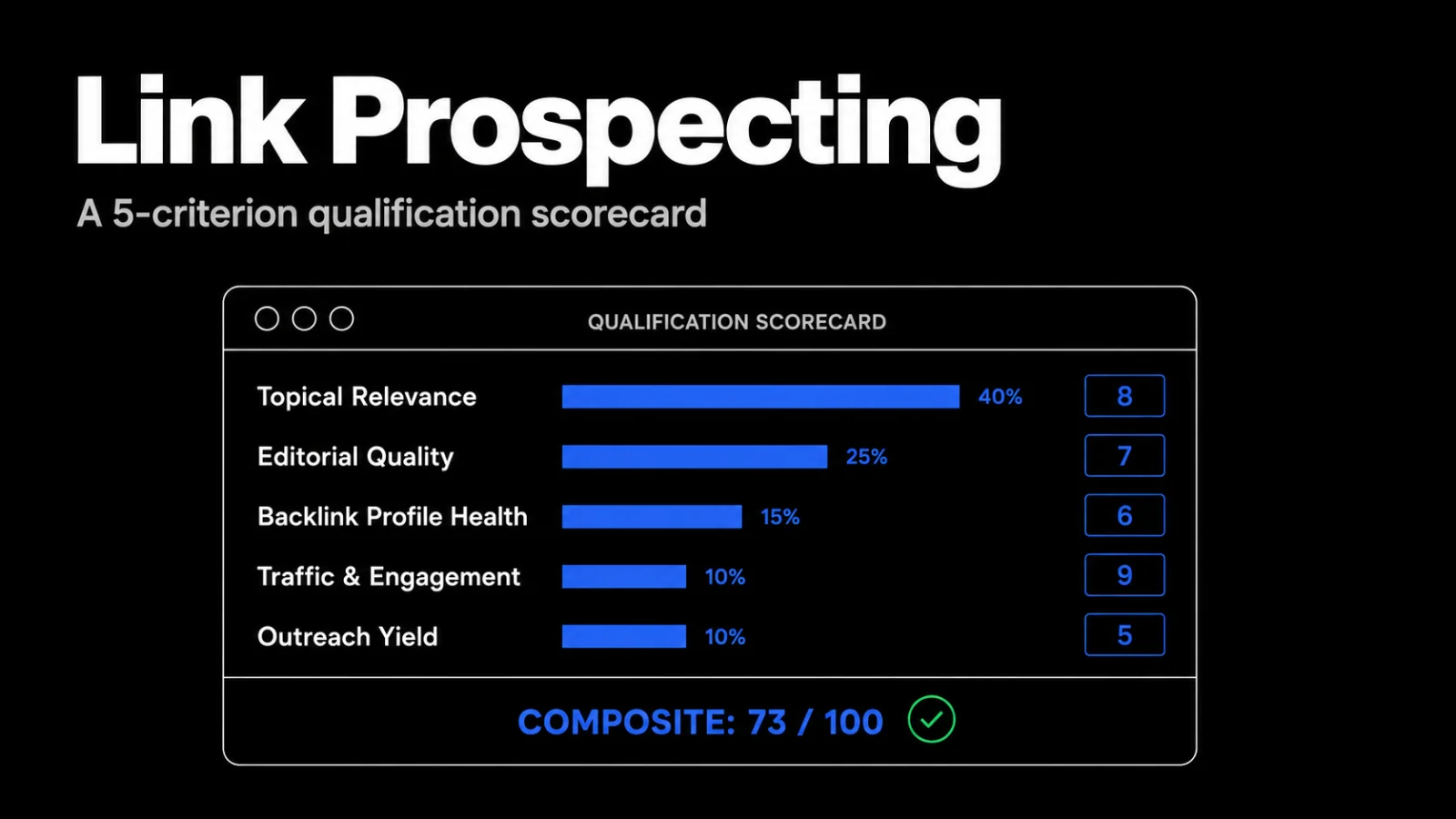
The scorecard weights five criteria: topical relevance (40%), editorial quality (25%), backlink profile health (15%), traffic and engagement signals (10%), and outreach yield probability (10%). Each criterion scores 0-10. Composite above 65 enters active outreach; below 40 gets killed.
Criterion 1: Topical relevance. Weight 40%. How much of the candidate's top 20 ranking pages share entity overlap with the target site's cluster.
Criterion 2: Editorial quality. Weight 25%. Real publisher signals (named editor, original content cadence, no thin-product reviews) vs PBN signature.
Criterion 3: Backlink profile health. Weight 15%. The prospect's OWN backlink profile (toxic ratio, foreign-spam ratio, brand-anchor share).
Criterion 4: Traffic and engagement signals. Weight 10%. Estimated monthly organic traffic, branded search share, time-on-page indicators.
Criterion 5: Outreach yield probability. Weight 10%. Editor responsiveness history, public guest-post policy, fee transparency.
Composite scoring is straightforward. Score each criterion 0-10, multiply by weight, sum to 0-100. The math stays visible because every line of the score gets defended in the campaign report. No hidden inputs, no proprietary black-box. The framework is published; the application is the service.
The 5 Qualification Criteria, Weighted
Five criteria, weighted to reflect what actually moves rankings. Topical relevance dominates because Google's algorithm reads context as the largest determinant of link value. The other four criteria filter for editorial trust, profile cleanliness, audience signal, and the operational reality of getting a yes.
Criterion 1: Topical Relevance (40% Weight)
Topical relevance is the single largest signal in the scorecard because it is the single largest signal in Google's link evaluation. A link from a page about commercial litigation to a page about personal injury law passes signal cleanly. A link from a page about food delivery to either of those passes signal at near-zero, regardless of DR. The concept piece on topical relevance covers why this is true at the semantic-SEO level.
Score topical relevance through manual editorial review of the candidate domain's top 20 ranking pages in Ahrefs. The metric is overlap: how many of those 20 pages cover entity territory that intersects with the target site's central topical cluster. A score of 10 means 60%+ overlap. A score of 5 means roughly 30%. A score of 0 means the candidate ranks for unrelated commercial queries that share no semantic vocabulary with the target site.
The score caps at the manual-review threshold. Do not delegate this to tooling, because the entity-overlap judgment requires human reading of the actual content, not just topic-tag inference. A 4-minute manual review per candidate is the cost. The cost is worth it because the alternative is a campaign that hits its link target and misses its ranking target.
Criterion 2: Editorial Quality (25% Weight)
Editorial quality separates real publishers from PBN networks dressed as publishers. The signals: named editorial team on the about page, content publishing cadence consistent with a staffed operation (not 47 posts uploaded on a single Tuesday), original photography or graphics, contributor bylines that link to real LinkedIn profiles. This criterion screens for placements that will hold up to guest post diligence by the brand's legal team in a regulated vertical.
Score 10 when the publisher has been operating for 3+ years with consistent editorial output, named editors, and no visible link-network signature. Score 5 means borderline (real publisher but light editorial signals, or strong signals but recent operation). Score 0 means the site looks like a PBN node (templated about page, ghost editorial team, link-network footprint in WHOIS or hosting).
Criterion 3: Backlink Profile Health (15% Weight)
A prospect's OWN backlink profile predicts whether linking from them passes signal at all. If 80% of their inbound links are foreign-language spam, Google has likely already discounted their authority and any link they pass to the target site will be discounted with it. Check this via Ahrefs Site Explorer's referring-domains report, sorted by country and language, looking for the toxic ratio. This is also the criterion that flags candidates for the link insertion service vs guest posting workflow.
Score 10: predominantly editorial referring domains, brand-anchor dominance, no foreign-spam concentration. Score 5: mixed profile, some flagged domains but core integrity holds. Score 0: foreign-spam concentration above 40% OR visible pattern of paid placements with commercial anchors at 30%+. Score 0 here triggers an automatic kill (not just a low score), because linking from a demoted domain is worse than not linking at all.
Criterion 4: Traffic and Engagement Signals (10% Weight)
Traffic and engagement matter less than topical fit but they validate the publisher is real. Ahrefs estimated traffic, branded search volume, and SimilarWeb engagement indicators show whether the site has actual human readers. A site with strong topical relevance but zero traffic is either very new or very dead; both deserve a closer look before a link is acquired there.
Score 10: 10K+ monthly organic visits, 5%+ branded search share, dwell time above 90 seconds. Score 5: lower traffic but real engagement signals. Score 0: zero estimated traffic, no branded search, no engagement indicators. The weight stays at 10% because traffic correlates with link value but does not cause it; topical fit on a low-traffic but relevant site can still outperform a high-traffic irrelevant one.
Criterion 5: Outreach Yield Probability (10% Weight)
Outreach yield probability is the operational reality criterion. A perfect prospect you cannot get a yes from is worth zero. Editor responsiveness gets tracked from the outreach database (prior placements here, editor response history, fee or contributor policy), public guest-post policy on the site, and fee transparency. This criterion is the difference between a theoretically qualified list and a list that actually converts. The emails themselves come from the outreach email templates, tuned per prospect type.
Score 10: confirmed editorial contact, clear policy, prior successful placement (or strong similarity to one). Score 5: public policy exists, no prior contact, likely-yes pattern from comparable sites. Score 0: no contact path, no policy, no signal this converts in under 6 outreach touches. The weight is operational rather than ranking-impact, but it determines whether the campaign delivers volume against deadline.
The Kill Thresholds That Disqualify a Prospect Instantly
Three kill thresholds disqualify a prospect on the spot regardless of other scores: visible private blog network signature, paid-link policy violation language on the site, or an inbound backlink profile dominated by foreign-language spam. Kill these before scoring the other four criteria.
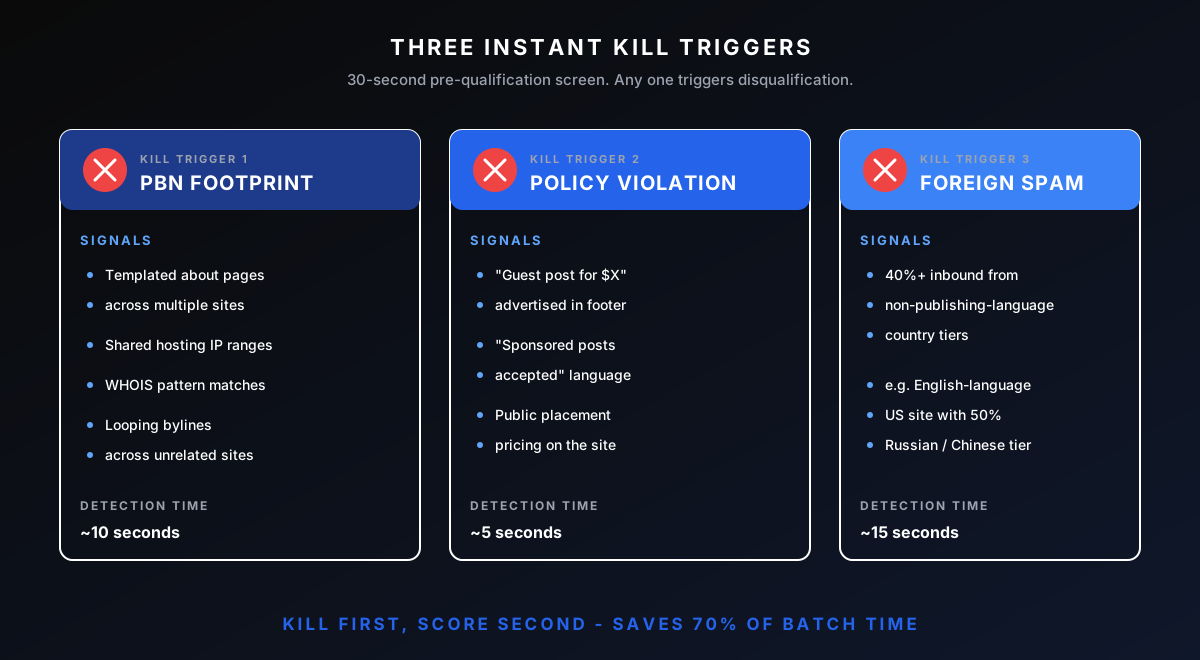
Kill trigger 1: PBN signature. Visible patterns include identical templated about pages across multiple sites, shared hosting IP ranges (Ahrefs and Spyfu both surface this), WHOIS pattern matches across a network, or contributor bylines that loop through a single shared author identity across unrelated sites.
Kill trigger 2: Paid-link policy violation language. Sites advertising "guest post for $X" or "we accept sponsored posts" in a footer typically have an inbound profile Google has already devalued. The placement may be a "real" guest post by transaction shape but the link signal is depressed by association.
Kill trigger 3: Foreign-spam-dominated profile. Ahrefs referring-domains report sorted by country shows a concentration above 40% on language tiers the site does not publish in (e.g. an English-language US site with 50% of inbound from Russian, Chinese, or Indonesian domains carries an active devaluation signal).
All three kill triggers stem from Google Search Essentials and the patterns Google has historically devalued or penalized. Kill at the trigger because partial credit on a triggered domain is worse than no link at all; the link can carry a negative association into the target site's profile.
The kill screen takes 30 seconds per prospect. The full scoring takes 4-6 minutes. Running the kill screen first saves 70% of scoring time on candidate lists that include any volume of PBN-adjacent domains. In regulated verticals like legal and medical, where Bart's prior work concentrates, the kill rate on raw candidate lists often hits 40-50%.
How The Scorecard Runs in a Real Engagement
Open Ahrefs Site Explorer, pull the candidate list, and run the scorecard in batches of 50. A typical engagement starts with 300 candidates from competitor intersection, scores down to roughly 60 actionable prospects, and converts 8 to 12 of those into placed links over 90 days through disciplined link-building outreach.
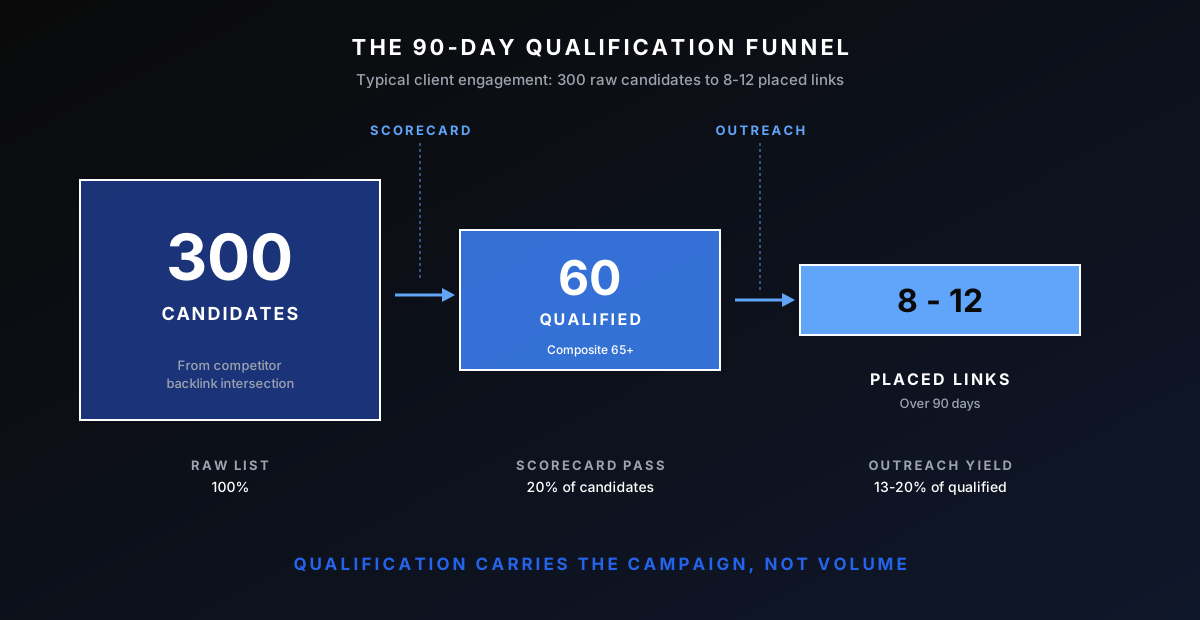
Discovery happens via competitor backlink discovery: pull the inbound profiles of the target site's top 5 organic competitors, find the referring-domain intersection (domains linking to 2+ competitors), and export the list. Three hundred candidates is the typical raw output for a site in a moderately competitive vertical. Mojo Links has seen 600 in legal SEO and 150 in narrow B2B SaaS niches; 300 is the median.
Scoring runs in 6 batches of 50. Each batch takes roughly 4 hours of operator time including the kill screen. Across the 300-candidate run, expect to kill 90-120 outright (PBN, foreign-spam, policy violations), score 100-130 in the "low" band (composite under 40, deprioritized), and qualify 60 in the "active outreach" band (composite 65+). The middle band (40-65) gets revisited if the campaign needs more volume than the qualified 60 yields.
Outreach conversion on the qualified 60 typically lands at 13-20% over 90 days in a regulated vertical. That math produces 8-12 placed links per quarter from this single qualification batch. For a year-round campaign, re-qualify every 90 days with fresh competitor intersection to avoid prospect-list staleness. [Bart: confirm vertical for anonymized example if you have a specific recent campaign whose numbers fit this funnel shape.]
Who Runs This Workflow (and Who Should Skip It)
This workflow is for in-house SEOs at brands running their own outreach, agency outreach managers handling 3+ active client campaigns, and link-building operators who outsource scraping but keep qualification in-house. Solo operators with a single campaign can use a lighter version. Solo operators starting from zero can also work through this vetted list of free backlink sites before spending on outreach.
The structured-scorecard approach earns its weight when the cost of a bad placement is high. A regulated-vertical client (legal, medical, financial) paying $400 a placement cannot afford a 30% bad-placement rate. A solo operator running content for their own site might tolerate the same rate because the only cost is their own time. The workflow scales with the stakes.
The lighter version for solo operators: run the kill screen on every candidate (30 seconds each), score topical relevance only (1 minute each), skip the other four criteria. That gets you 70% of the protection at 25% of the time cost. For paid-client work, run the full scorecard. The audit trail of the weighted score is also what gets handed to the client when they ask "why did you pick these prospects?" - a defended 5-criterion score answers that better than a feeling about DR. The audit trail also becomes the diagnostic input when a campaign underperforms and moves into a growth audit on the existing profile.
What Goes Wrong with Most Prospect Qualification
Three failure modes repeat: chasing DR while ignoring topical fit, accepting placements from networks that share a common footprint, and budgeting outreach time per prospect without budgeting qualification time per prospect. The biggest single failure is treating qualification as a quick filter rather than a structured workflow.
Anyone selling you a DR 70+ list at $200 per link is selling you a spreadsheet, not a strategy. The spreadsheet shows up in the deliverable; the rankings do not show up in the chart. Mojo Links has audited enough underperforming campaigns inherited from prior agencies to see this pattern as the dominant failure mode. The list looks impressive on paper. The ranking impact is flat.
Network-shared-footprint failures usually come from buying outreach lists from third-party vendors who source from the same upstream PBN aggregators. The client gets 20 placements that look diverse by domain name but share registration patterns, hosting IPs, or contributor identities. Google's pattern-detection systems devalue the whole batch within 6-12 weeks. The links exist; the signal does not.
Time-budget failures happen when operators budget outreach time per prospect (10 minutes to write an email, 5 minutes for follow-up) but skip the qualification budget entirely. They are spending 15 minutes converting prospects that should have been killed in 30 seconds. The fix is the kill screen at the top of every batch. The broader fix is integrating qualification into a manual link-building workflow that treats prospecting as a first-class deliverable, not a pre-step.
Prospecting is phase two of the production workflow this post sits inside. For the end-to-end program this fits into, see the link building pillar.
Link Prospecting Qualification FAQ
How long does the full scorecard take per prospect?
4-6 minutes per prospect for the full scoring across all 5 criteria, plus 30 seconds for the kill-trigger screen. On a 300-candidate list, expect roughly 24 operator-hours total including the kill screen. The kill screen runs first and typically eliminates 30-40% of the list before scoring begins.
What if Ahrefs access is not available?
Mojo Links uses its own Ahrefs subscription against the target domain, so no extra seat is needed. Mojo Links does request Google Search Console access for the post-placement attribution work, but the prospecting workflow itself runs without it.
Why is topical relevance weighted at 40% rather than 50% or 60%?
40% reflects that topical fit is the largest single signal but it is not the only signal. A topically perfect placement on a site Google has algorithmically demoted will not pass signal. The other 60% across editorial quality, profile health, traffic, and yield catches the cases where topical perfection is necessary but not sufficient.
How often should the qualified-prospect list be refreshed?
Every 90 days for active campaigns. Competitor backlink profiles change, new editorial publishers enter the niche, and old prospects either get exhausted (you have placed there) or rotated out (their editorial standards shifted). Stale prospect lists drop conversion rates 30-50% over 6 months without refresh.
What is the difference between qualification and pre-qualification?
Pre-qualification is the kill screen (30 seconds, binary keep/kill on the three kill triggers). Qualification is the full 5-criterion weighted score (4-6 minutes, produces a 0-100 composite). Run pre-qualification on the raw 300-candidate list and qualification only on the 200-210 that survive.
Can this workflow be automated?
Partially. The kill screen automates well for two of three triggers (PBN footprint detection via shared hosting and WHOIS, foreign-spam ratio via Ahrefs API). Criterion 1 (topical relevance) requires manual editorial review and resists clean automation because entity overlap is a reading judgment, not a tag-match. Be skeptical of any tool that claims to fully automate qualification; the ones Mojo Links has tested produce 60-70% accuracy at best, which is below the threshold for paid-client work. The one part that does automate cleanly is the metric pass: the free bulk Domain Rating checker sizes a raw candidate list by DR in a single paste, so operator hours go to the topical read that tooling cannot fake.

About Bart Magera
Bart Magera is the founder of Mojo Links. Ten years across YMYL verticals (legal, medical, finance, supplements, crypto, gambling). Trained under Koray Tuğberk Gübür's Topical Authority framework. Author of two SEO books and international speaker.
Want this kind of analysis on your site?
Get a free video walkthrough within 48 hours covering technical health, backlinks, content gaps, and AI visibility.
Related posts
Keep reading on adjacent topics.
- Link Building
 Bart Magera10 min read
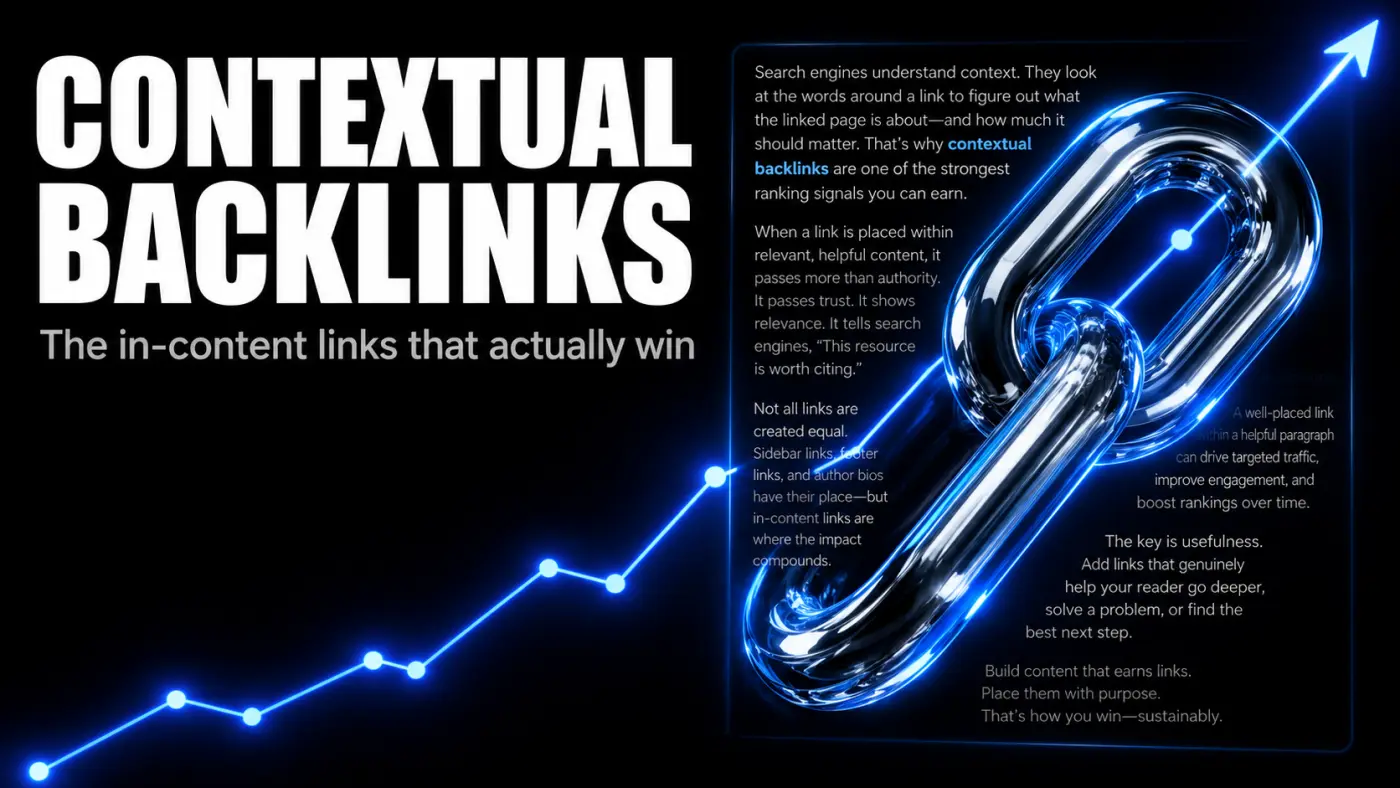
Contextual Backlinks: What They Are, Why They Win, and How To Earn Them
A contextual backlink sits inside the body of an article, surrounded by relevant text, not in a footer or author bio. That placement is what gives it weight. Here is what contextual backlinks are, what makes one high quality, how to earn them, and how to spot the cheap fakes.
- Link Building
 Bart Magera12 min read
What Is White Hat Link Building? Techniques That Work in 2026
The Problem: Why Most Link Building Fails Your SEO You wrote great content. It’s relevant. It’s useful. It even has infographics. But guess what? Crickets. Nobody’s linking. Google’s not ranking. And your “ultimate guide” is buried somewhere on page 7 under a recipe blog and a…
- Link Building
 Bart Magera10 min read
Tiered Link Building: How It Works and How To Do It Safely
Tiered link building layers weaker links behind your strongest ones to pass more authority to your money pages. Here is how the pyramid works, how to build one, which links are worth tiering, the risk SpamBrain introduced, and the lower-risk path I use on client sites.