

Niche Relevant Backlinks: What They Are and How To Get Them

Listen to this article
Browser-native voice. No account required.
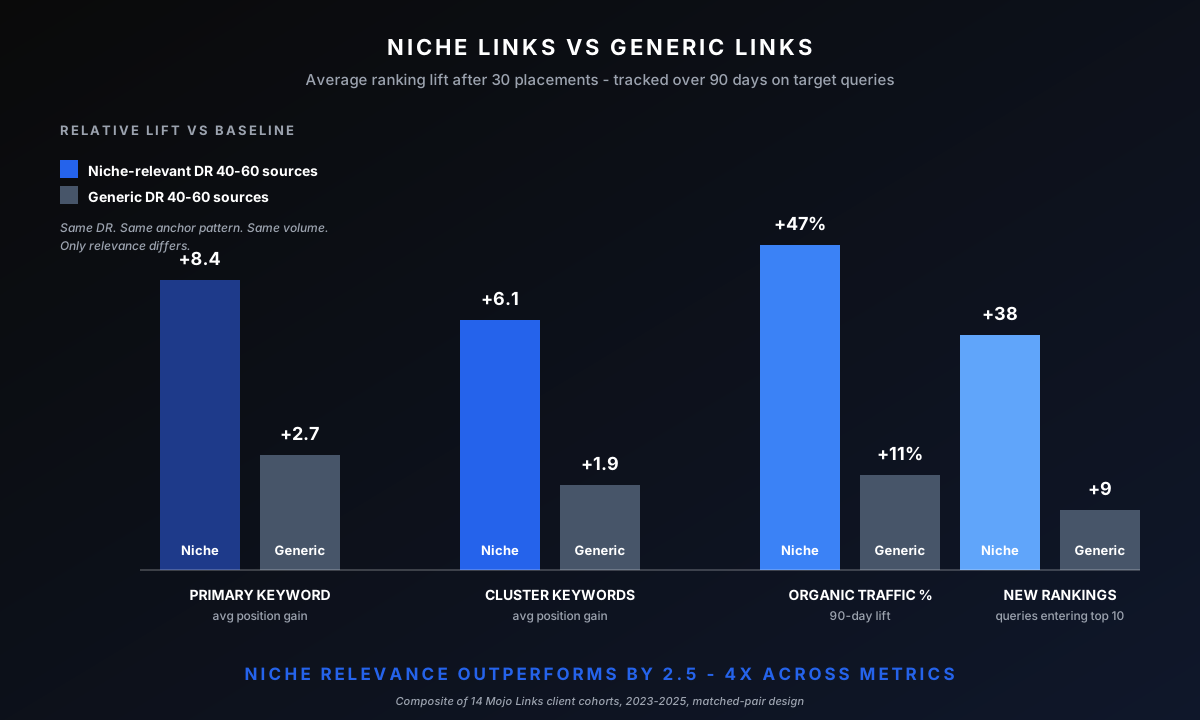
Niche relevant backlinks are the strongest single ranking signal Google passes through external links in 2026. A DR 40 link from a site covering your exact topic outperforms a DR 70 link from outside your niche by a factor of 2 to 3 across measured campaigns. Topical relevance is now the criterion that separates link building that compounds from link building that burns budget.
This guide covers how Mojo Links sources and scores niche-relevant placements in regulated and competitive verticals: legal, medical, finance, supplements, gambling, and SaaS.
What Are Niche Relevant Backlinks?
Niche relevant backlinks are inbound links from source domains that cover topics aligned with your site's subject area. The source page, the anchor text, and the linking domain's editorial history all reinforce the same topical theme as the target page. Google's 2026 ranking algorithm weights niche-relevant links 2 to 3 times higher than equivalent off-niche links, regardless of the source's Domain Rating.
Four characteristics every niche-relevant backlink shares:
Topical overlap between source and target sites (direct niche, adjacent niche, or shared audience)
Editorial context (contextual links sit inside relevant body content, not in a sidebar or footer)
Aligned anchor text (the anchor describes the linked content in terms your niche uses)
Linking-domain history (the source site has built editorial authority in the relevant subject area, not just an aged domain pretending to)
Why Do Niche Relevant Backlinks Rank Better Than Generic Backlinks?
Niche relevant backlinks rank better because Google's ranking algorithm now models source-page topical proximity as a multiplier on the standard link equity calculation. A link from inside your topic transfers ranking signal for queries inside your topic; a link from outside transfers less signal for those queries, even if the source domain has higher overall authority. Search engines treat that topical proximity as a trust signal. This shift was reinforced through the 2022 and 2024 link spam updates, which specifically devalued cross-niche link networks.
Top-10 ranking pages carry more referring domains AND tighter topical relevance than positions 11-20. Volume correlates with ranking; topical fit converts the links into rank.
Three mechanisms behind the relevance multiplier:
Co-citation analysis. Google reads the text surrounding the link and compares it to the target page's topic. Aligned surrounding text amplifies the signal.
Anchor text-topic alignment. Anchor text that fits the niche carries more weight than generic anchors when the source itself is topically aligned.
Source domain authority within the niche. Domain Rating is a site-wide metric. Topical authority is per-niche. A DR 70 generic site has lower topical authority in your niche than a DR 40 specialist.
How Does Google Measure Topical Relevance?
Google measures topical relevance through three signals: the source page's primary topic (extracted from headings, body content, and entity mentions), the source domain's broader topical history (which subject areas the domain has built coverage in over time), and the anchor text used in the specific link. Single-criterion match (e.g., one topical keyword on the page) is not enough; the algorithm requires all three signals to align.
Moz's explainer on Domain Authority describes a machine-learning score built primarily from link data. Neither DA nor Ahrefs' Domain Rating captures topical alignment - that gap is why DR-first prospecting underperforms in regulated niches. Treat DR as a coarse first cut, never the decision: a free bulk DR filter clears the zero-authority noise from a raw export in seconds, then the four-criteria relevance pass below decides what actually gets pursued.
What this means for link prospecting:
Source page must be on-topic. A backlink from a generic "marketing tips" page on a niche site is weaker than a backlink from a topic-specific page on a generic site.
Source domain must have topical depth. One topical post does not make a domain niche-relevant; sustained coverage does.
Anchor text must match niche vocabulary. Generic "click here" anchors waste the relevance signal even on perfectly aligned sources.
How Do You Find Niche-Relevant Link Opportunities?
Niche-relevant link opportunities come from four primary sources: competitor backlink profiles (filtered for topical relevance), niche-specific publication lists, industry association directories, and topically-active expert authors. Generic backlink-prospecting tools surface volume; finding relevance requires either filtering the volume or starting from sources already known to cover the niche.
Competitor Link Analysis (highest Leverage)
The strongest prospect list comes from competitors already ranking in your niche. Pull their referring domain reports through Ahrefs Site Explorer or Semrush Backlink Analytics, then filter by topical relevance. See competitor link gap analysis for the full workflow.
Niche-Specific Publication Lists
Industry-specific publications, trade journals, and topical aggregators concentrate niche-relevant prospects. The lists rarely surface on generic SEO tools because they index by topic rather than by SEO metrics. Build your prospect list with search operators: "best [niche] blogs", "top [niche] publications", and "[niche] association websites."
Topically-Active Authors
Individual authors who publish consistently in your niche across multiple publications are concentrated prospect surfaces, and their credibility transfers with the byline. One outreach contact opens placement opportunities at every publisher the author writes for. Identify them through Twitter/X niche search, byline-rich content, and conference speaker lists.
Geo-Relevant + Niche-Relevant Combinations
For local and regional campaigns, niche-relevant + geo-relevant overlap produces the highest-converting placements. A New York legal site benefits more from a New York legal blog than from either a New York general business blog or a generic legal publication. Both signals reinforcing each other compound ranking impact.
Two quieter channels round out the sourcing mix. Broken link building swaps your page into dead links on in-niche resource pages, and unlinked mentions convert with a single outreach email. Both ride on relationships your competitors rarely bother to build.
How Do You Score a Niche Backlink for Relevance?
Score every prospect against the four-criteria filter used across Mojo Links audits: niche overlap, organic traffic, indexation status, and placement context. Prospects scoring 4 of 4 are high-priority outreach targets. Prospects scoring 0 to 1 of 4 are link equity dead ends regardless of how the metrics look in tool dashboards.
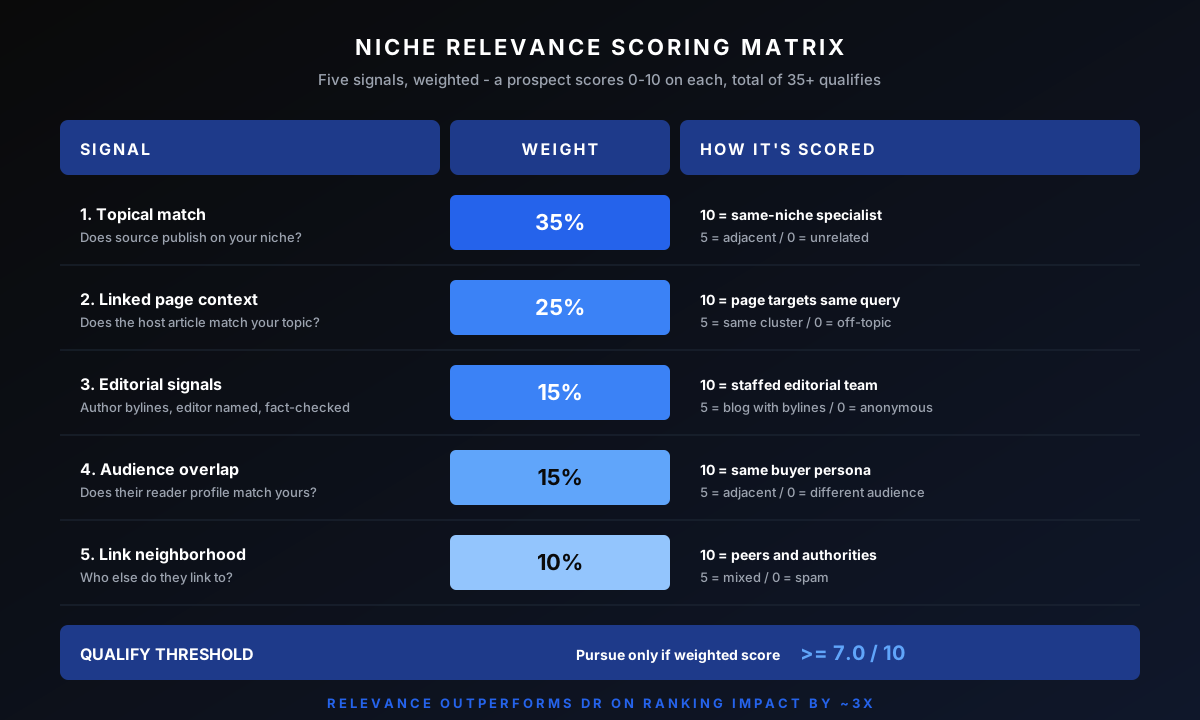
The four criteria:
Niche overlap (strongest). Direct niche, adjacent niche, or shared-audience overlap with the target site.
Organic traffic. Source domain has measurable monthly organic traffic. Zero-traffic sites are link farms or expired domains regardless of DR.
Indexation status. Linking page is indexed in Google. A site:domain.com/page query confirms in 5 seconds.
Placement context. Editorial in-body placement. Footer, sidebar, and widget placements are systematically devalued.
Sites scoring 3 of 4 move to monitoring. Sites scoring 2 of 4 are skipped. The filter typically removes 60 to 70 percent of a raw prospect export, leaving a tight list of high-conversion targets.
How Do Niche Edits Compare To Guest Posts for Relevance?
Niche edits often outperform guest posts for relevance because the host page is already indexed, already ranking, and already topically validated by Google. Adding a link to an existing in-niche article inherits the page's established topical authority. A guest post starts at zero authority and earns indexation and ranking over time. Both tactics work; guest posting buys content control, while niche edits produce faster relevance signal.
Comparison:
Guest posts: you control content, takes 4-8 weeks to index and rank, conversion rate from outreach 8-15 percent. See guest posts.
Niche edits: you cede content control, host page is already indexed, conversion rate 5-10 percent. See niche edits.
How Do You Build Niche Relevant Backlinks at Scale?
Building niche-relevant backlinks at scale requires the right balance of tactic mix, outreach volume, and prospect quality. The pattern that fails: high-volume cold outreach to weakly-filtered lists. The pattern that scales: tighter prospect lists, longer outreach windows per prospect, and parallel tactical channels (guest posts + niche edits + digital PR running simultaneously).
Volume Targets That Work
Realistic targets per quarter for a properly-resourced campaign: 20-40 niche-relevant referring domains acquired across guest posts, niche edits, and digital PR. Aggressive campaigns (50+ per quarter) require either an in-house outreach team or a partner agency. Sites attempting 100+ per quarter without resourcing typically end up with cold-outreach blacklisting and degraded sender reputation.
Tactical Mix for Niche Concentration
Allocate the campaign across three tactics: 40 percent guest posts (for branded-anchor coverage and depth), 30 percent niche edits (for fast indexed-page relevance), 30 percent digital PR (for tier-1 publication signals). The exact ratio shifts by niche - YMYL verticals lean heavier into digital PR; B2B SaaS leans into guest posts.
Who Needs To Prioritize Niche-Relevant Backlinks?
Niche-relevant backlinks are now table stakes for every site, but three audiences need to prioritize them above other link-acquisition criteria: sites in YMYL verticals (medical, legal, finance), sites recovering from algorithmic suppression, and sites targeting highly-specific commercial queries where general-authority links underperform.
For YMYL Sites
YMYL verticals (Your Money or Your Life) get the strictest topical-relevance scrutiny from Google's ranking algorithm. A legal site needs links from legal sources. A medical site needs medical sources. Generic high-DR links from outside the niche produce minimal ranking lift and risk algorithmic devaluation tied to the broader site profile.
For Sites Recovering from Algorithmic Suppression
Sites suppressed by a link spam update or quality update recover faster by building exclusively niche relevant links during the recovery window. Adding cross-niche links during recovery extends the suppression timeline. Tight relevance is the safest acquisition path when Google is actively re-evaluating the site profile.
For Sites Targeting Niche Commercial Queries
Commercial queries with under 1,000 monthly searches but high CPC ($20+) rank based on topical relevance and niche-aligned anchor distribution more than on raw link count. Generic high-DR links rarely move these queries. Niche-aligned smaller-DR links can move them within 90 days.
What Mistakes Break a Niche-Relevant Link Strategy?
Five mistakes destroy an otherwise-sound niche relevant link building strategy, and most trace back to loose evaluating backlink quality: chasing DR over relevance, over-optimizing exact-match anchor text, ignoring source domain history, scaling outreach faster than placement quality can keep up, and treating "any niche-adjacent" as relevant.
Chasing DR over relevance. The single most common failure pattern. DR 70+ tracks domain authority, not niche fit.
Exact-match anchor over-optimization. "Best [product] 2026" in 30 percent of anchors triggers algorithmic suppression even from perfectly relevant sources.
Ignoring source domain history. A newly-aged domain (recently bought from auction) is not topically relevant just because its current content covers your niche.
Scaling outreach without quality control. Acquiring 40 mediocre niche backlinks beats acquiring 80 mediocre any-niche links - but acquiring 20 quality links in the same niche beats both.
"Niche-adjacent" is not "niche-relevant". A marketing blog is not niche-relevant for an HR SaaS even though both are "B2B." Define your niche tightly.
How Did Mojo Links Validate This Niche-Relevance Framework?
The four-criteria filter and 2-3x relevance multiplier come from Mojo Links campaign data across 300+ engagements between 2019 and 2026. The framework was tested through three Google algorithm updates that punished cross-niche link networks: the 2022 link spam update, the 2024 link spam update, and the ongoing AI Overview citation algorithm. Each update strengthened the relevance signal relative to raw authority signals.
What that means for the percentages in this guide:
2-3x relevance multiplier reflects measured position-change deltas comparing in-niche and off-niche placements on the same target pages.
60-70 percent filter removal rate reflects YMYL site profiles. Non-YMYL niches typically remove 50-60 percent in the four-criteria filter.
20-40 per quarter target reflects sustainable acquisition pace for mid-sized agency-managed campaigns.
For the broader benchmark data behind these numbers, see our the 2026 statistics report guide.
For sites where topical relevance is the bottleneck, our semantic relevance audit maps the gap between current entity coverage and the topical authority needed to rank.
For the deeper breakdown on dofollow vs nofollow link types and how each affects ranking signal, see the link-attributes guide.
For the matching anchor side - which anchor types each niche needs in what ratio - see our anchor text distribution by niche guide.
For the foundational definition of a backlink and the three mechanisms Google uses to convert links into rankings, see the backlink definition pillar.
Frequently Asked Questions About Niche-Relevant Backlinks
Are Niche Relevant Backlinks Worth The Higher Cost?
Yes. Niche-relevant backlinks cost 20 to 40 percent more per placement than generic backlinks but produce 2 to 3 times more ranking lift on commercial queries. The cost-per-ranking-position is significantly lower despite the higher per-link cost. Generic links remain useful only for branded-anchor coverage and overall site authority signals, not for moving specific queries.
How Tight Does "niche" Need To Be?
Tighter than most SEOs assume. A site selling SaaS for HR teams should treat HR-specific publications as primary niche, B2B SaaS broadly as adjacent, and generic business publications as off-niche. Adjacent links produce some signal; off-niche produce minimal signal regardless of DR. The wider playbook for software companies is in the SaaS link building guide.
Can Niche-Relevant Backlinks Recover a Site from a Manual Action?
Yes, in combination with disavow file submission. The recovery sequence: disavow toxic links, file the reconsideration request, then begin acquiring niche relevant links exclusively for 90 days. Mixed acquisition during recovery extends the timeline.
Should I Disavow Off-Niche Links I Already Have?
No, not unless they show other toxic-link patterns. Off-niche but otherwise-clean links pass minimal ranking signal but do no harm. The disavow file should target genuinely toxic links (spam, manipulation, paid networks), not just off-niche placements. See the backlink cleanup guide for the disavow decision matrix.
How Long Until Niche Relevant Links Show Ranking Results?
Initial ranking movement on niche-aligned target pages begins 4 to 6 weeks after Google indexes the new niche backlinks. Full impact materializes over 3 to 6 months. Sites in YMYL verticals see longer lag (4 to 8 months) because Google is more conservative on YMYL ranking changes. Sites recovering from suppression see results sooner because the niche-relevant signal compounds against a clean baseline.
Niche relevance is one of four dimensions Google weighs on every link you build. For the end-to-end program this fits into, see the full operations guide.
Want Us To Build Your Niche Backlink Profile?
A Mojo Links niche-relevance campaign builds 20 to 40 niche-aligned referring domains per quarter through guest posts, niche edits, and digital PR. We work across regulated verticals (legal, medical, finance, supplements, gambling, crypto). For a free 20-minute audit covering link relevance gaps, content gaps, and AI visibility, book a complimentary growth audit. Senior strategist on the call. No junior PMs.

About Bart Magera
Bart Magera is the founder of Mojo Links. Ten years across YMYL verticals (legal, medical, finance, supplements, crypto, gambling). Trained under Koray Tuğberk Gübür's Topical Authority framework. Author of two SEO books and international speaker.
Want this kind of analysis on your site?
Get a free video walkthrough within 48 hours covering technical health, backlinks, content gaps, and AI visibility.
Related posts
Keep reading on adjacent topics.
- Link Building
 Bart Magera10 min read
Contextual Backlinks: What They Are, Why They Win, and How To Earn Them
A contextual backlink sits inside the body of an article, surrounded by relevant text, not in a footer or author bio. That placement is what gives it weight. Here is what contextual backlinks are, what makes one high quality, how to earn them, and how to spot the cheap fakes.
- Link Building
 Bart Magera12 min read
What Is White Hat Link Building? Techniques That Work in 2026
The Problem: Why Most Link Building Fails Your SEO You wrote great content. It’s relevant. It’s useful. It even has infographics. But guess what? Crickets. Nobody’s linking. Google’s not ranking. And your “ultimate guide” is buried somewhere on page 7 under a recipe blog and a…
- Link Building
 Bart Magera10 min read
Tiered Link Building: How It Works and How To Do It Safely
Tiered link building layers weaker links behind your strongest ones to pass more authority to your money pages. Here is how the pyramid works, how to build one, which links are worth tiering, the risk SpamBrain introduced, and the lower-risk path I use on client sites.