

What Makes a High-Quality Backlink: The Criteria That Matter
Listen to this article
Browser-native voice. No account required.
Every link you build is a bet. Some compound for years, some sit there doing nothing, and a few quietly drag the whole domain into a manual review.
The problem is that most "high quality" checklists stop at domain rating. Mojo Links campaigns have seen DR 80 links move nothing and DR 35 links move a keyword 12 spots in a fortnight. So before building or accepting any link, run it through the same evaluation pass, the one that anchors the link building playbook. Here it is.
What Makes a Backlink High Quality?
A high-quality backlink comes from a relevant, trusted page that links to you editorially, in body content, with descriptive anchor text, on a page real people actually visit. It passes PageRank, fits a natural link profile, and would still make sense if Google never existed. Relevance and trust first. Metrics second.
That definition has four load-bearing words: relevant, trusted, editorial, real. Strip any one and the link weakens. A relevant link buried in a footer is wasted. A perfectly placed link on a dead site is a trophy, not a vote.
The rest of this piece is how to test each of those properties on a specific prospect, not in theory.
Why Does Link Quality Matter More Than Quantity?
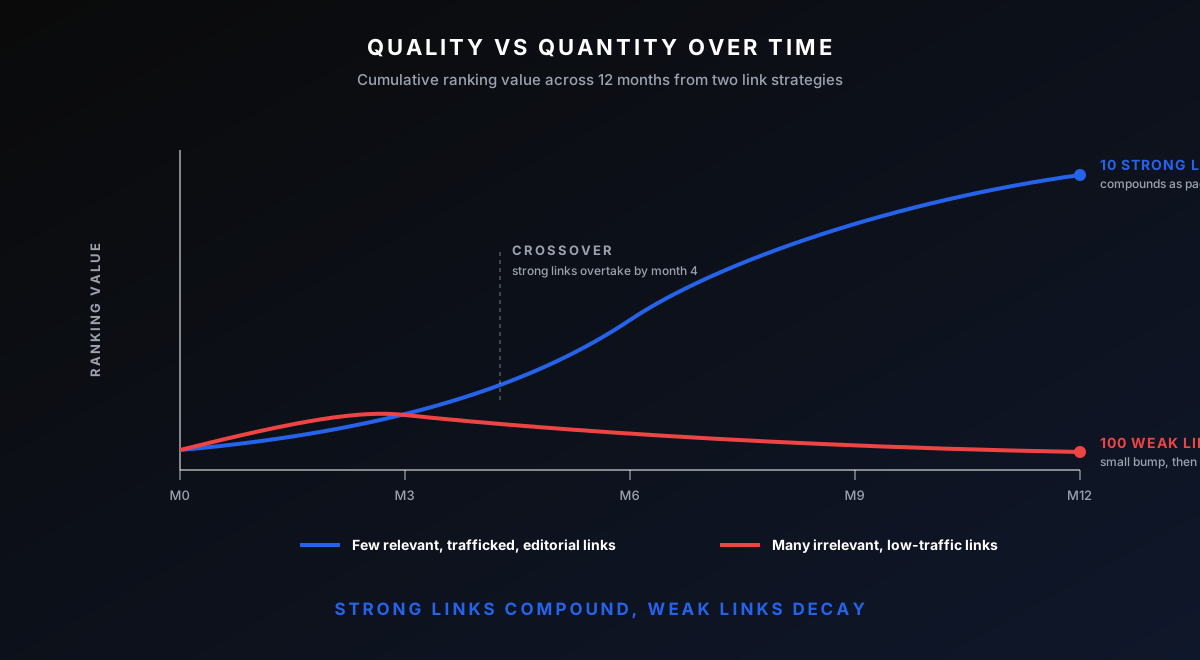
Quality wins because Google scores the strength of each link, not the count. A handful of relevant, trafficked, editorial links can outrank a competitor sitting on hundreds of directory and forum links. The links that move rankings are the authoritative, relevant ones.
More total links correlate with higher rankings, but it is the quality of the linking domains that does the real work.
Mojo Links has rebuilt profiles where 60% of the links were removed and rankings went up. The weak links were not neutral. They were signal dilution, and a few were liabilities.
The Evaluation Criteria
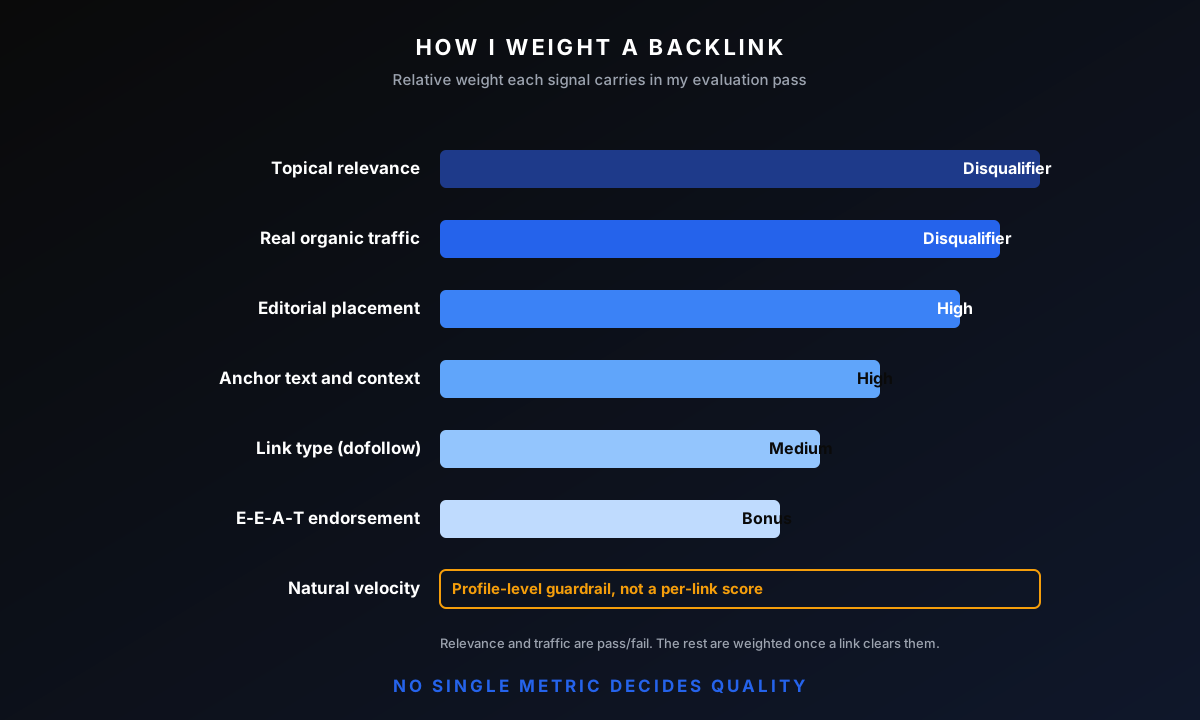
These are the tests, in the order to apply them. The early ones disqualify fast and cost nothing to check. The later ones need a closer read.
Topical Relevance
Relevance is the first filter and the one to weight highest. The source page and the site as a whole should share your subject, niche, or geography. A personal-injury law firm earns more from a legal directory or a local news story than from a generic DR 85 marketing blog.
Topical fit beats raw strength. A DR 40 in-niche link usually outperforms a DR 75 off-niche one, which is why a relevant placement beats a bigger irrelevant one every time. The mechanics of why relevance carries weight sit in the guide to niche-relevant backlinks.
Source Authority and Real Traffic
Authority and traffic travel together. Check domain rating to gauge the backlink profile, then check whether the referring page actually pulls organic visitors. A site with a strong metric and zero traffic is usually an aged domain propped up by its own link network.
The threshold is simple: the source needs measurable organic traffic, not just a number on a toolbar. A page nobody visits passes no equity worth having. Zero-traffic domains are link farms wearing a good DR, regardless of the badge.
Editorial Placement
Placement decides how much of the link's potential value survives. A link inside body copy, surrounded by relevant text, signals an editorial decision by a human. Google treats those as the real votes.
Footer links, sidebar links, author-box links, and sitewide template links are devalued by design. They repeat across thousands of pages and signal an arrangement, not an endorsement. If the only way to get the link is a footer slot, pass.
Anchor Text and Context
Anchor text should read naturally and describe the destination. Descriptive, varied, mostly branded or partial-match anchors look like the web writing about you. A pile of exact-match commercial anchors looks like you writing about you.
The words around the link matter as much as the anchor itself. A link sitting inside semantically related content carries clearer meaning to Google than the same link dropped into an unrelated paragraph. Forced placement reads as forced. So does a sentence that only exists to host a keyword.
Link Type: Dofollow, Nofollow, Sponsored, UGC
Link type sets the ceiling on direct value, and the full range of backlink types sorts by it. Dofollow links pass PageRank and do the ranking work. Sponsored and UGC tags tell Google the link is paid or user-generated, which caps direct equity.
Nofollow is not worthless. Google now treats it as a hint, and a healthy profile includes a natural mix of follow and nofollow from social, news, and forums. A profile that is 100% dofollow exact-match looks engineered, because it is.
Outbound Profile and Indexation
Two quick disqualifiers live here. First, indexation: if the referring page is not in Google's index, the link does not exist as far as rankings go. A site:domain.com/page check settles it in seconds.
Second, the page's own outbound profile. A page linking out to 80 unrelated sites is a link farm, and your link is one of 80 diluted votes. Look for pages that link out sparingly and on-topic.
E-E-A-T Enhancement
The best links do more than pass equity. They reinforce experience, expertise, authoritativeness, and trust. A link that comes with a quote from your team, a citation of your original data, or a credentialed author bio tells both readers and Google that a real authority vouched for you.
This is why a single mention in an industry publication can outperform a batch of bought placements. It is an endorsement, not a transaction. When prospecting, a source that can carry that kind of context gets bumped up the list.
Natural Link Velocity
Velocity is the criterion most "10 traits" posts ignore, and it is the one that gets sites flagged. Links should accrue at a steady, believable pace. A brand-new page that gains 400 links in a week did not earn them organically, and the pattern looks exactly like what it is.
Pace campaigns to match how a real site in that niche actually grows. Steady beats spiky. A profile that ramps gradually survives scrutiny that a sudden burst will not.
Authority Metrics in Context
Domain rating, domain authority, and URL rating are useful. They are also routinely misread as a verdict when they are only an input.
What The Metrics Get Right
Authority metrics are good shorthand for the strength of a site's backlink profile. As the Search Engine Land guide to quality backlinks lays out, Ahrefs DR, Moz DA, and Majestic Trust Flow each estimate how much link equity a domain has accumulated. For a fast first-pass sort across hundreds of prospects, they save real time. The free bulk DR checker is built for exactly that first-pass sort: paste the prospect list, read DR against a floor you set, then spend the real time on relevance and traffic.
Where Metrics Mislead
The trap is treating a high score as proof of quality. Different tools use different methods, so scores do not compare across platforms. A high metric with low relevance is still a bad link, and aged domains can carry inflated scores propped up by stale link rot. The differences are broken down in DR vs DA vs UR.
There is a real exception. Domain authority matters most when the source is the kind of site that earns trust by default: national news outlets, .edu and .gov domains, large trade organizations, established nonprofits, and reference sites like encyclopedias. A link from one of those is worth chasing on authority alone, because the trust is structural, not gamed.
Quality Versus Quantity
Here is the trade-off in practice. Ten relevant, trafficked, editorial links will out-earn a hundred weak ones, and they age better. The strong links compound as the linking pages themselves gain authority. The weak ones flatten or decay.
Mojo Links has seen one tier-one placement in a finance engagement move a target keyword more than the previous quarter of low-tier link buys combined (debexpert.com, where focused link building helped drive organic traffic up several hundred percent). One good link, paid for once, kept paying. That is the whole case for quality, and it is the logic behind every link-building campaign Mojo Links runs.
Red Flags To Reject
Some signals end the evaluation immediately. These are the ones that get a hard no.
PBN and Link-Scheme Footprints
A private blog network leaves fingerprints: shared hosting, recycled templates, thin content built only to host links, and outbound profiles pointing at unrelated commercial sites. Google's link spam policy is explicit that link exchanges, paid follow links, and automated link creation are violations. Treat any PBN footprint as a liability, not an opportunity.
The reciprocal-linking and "link exchange" pitch falls here too. Systematic you-link-me-I-link-you arrangements are a pattern Google detects, and the short-term gain is not worth the cleanup. Anyone selling you 200 links for a flat fee is selling you a future disavow file.
Irrelevant or Low-Traffic Sources
The quieter red flag is the link that is not toxic, just useless. Irrelevant niche, no organic traffic, generic anchor, forced placement. It will not hurt you, but it will not help, and the time spent acquiring it is gone. When a profile fills with these, see the breakdown of toxic backlinks for what to clean and what to leave.
How To Score a Prospect
This is where the criteria become a workflow. Every prospect that survives the first sort gets the same pass, and most of it happens inside the backlink checker tools Mojo Links runs daily.
The Pass/fail Checklist
Run the prospect against eight questions. Relevant niche? Real organic traffic on the domain and the page? Editorial in-body placement available? Indexed page? Healthy outbound profile? Natural anchor possible? Does it strengthen E-E-A-T? Does it fit the campaign's velocity?
A prospect needs to clear relevance, traffic, placement, and indexation without exception. The rest are weighted. Where this scoring sits in the wider workflow is covered in link prospecting.
When To Make An Exception
Bend on metrics, never on relevance or spam signals. A DR 25 site with genuine traffic, a tight niche match, and a real editorial slot gets a yes even though the number looks small. A brand-new but clearly legitimate publication with no DR yet can be worth an early bet.
Never accept an irrelevant link because the DR is high, or a placement on a site with link-scheme footprints because the traffic looks good. Those are the trades that age badly.
Proof from Real Engagements
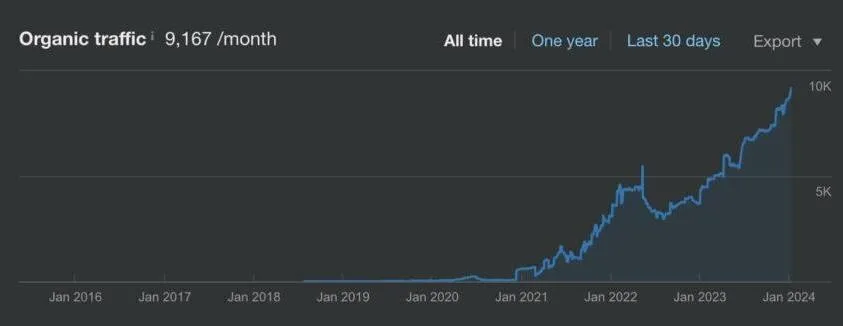
The criteria hold up against real numbers. For bspin.io, a full SEO engagement in a brutally competitive vertical, the profile Mojo Links built reached 9,167 organic visits a month against an estimated $17,330 in monthly traffic value, on roughly 200 referring links. Not thousands of links. Two hundred, chosen on these tests.
The inverse is just as instructive. During my time at Paradox Marketing, a health-vertical site carried roughly 7,000 toxic backlinks that had to be disavowed before recovery could start. Those links were free to acquire and expensive to remove, which is the real cost of ignoring quality at the point of acquisition.
Quality Signals in AI Search
The same signals now feed AI visibility. When ChatGPT, Perplexity, or Google's AI Overviews assemble an answer, they lean on authoritative, frequently cited sources, and brand mentions tend to travel alongside backlinks from those sources.
A relevant link from a trusted publication does double duty. It passes equity for classic search and it raises the odds your brand shows up where language models source their answers. Off-topic, low-trust links do neither. The criteria that win in Google are converging with the ones that win in AI search.
Common Mistakes
The expensive errors repeat. Buying on DR alone is the most common, and it loads a profile with strong-looking, irrelevant links that move nothing.
Over-optimizing anchors is the second. A stack of exact-match commercial anchors is a textbook manipulation signal, and it is easy to avoid. Ignoring the source's real traffic is the third, because a metric without traffic is a costume. Get those three right and you have already beaten most profiles in your niche.
Frequently Asked Questions
Is a High-DR Link Always Good?
No. Domain rating measures backlink strength, not relevance, traffic, or placement. A high-DR link from an off-topic or zero-traffic page can pass little value, and an irrelevant one can look unnatural. Relevance and real traffic decide quality. DR is one input among several.
Do Nofollow Links Count?
Yes, in a supporting role. Google treats nofollow as a hint rather than a strict directive, and a natural profile includes nofollow links from social, news, and forums. They rarely move rankings on their own, but they make a profile look earned. An all-dofollow profile looks engineered.
How Many High-Quality Links Do I Need?
Fewer than most sellers imply. The right number depends on niche difficulty and your competitors' profiles, not a fixed quota. Mojo Links has ranked sites in competitive verticals on a couple of hundred well-chosen links. Match the relevant link velocity of the sites already ranking, then keep pace.
Can One Bad Link Hurt My Site?
A single bad link, rarely. A pattern of them, yes. Google's systems mostly ignore isolated spam, but PBN footprints, paid follow links at scale, or a sudden spike of identical anchors can trigger devaluation or a manual action. The risk is the pattern, not the one link.
How Do I Check a Link's Quality Quickly?
Three checks in under a minute. Confirm the page is indexed, glance at the domain's organic traffic in any backlink tool, and read the paragraph the link sits in to confirm it is editorial and relevant. If it fails any of the three, it is not worth more of your time.
Want a Second Opinion on Your Link Profile?
If you are not sure which of your links are pulling weight and which are dead, that is exactly what I assess. The free video audit includes a backlink pass that flags your strongest links, your riskiest ones, and the relevance gaps a competitor is exploiting.
From there, niche edits and full campaigns build only the links that clear these criteria, every one backed by a 120-day replacement guarantee.

About Bart Magera
Bart Magera is the founder of Mojo Links. Ten years across YMYL verticals (legal, medical, finance, supplements, crypto, gambling). Trained under Koray Tuğberk Gübür's Topical Authority framework. Author of two SEO books and international speaker.
Want this kind of analysis on your site?
Get a free video walkthrough within 48 hours covering technical health, backlinks, content gaps, and AI visibility.
Related posts
Keep reading on adjacent topics.
- Link Building
 Bart Magera10 min read
Contextual Backlinks: What They Are, Why They Win, and How To Earn Them
A contextual backlink sits inside the body of an article, surrounded by relevant text, not in a footer or author bio. That placement is what gives it weight. Here is what contextual backlinks are, what makes one high quality, how to earn them, and how to spot the cheap fakes.
- Link Building
 Bart Magera12 min read
What Is White Hat Link Building? Techniques That Work in 2026
The Problem: Why Most Link Building Fails Your SEO You wrote great content. It’s relevant. It’s useful. It even has infographics. But guess what? Crickets. Nobody’s linking. Google’s not ranking. And your “ultimate guide” is buried somewhere on page 7 under a recipe blog and a…
- Link Building
 Bart Magera10 min read
Tiered Link Building: How It Works and How To Do It Safely
Tiered link building layers weaker links behind your strongest ones to pass more authority to your money pages. Here is how the pyramid works, how to build one, which links are worth tiering, the risk SpamBrain introduced, and the lower-risk path I use on client sites.