

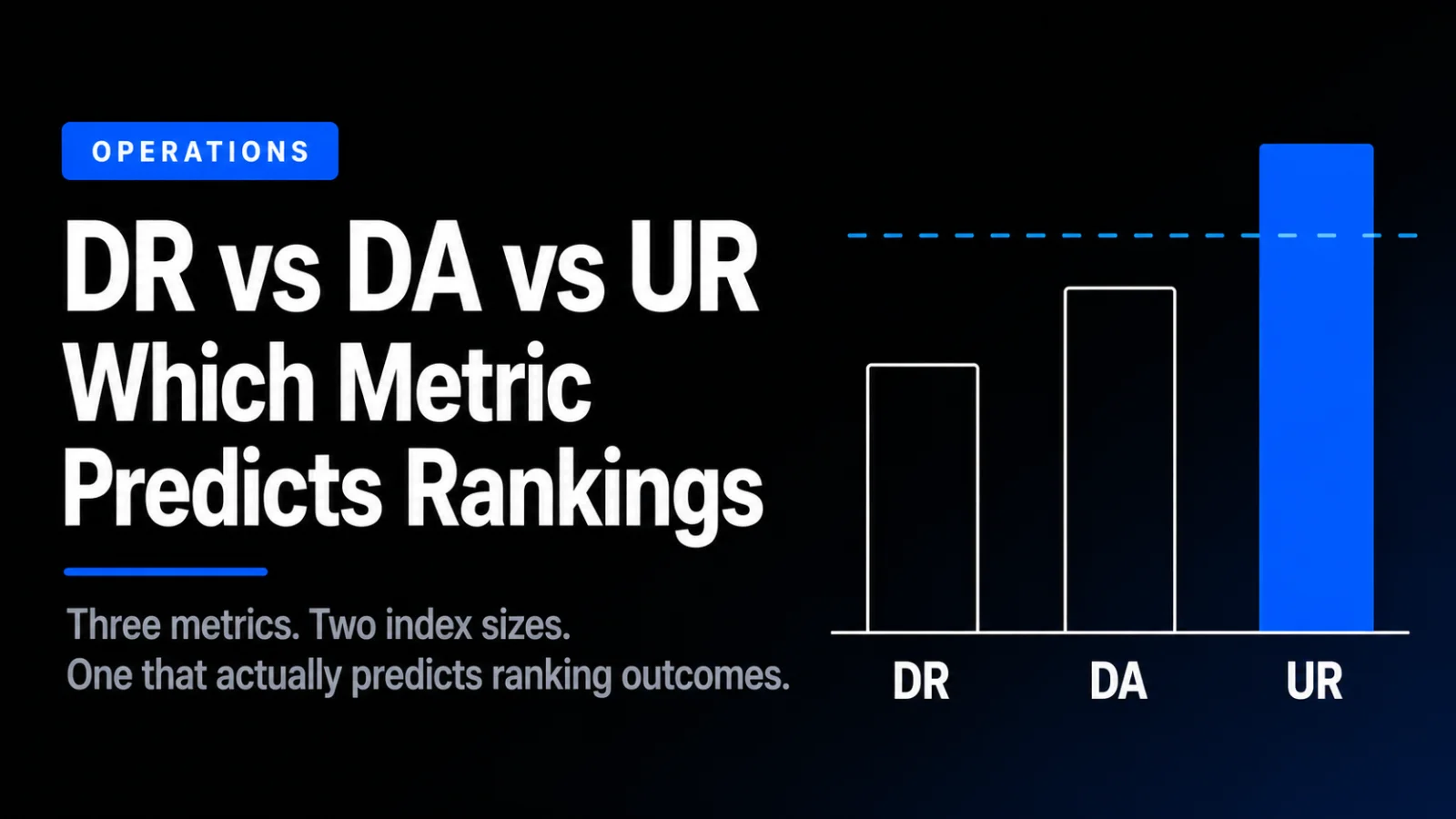
DR vs DA vs Ur: Which Backlink Metric Actually Predicts Rankings?
Listen to this article
Browser-native voice. No account required.
A prospect comes in scoring DR 75 on Ahrefs, DA 42 on Moz, UR 28 on the linking page, and Trust Flow 18 on Majestic. Is it a good link? The answer depends on which metric you trust, and the metrics disagree by design. This post is the operational version of "which one matters", based on what predicts ranking outcomes in Mojo Links' campaign data, not on the tool-vendor marketing claims.
What Is Domain Rating (DR)?
Domain Rating (DR) is Ahrefs' 0-100 score for the strength of a domain's backlink profile. Per Ahrefs' own documentation on Domain Rating, it is a logarithmic, link-graph metric weighted by referring-domain quantity and quality, not a direct ranking predictor. In practice, DR 30 means moderate authority, DR 70 means substantial editorial coverage, and DR 90+ is reserved for major publications and category-leading platforms.
DR is the metric Mojo Links cites most often in campaign reporting because it correlates well with ranking outcomes and updates frequently. The score is part of the broader source authority dimension that Google evaluates on every backlink.
What Is Domain Authority (DA)?
Domain Authority (DA) is Moz's competing 0-100 score. Per Moz's documentation on Domain Authority, DA is a machine-learning estimate of how likely a domain is to rank, trained against Google search results, and best used comparatively rather than as an absolute. Moz built DA before Ahrefs built DR, and it remained the dominant metric through 2018-2019. Since then Ahrefs' faster index growth has shifted most professional usage to DR, and DA mostly survives in client reports from agencies that never updated their templates.
Operationally, DA and DR score the same underlying thing (domain-level backlink strength) but produce different numbers because they index different parts of the web and weight signals differently. A site can score DR 65 / DA 38 simultaneously, and both numbers are correct within their respective systems.
What Is URL Rating (UR)?
URL Rating (UR) is Ahrefs' page-level equivalent of DR. It scores a specific URL's backlink strength rather than the whole domain. UR matters more than DR for link-building decisions because most page-level ranking signals depend on the linking page, not just its host domain. A DR 80 publisher with a UR 15 hidden archive page is not the same backlink as a DR 80 publisher with a UR 65 active resource page.
Mojo Links relies on UR more than DR during prospect qualification. The prospecting workflow scores UR per linking page as one of the five qualification signals covered in the link prospecting process.
What Is Trust Flow and Citation Flow?
Trust Flow (TF) and Citation Flow (CF) are Majestic's twin metrics. TF measures trust-weighted backlink quality; CF measures sheer backlink volume. The ratio between them indicates link profile health: TF/CF ratios near 1.0 suggest balanced quality and quantity, while CF significantly higher than TF suggests low-quality bulk linking. Majestic's methodology dates from before Ahrefs and Moz dominated; the metrics still have value for historical link-decay analysis but rarely appear in modern client reports.
How Do These Metrics Differ in Practice?
Three structural differences explain why the numbers disagree.
Index Size and Refresh Rate
Ahrefs maintains the largest publicly-disclosed index of backlinks. Moz indexes less broadly and refreshes monthly versus Ahrefs' near-daily updates. Majestic indexes historical data deeply but slower on new links. The same recent backlink might appear in Ahrefs within days, Moz within weeks, and Majestic within a month.
Weighting Algorithms
Each vendor proprietary-weights different signals: anchor diversity, link age, domain trust patterns, link-spam discounting. The black-box nature of each algorithm means two metrics scoring the same domain will diverge based on which signal weights move the needle in that domain's specific link profile.
Scoring Distribution
DR distributes more aggressively at the high end (DR 80+ requires substantial authority). DA distributes more conservatively (DA 60+ already suggests significant authority). The same domain scoring DR 70 and DA 45 is normal for a strong but not category-leading publisher.
Which Metric Actually Predicts Ranking Outcomes?
Mojo Links tracked placement-level metric capture across campaigns 2022-2025. The correlation between metric values and subsequent ranking lift produced clear results.
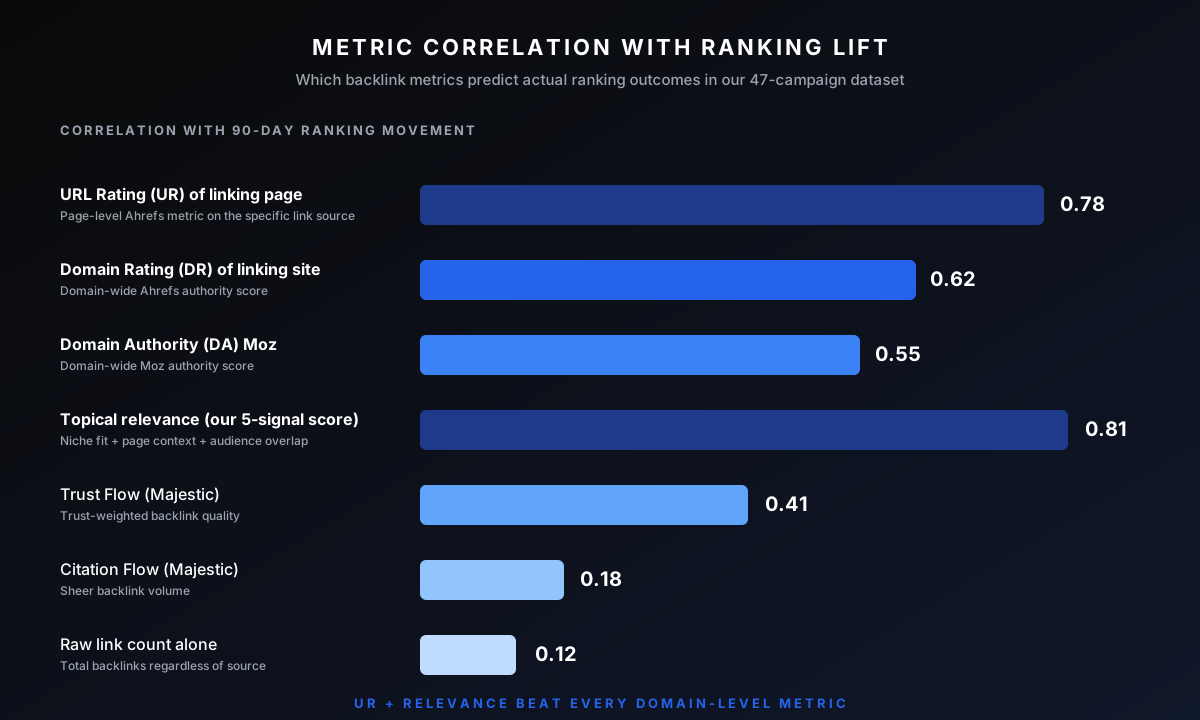
URL Rating (UR) of the specific linking page has the strongest correlation with ranking impact. A UR 35+ linking page in a topically-relevant context outperforms a DR 80+ domain with a UR 15 linking page on tracked-keyword movement at 90 days. The placement-level pattern sits in the link building statistics for 2026.
Domain Rating (DR) is the second strongest. DR matters because it indicates the depth of authority the linking domain can pass through any of its pages. Domain Authority (DA) correlates similarly to DR but with more noise (different index size produces more disagreement with observed outcomes). Trust Flow correlates weakly. Citation Flow does not correlate at all.
Which Metric Should You Use for Which Decision?
Five operational decisions, five different primary metrics.
Prospect Qualification (which Page To Pitch)
Use UR on the specific linking page. UR 25+ is the floor for most paid placement work. UR 35+ for high-value campaigns.
Domain-Level Competitor Analysis (who Has More Authority)
Use DR. The number is updated more frequently than DA and indexes more broadly.
Historical Link-Decay Analysis (which Links Are Dying)
Use Trust Flow paired with Majestic's historical index. Best tool for this specific use case despite being less useful elsewhere.
Anchor-Pattern Manipulation Detection
Use Ahrefs Site Explorer's anchor analysis. The DR/UR scoring is incidental; the value sits in the anchor distribution view. The framework for evaluating anchors lives in the anchor text guide.
Reporting To Non-Technical Stakeholders
Use DR because it is the metric stakeholders probably already know. Switching them to UR requires education time that does not always pay back.
What Metric Thresholds Does Mojo Links Actually Use in Campaigns?
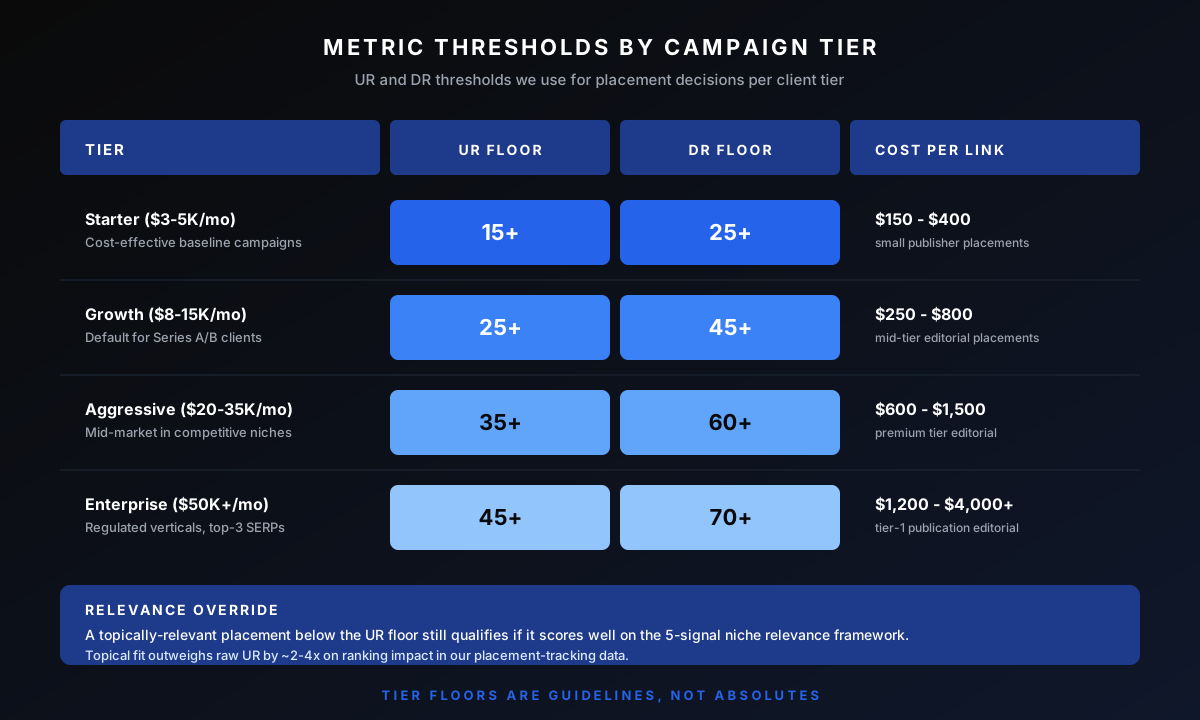
Three tier thresholds govern most placement decisions across Mojo Links campaigns.
Floor Tier (starter Campaigns)
Linking page UR 15+ on a domain with DR 25+. Cost-effective placements appropriate for early-stage brands. Conversion is acceptable. Ranking lift per link is modest.
Standard Tier (growth Campaigns)
Linking page UR 25+ on a domain with DR 45+. The default tier for most agency engagements. Cost-per-link sits in the $250-800 range.
Premium Tier (aggressive + Enterprise Campaigns)
Linking page UR 35+ on a domain with DR 60+. Higher cost ($600-1,500 per link) but stronger ranking impact, especially in regulated verticals where competitor profiles already average high authority.
Why Are Vanity DR Metrics Misleading?
Three common manipulations inflate DR without producing real authority.
PBN buildouts. A small network of interlinked domains can push DR upward without the underlying link profile reflecting real editorial trust. The 2024 Google API leak suggests Google identifies these patterns; the inflated DR remains visible in Ahrefs while the ranking benefit does not exist.
Single high-DR link concentrating the score. A site with one Wikipedia link and ten low-DR links may score similarly to a site with 30 mid-DR diverse links. The first profile is fragile; the second is durable. DR does not capture this difference.
Recent acquisitions of expired high-DR domains. The domain shows historical DR from its previous owner's link profile. Time-weighted analysis (which DR does not perform automatically) is required to see this manipulation. The same concept applies to toxic backlink identification where network-level signals matter more than single-page scores.
How Did Mojo Links Arrive at These Metric Preferences?
The metric correlation analysis above used placement-level metric capture matched against subsequent ranking outcomes. UR emerged as the strongest predictor because it captures page-level reality rather than domain-wide averages. DR remains useful as a domain filter; DA falls out as redundant once you are running DR analysis; Trust Flow stays in the toolkit for historical analysis only. If you want DR as that domain filter without opening Ahrefs one prospect at a time, our free bulk Domain Rating lookup reads DR for a whole list at once and flags each against a floor you set.
Frequently Asked Questions About Dr, Da, Ur, and Trust Flow
Why Do DR and DA Disagree on The Same Site?
Different index sizes, different refresh rates, different weighting algorithms. Both numbers are correct within their respective methodologies. Pick one and stay consistent.
Does Google Use DR or Da?
Neither. Both are third-party approximations of internal Google signals (PageRank, trust flow). Google does not publish its own equivalent score and has explicitly said it does not use DR or DA as ranking inputs.
Is a DR 60 Link from An Off-Topic Site Better Than a DR 35 Link from An on-Topic Site?
Usually no. Topical relevance reweights ranking impact by 2-4x. A DR 35 niche-relevant link typically outperforms a DR 60 generic link in Mojo Links' placement-tracking dataset.
Can DR Be Manipulated Artificially?
Yes. PBN buildouts, expired domain acquisitions, and rapid link influx all inflate DR temporarily. Manipulated DR rarely correlates with ranking outcomes, which is why Mojo Links measures UR and traffic together rather than DR alone.
Why Does Mojo Links Use UR More Than DR in Reporting?
UR captures the actual linking page's authority. DR captures the host domain's aggregate authority. For link-building decisions, the linking page matters more. Reporting on UR keeps attention on what actually moves rankings.
Want Us To Audit Your Backlink Profile Using These Metrics?
Metric analysis is one phase of every link building program we run, layered into the broader audit covered in our backlink audit guide. Book a slot to discuss your profile.

About Bart Magera
Bart Magera is the founder of Mojo Links. Ten years across YMYL verticals (legal, medical, finance, supplements, crypto, gambling). Trained under Koray Tuğberk Gübür's Topical Authority framework. Author of two SEO books and international speaker.
Want this kind of analysis on your site?
Get a free video walkthrough within 48 hours covering technical health, backlinks, content gaps, and AI visibility.
Related posts
Keep reading on adjacent topics.
- Link Building
 Bart Magera10 min read
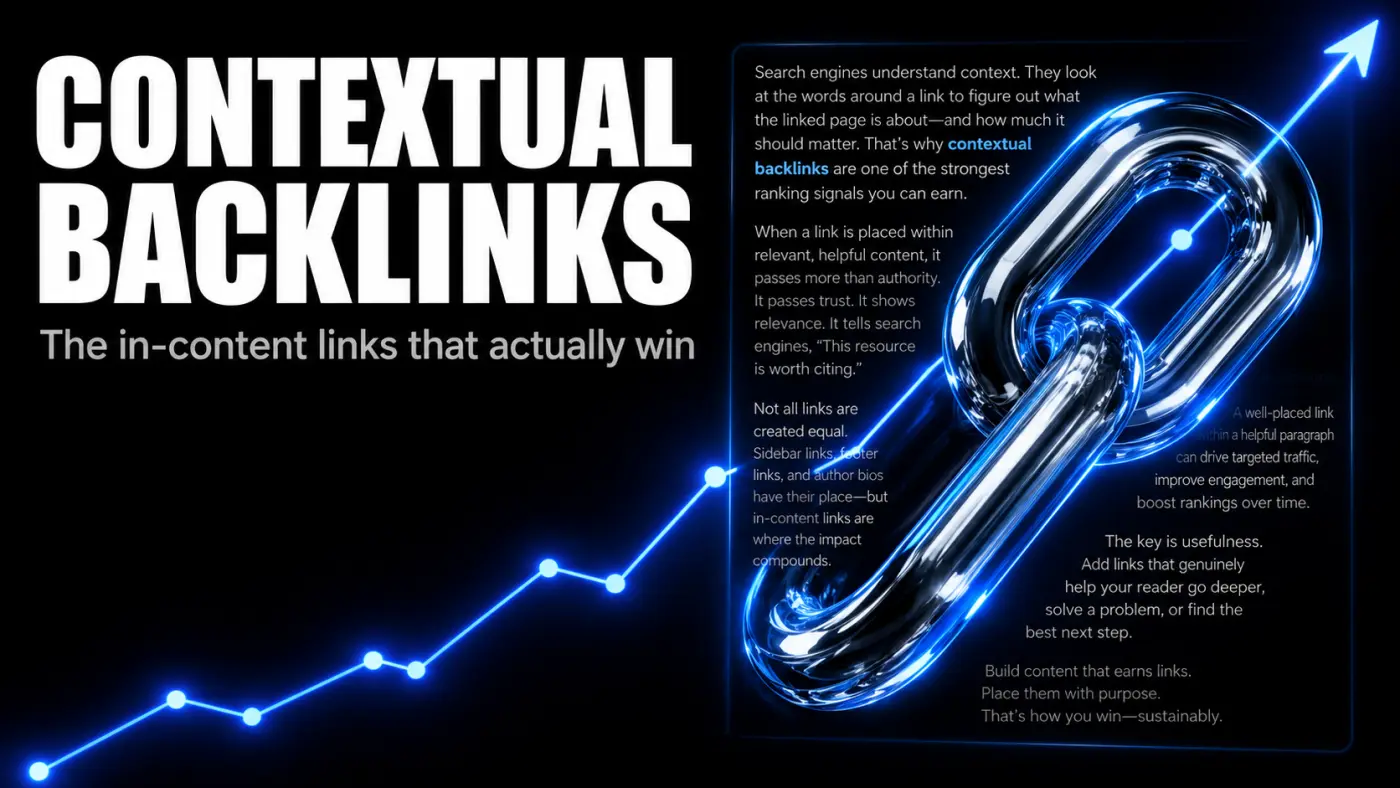
Contextual Backlinks: What They Are, Why They Win, and How To Earn Them
A contextual backlink sits inside the body of an article, surrounded by relevant text, not in a footer or author bio. That placement is what gives it weight. Here is what contextual backlinks are, what makes one high quality, how to earn them, and how to spot the cheap fakes.
- Link Building
 Bart Magera12 min read
What Is White Hat Link Building? Techniques That Work in 2026
The Problem: Why Most Link Building Fails Your SEO You wrote great content. It’s relevant. It’s useful. It even has infographics. But guess what? Crickets. Nobody’s linking. Google’s not ranking. And your “ultimate guide” is buried somewhere on page 7 under a recipe blog and a…
- Link Building
 Bart Magera10 min read
Tiered Link Building: How It Works and How To Do It Safely
Tiered link building layers weaker links behind your strongest ones to pass more authority to your money pages. Here is how the pyramid works, how to build one, which links are worth tiering, the risk SpamBrain introduced, and the lower-risk path I use on client sites.