

What Is Link Equity? How It Works and Why It Matters
Listen to this article
Browser-native voice. No account required.
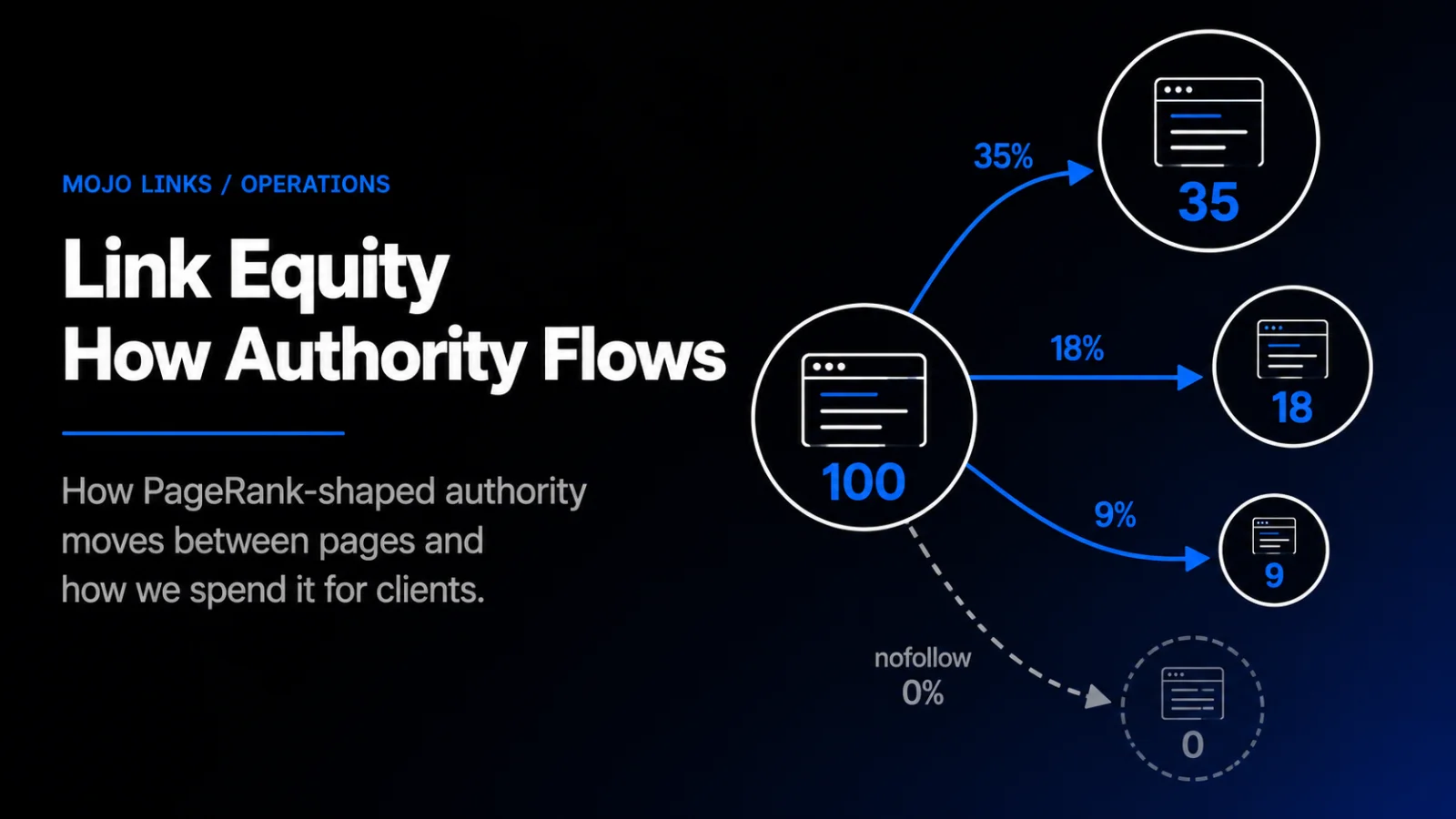
Every page on your site has an authority budget. Every link out of that page spends part of the budget. Every backlink in tops it up. Site owners spend years burning that authority budget on irrelevant outbound links and underpowered internal hubs, then wonder why their money pages will not rank. This guide is the framework for planning and auditing that flow. Deciding which group each page belongs to is the work of SEO siloing.
It is operational, not academic. Skip to the section that fits your situation.
What Is Link Equity?
Link equity is the PageRank-shaped authority that flows from one page to another through a hyperlink. It is also called link juice. Every page accumulates equity from inbound links, then redistributes a share of that equity through every outbound link it contains. The mechanism is the foundation of Google's ranking system since 1998 and remains operational in 2026.
Two implications matter. First, your homepage is rarely your most-equity-rich page. The page with the most external editorial backlinks is. Second, every internal link is a deliberate redistribution decision, whether you treat it as one or not. Choosing where that authority lands on purpose is the discipline of link sculpting. Those links usually come from contextual link building.
How Is Link Equity Different from PageRank?
PageRank is the algorithm. Link equity is what flows through it. PageRank assigns a numerical score to every page on the web based on the citation graph: who links to whom, weighted by the linking page's own score. Link equity is the operational shorthand SEOs use for "the authority a page can pass through its outbound links". The original 1998 PageRank paper by Brin and Page describes the maths. The practical takeaway is that authority is finite per page, distributable through links, and decayed by a damping factor each hop.
How Does Link Equity Flow Between Pages?
A page with accumulated equity distributes a share of that equity through each of its outbound links. The share is not equal across links. Google's 2009 PageRank sculpting update and subsequent refinements introduced position weighting (in-body editorial links carry more than sidebar or footer), topical weighting (links to relevant destinations pass more equity), and decay (each hop loses ~15% to the damping factor).
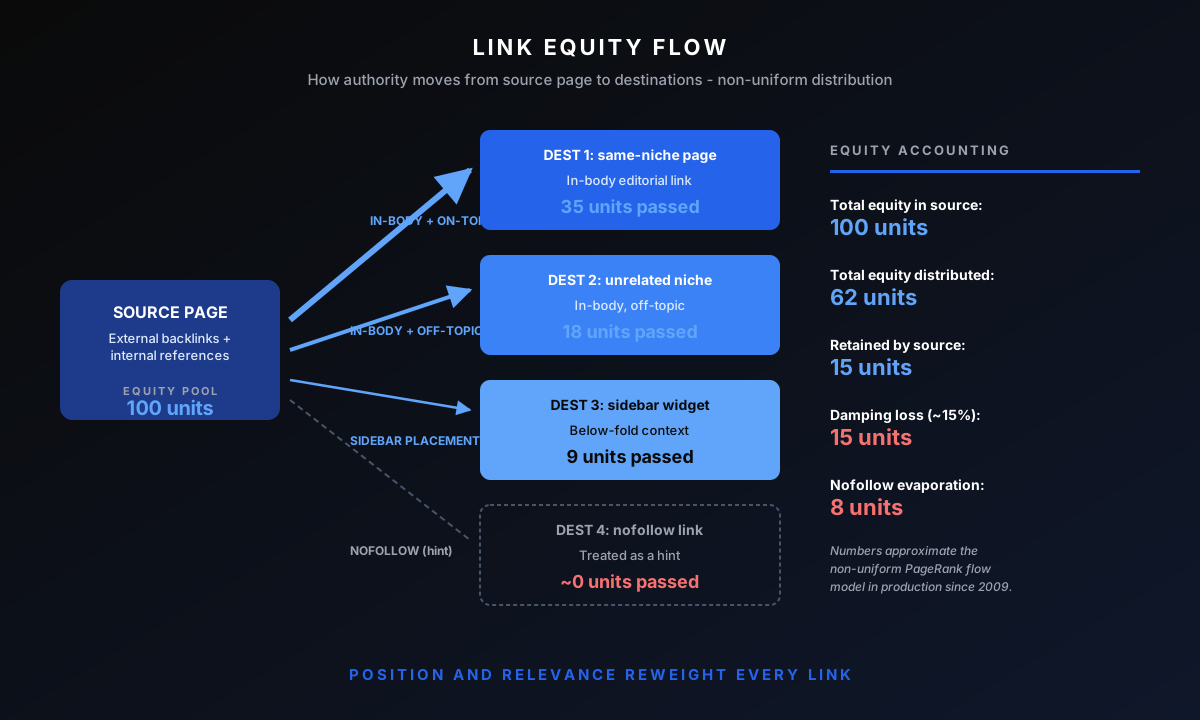
In simple terms: if a page has 100 units of equity and 5 outbound links, each outbound link does not necessarily carry 20 units. A contextual in-body link to a topically-relevant destination might carry 35. A footer link to an unrelated page might carry 5. The remaining sits with the source page.
What Role Does Dofollow Attribution Play?
Only dofollow links pass equity in full. A nofollow link is treated as a hint Google may discount or ignore entirely. Since the 2020 update, the rel attribute is no longer a strict directive. Google can still credit certain nofollow links if context warrants it, but operationally, plan campaigns assuming nofollow passes zero equity unless there is evidence otherwise on a specific source.
How Does Internal Architecture Concentrate Equity?
Hub-and-spoke architecture concentrates equity by design. The hub page (typically a pillar) accumulates equity from inbound external backlinks and internal cross-links. Spokes link upward to the hub, and the hub links downward to each spoke. The result is a structure where every external link to any spoke benefits the hub, and the hub redistributes consolidated equity to the spoke topics that need ranking lift. This is exactly the architecture Mojo Links built around its own operations guide for SEO teams.
What Dilutes Link Equity?
Five factors dilute link equity in measurable ways.
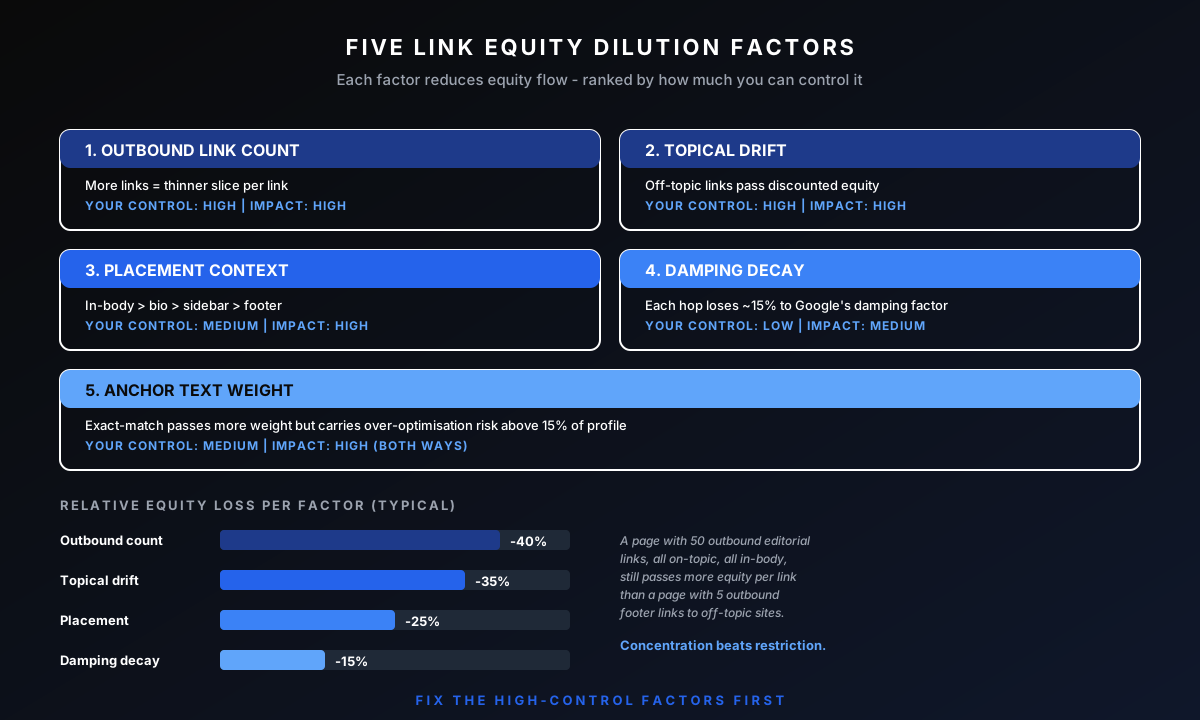
Outbound link count: a page with 50 outbound links splits its equity more thinly than a page with 8. This is why navigation menus, footers, and mega-menus drain equity from money pages if not architected carefully.
Topical drift: a link from a finance article to a fashion page passes less equity than a link from finance to finance. Google's topical reweighting penalises off-topic flow as a spam signal.
Placement context: in-body editorial links pass more than navigation, sidebar, or footer placements. The placement weighting is covered in the pillar's evaluation framework.
Damping decay: each link hop loses roughly 15% to Google's damping factor. By the third hop from a high-equity source, only ~60% of the original equity remains.
Anchor weight: branded and naked-URL anchors pass less weight than exact-match commercial anchors, but they also carry less penalty risk. Balance matters more than maximisation.
How Do You Measure Link Equity on a Page?
Link equity is not a directly-readable number. Google does not publish PageRank scores anymore (the public toolbar PR was retired in 2016). What works instead: proxies that correlate with equity well enough to plan around.
Which Proxy Metrics Actually Work?
Three proxies do most of the work. Ahrefs URL Rating (UR) scores individual pages 0-100 based on a backlink-graph traversal. Moz Page Authority (PA) is similar. Majestic Trust Flow and Citation Flow together model trust-weighted authority. None of the three matches Google's internal PageRank, but UR has the strongest correlation with ranking behaviour across Mojo Links campaigns. Use UR as the primary page-level proxy and DR as a domain-level sanity check.
How Do You Compare Equity Between Pages?
To compare two pages on the same site, pull UR for each, count their referring domains via Ahrefs Site Explorer, and check their position depth in the site's internal link graph. A page with UR 35 and 14 referring domains has more equity than a page with UR 22 and 4 referring domains, even if the URs look close. The manual backlink checking workflow walks through the verification step in detail.
How Do You Control Link Equity Flow Inside Your Site?
Three operational levers control internal equity distribution: link selection, link position, and the optional use of nofollow attribution.
Link Selection: Which Pages Link To Which
Map your money pages. List every page on your site that links to each of them. Cut links from low-relevance pages that drain equity without contributing topical signal. Add links from high-equity hubs (pillars, top-traffic guides, the homepage when appropriate). This is sometimes called "internal link consolidation" and it is the single most cost-effective intervention available on existing sites.
Link Position: Above or Below The Fold
Above-the-fold in-body editorial links pass more equity than below-fold or sidebar placements. Where the link sits on the page matters as much as whether the link exists. A QA pass on every placement (phase 5 of the workflow) verifies above-fold positioning for high-priority anchor targets.
Nofollow Attribution: Rarely The Right Tool
The 2009 PageRank sculpting era treated internal nofollow as a way to redirect equity flow. Google patched that behaviour: nofollow now causes the equity to evaporate rather than redistribute to remaining links. Use internal nofollow only for user-generated comment areas and certain legal-required disclosure links. Sculpting via internal nofollow no longer works.
How Do External Backlinks Distribute Link Equity To Your Site?
Every external backlink lands on a specific page and accumulates equity there. That equity then flows through internal links to other pages. The implication: the choice of which page receives external links is a leveraged decision. Pointing 30 placements at a money page that has zero internal outbound links concentrates equity there. Pointing them at a hub page distributes equity across the hub's downstream spokes.
Choose target pages during the prospecting phase based on the priority queue. Detail on the prospecting decision sits in the link prospecting workflow.
What Does Mojo Links Do To Manage Link Equity?
We run a three-step audit on every new engagement. First, internal architecture: we map the site's hub-and-spoke structure, identify drains (excessive navigation, footer links to off-site partners, orphaned pages), and produce a remediation list. Second, external profile: we pull every referring domain, score by quality and relevance, and identify the pages that already accumulate the most equity. Third, prospecting target list: we align planned acquisition with the pages where equity will compound the fastest.
The audit phase is documented in detail in our backlink audit guide. The downstream cleanup phase, when the audit reveals equity-draining toxic links, is covered in our backlink cleanup workflow.
Frequently Asked Questions About Link Equity
Does Google Still Use PageRank in 2026?
Yes. The public PageRank toolbar score was retired in 2016, but the underlying algorithm and the equity-flow graph it produces remain operational in Google's ranking system. The 2024 Google API leak confirmed signal names tied directly to PageRank-style flow.
Can You Transfer Link Equity from One URL To Another?
Partially, via 301 redirects. A 301 redirect from URL A to URL B passes most of A's accumulated equity to B, with a small damping loss. The mechanism is reliable for consolidating duplicate content, replacing retired URLs, and migrating to new domains. Equity is not perfectly preserved (~85-95% transfers in practice based on Mojo Links migration audits).
Does Internal Linking Really Change Rankings?
Yes. Pages with more internal links from high-equity sources rank better, all else equal. The effect is smaller than external backlinks per link, but internal linking is free, controllable, and scales. Mojo Links campaigns see 15-30% ranking lift on previously orphaned pages within 6-12 weeks of internal link consolidation alone, without any new external acquisition.
How Do You Tell If Your Money Pages Have Enough Link Equity?
Pull UR for each money page. Compare to the UR of pages currently ranking in the top 5 for your target keyword. If your page is more than 10 UR points below the median ranking page, equity is likely the binding constraint. Below 5 points and other factors usually matter more.
What Is The Difference Between Link Equity and Topical Authority?
Link equity is graph-level authority that flows through citations. Topical authority is the semantic strength of a site within a defined topic. The two compound: high topical authority sites pass more relevant equity through their links, and equity flowing into pages that already have strong topical signals produces larger ranking lifts than equity flowing into off-topic pages. The methodology canonical for topical authority lives at bartmagera.com.
Want Us To Audit Your Link Equity?
We audit client link equity as part of the standard onboarding for every managed campaign. The audit includes internal architecture mapping, external profile scoring, and a prospecting target list aligned to where equity will compound fastest. Book a slot to discuss your site.

About Bart Magera
Bart Magera is the founder of Mojo Links. Ten years across YMYL verticals (legal, medical, finance, supplements, crypto, gambling). Trained under Koray Tuğberk Gübür's Topical Authority framework. Author of two SEO books and international speaker.
Want this kind of analysis on your site?
Get a free video walkthrough within 48 hours covering technical health, backlinks, content gaps, and AI visibility.
Related posts
Keep reading on adjacent topics.
- Link Building
 Bart Magera10 min read
Contextual Backlinks: What They Are, Why They Win, and How To Earn Them
A contextual backlink sits inside the body of an article, surrounded by relevant text, not in a footer or author bio. That placement is what gives it weight. Here is what contextual backlinks are, what makes one high quality, how to earn them, and how to spot the cheap fakes.
- Link Building
 Bart Magera12 min read
What Is White Hat Link Building? Techniques That Work in 2026
The Problem: Why Most Link Building Fails Your SEO You wrote great content. It’s relevant. It’s useful. It even has infographics. But guess what? Crickets. Nobody’s linking. Google’s not ranking. And your “ultimate guide” is buried somewhere on page 7 under a recipe blog and a…
- Link Building
 Bart Magera10 min read
Tiered Link Building: How It Works and How To Do It Safely
Tiered link building layers weaker links behind your strongest ones to pass more authority to your money pages. Here is how the pyramid works, how to build one, which links are worth tiering, the risk SpamBrain introduced, and the lower-risk path I use on client sites.