

Backlink Cleanup: The Full Workflow for Removing Bad Links Without Wrecking Rankings

Listen to this article
Browser-native voice. No account required.
Backlink cleanup is the recovery workflow you run when your link profile is hurting your rankings. The process covers identification, removal requests, disavow submission, and prevention. It is not the same as a backlink audit (which only identifies bad links) or a disavow submission (which is the final action). This guide covers the full workflow used on sites in regulated and competitive niches.
What Is Backlink Cleanup?
Backlink cleanup is the end-to-end process of removing bad backlinks from a site's ranking equation. The workflow identifies toxic placements through a backlink audit, attempts removal through publisher outreach, disavows links that cannot be removed, and establishes monitoring to prevent recurrence. Cleanup is the recovery action sites take when algorithmic devaluation or a manual action signals link-profile risk.
Backlink cleanup differs from a backlink audit (which identifies but does not act) and from the disavow procedure (which is one specific action inside the broader cleanup workflow).
What's The Difference Between a Backlink Audit, Cleanup, and Disavow?
A backlink audit identifies toxic links. Backlink cleanup acts on what the audit finds. Disavow is the technical Google Search Console action you take for links that cannot be removed through outreach. Audit answers "which links are hurting me." Cleanup answers "how do we fix this." Disavow answers "what exact file do I submit to Google."
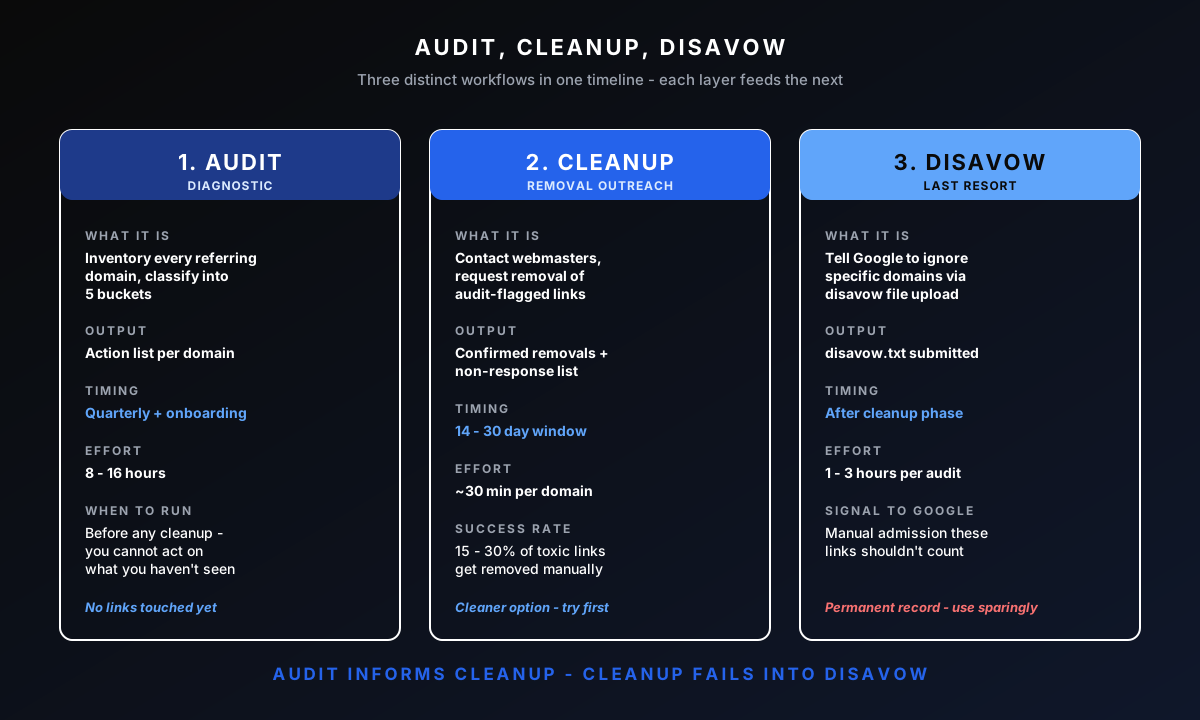
The disavow file is a hint to Google to ignore specific URLs or domains. It applies at the next recrawl cycle and does not remove the links - it tells Google not to count them.
Each action is a separate deliverable with separate timing and separate ownership:
Backlink audit: diagnostic. Output is a list of toxic links with severity scoring. See the full audit guide for the procedure.
Backlink cleanup: the workflow this page covers. Audit + outreach + disavow + monitoring.
Disavow procedure: the technical Search Console action. See the disavow guide for file format and upload steps.
What Are Toxic Backlinks?
Toxic backlinks are inbound links from spam, low-trust, irrelevant, or manipulative source domains that signal manipulation to Google. The algorithm devalues them by default. Patterns that earn the toxic label include domain rating under 10 with zero organic traffic, anchor text in unrelated languages, sitewide footer placements, and footprints from private blog networks (PBNs) or expired-domain link schemes.
When Google's December 2022 link spam update shipped, it used machine learning to neutralize unnatural links across the web rather than penalize each receiving site by hand. The cleanup workflow below targets the same patterns Google's spam systems are built to discount.
Six signals that identify a toxic backlink:
Source domain has DR under 10 and zero organic traffic. Real sites generate traffic. Link farms do not.
Anchor text in a language unrelated to the source or target site. A Polish casino site linking to a US legal page with Chinese anchor text is not a real recommendation.
Sitewide footer or sidebar placement. Editorial links sit inside body content. Footer placements signal a paid or networked relationship.
PBN footprints. Whois privacy, expired-domain history, shared hosting IPs, and identical CMS themes across linking sites.
Money-keyword anchor text in volume. "Best payday loan 2026" as anchor text is a red flag pattern.
Source page is unindexed or noindex. Google does not credit links from pages it does not index.
Not every low-DR link is toxic. Niche directories, local citations, and forum links can be legitimate. The judgment call sits on the audit, not the cleanup.
How Do You Identify Bad Backlinks?
Bad backlinks are identified through three layers: tool data (Ahrefs, Search Console, Majestic), pattern analysis (anchor distribution, source domain quality, link velocity), and manual review of the highest-risk sources. Single-metric filtering misses context, and pattern-only analysis misses individual outliers. The full audit procedure combines all three.
Ahrefs vs Search Console for Identification
Ahrefs gives you the most complete external view of a backlink profile and supports filtering by referring domain DR, traffic, and link velocity. Search Console gives you the links Google itself acknowledges, including some Ahrefs cannot see. Use both. Ahrefs surfaces external link patterns; Search Console confirms what Google attributes to the site.
When To Bridge To a Full Backlink Audit
If the link profile has more than 500 referring domains, or if the site has experienced a manual action, run the full audit procedure documented in the step-by-step workflow. The cleanup workflow assumes the audit has been completed; this section covers the identification basics, not the full diagnostic.
Should You Remove or Disavow a Bad Backlink?
Always attempt removal before disavowing. Removal eliminates the link from Google's index entirely and reaches every search engine, while disavow only signals Google to ignore it. The decision rule: outreach first, disavow second, and disavow alone only when removal is impossible (publisher unreachable, demands payment, or hostile).
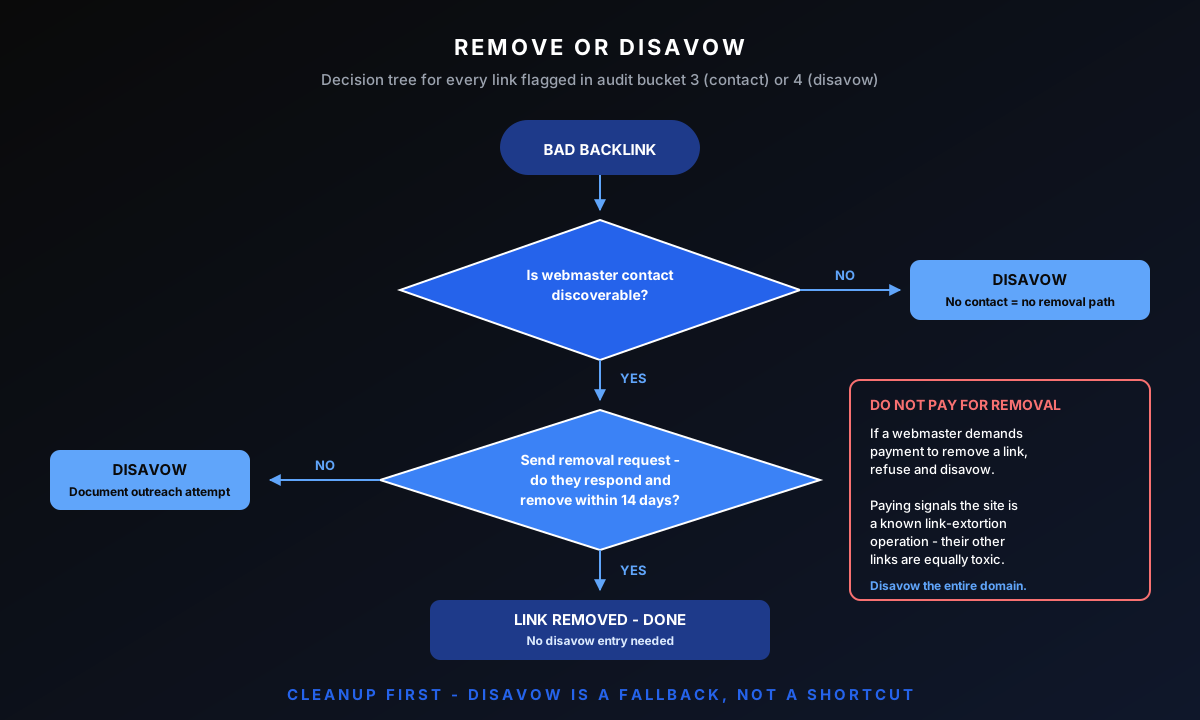
Decision matrix:
Publisher reachable and responsive: request removal. Always.
Publisher reachable but demands payment to remove: refuse, disavow.
Publisher unreachable (no contact, dead domain, anonymous network): disavow directly.
Negative SEO attack pattern (sudden volume from spam domains): disavow at scale, skip outreach.
Single legitimate-looking link from low-trust source: often safe to leave alone. Disavow only the patterns, not the outliers.
How Do You Request a Backlink Removal?
Backlink removal requests are sent to the webmaster contact or domain owner with a specific URL list and a clear request. Response rates run 5 to 15% across Mojo Links campaigns. The follow-up cadence is one initial email, one follow-up after 7 days, and a final notice at 14 days. Pages that ignore three rounds move to the disavow file. The free disavow tool turns that list into an upload-ready file.
Template structure that performs:
Subject line: "Backlink removal request - [your domain]"
Opening line: name the specific URL hosting the link, not a generic reference
Request: "Please remove the link from [source URL] pointing to [destination URL]"
Reason (optional): "We are conducting a backlink audit and identified this placement as not aligned with our current link policy"
No threats, no SEO jargon, no Google penalty language. Webmasters ignore those.
When Should You Disavow Instead of Removing?
Disavow instead of removing when the publisher cannot be reached, refuses to remove without payment, or when the link volume from a single hostile source makes outreach impractical. Disavow is also the only viable response to negative SEO attacks. The disavow file does not remove the link from the web; it signals Google to discount it from ranking calculations.
For the technical procedure (file format, Search Console upload, common mistakes), see how to disavow backlinks safely in Google. This page covers the decision; that page covers the action.
How Do You Prevent Bad Backlinks from Coming Back?
Bad backlink prevention runs on three layers: quarterly monitoring to catch new toxic placements within 90 days, an active disavow file maintained as new threats appear, and link-vetting discipline that filters acquisitions before they hit the live profile. Prevention costs less than cleanup and avoids the ranking drag of accumulated toxic links.
Quarterly Link Monitoring
Run a complete referring-domain export every 90 days. Compare against the previous quarter. New domains that match toxic patterns (PBN footprints, sudden volume, irrelevant anchor text) get added to the disavow file before they accumulate ranking impact. Monitoring is cheap. Reactive cleanup after a six-month drift is not.
Disavow File Maintenance
The disavow file is not a one-time submission. Add new toxic domains as monitoring surfaces them, and re-upload the updated file to Search Console quarterly. A stale disavow file from two years ago leaves new threats unaddressed. Keep the file in version control or shared documentation so multiple team members can update it.
The Link-Vetting Rule To Apply To Every New Link
Every paid placement, guest post target, or PR pickup gets vetted against three criteria before acquisition: source domain has real organic traffic (Ahrefs traffic value above $500/month), source is topically relevant to the site's niche, and the anchor text matches a planned distribution. Sites that fail two of three criteria do not get acquired, regardless of DR. This stops bad links at the source.
How Long Does Backlink Cleanup Take To Recover Rankings?
Backlink cleanup recovery runs 4 to 6 weeks for algorithmic devaluation and 3 to 6 months after a manual action. Algorithmic recovery begins as soon as Google reprocesses the disavow file (24 to 72 hours for ingestion). Manual action recovery requires a reconsideration request and Google reviewer approval, which adds 4 to 8 weeks on top of the algorithmic timeline.
Cases where recovery does not happen:
The ranking drop was not caused by links. Disavowing legitimate links can suppress rankings further.
The toxic link pattern is the symptom, not the cause. A site with poor content quality and a clean link profile will still underperform.
The site has already been algorithmically suppressed past the point of recovery (rare; usually only on heavily-penalized historical domains).
Frequently Asked Questions About Backlink Cleanup
What Are Backlinks and Why Do They Need To Be Cleaned Up?
Backlinks are inbound hyperlinks from external domains. They need cleanup when the link profile includes toxic placements (spam, manipulation, irrelevance) that signal ranking risk to Google. Most sites accumulate some toxic links over time through scrapers, expired domains, or competitor negative SEO. Cleanup keeps the profile healthy.
How Do I Know If I Have Bad Backlinks?
Indicators include sudden ranking drops without algorithm updates, manual action notifications in Search Console, sudden growth in referring domains from low-quality sources, and anchor text distribution skewed toward exact-match commercial terms. A backlink audit confirms the diagnosis. A free anchor text checker quantifies how skewed the distribution has become before you audit.
Do I Need To Disavow Every Bad Link?
No. Disavow patterns, not outliers. A single low-DR forum link is not worth disavowing. A volume pattern from a PBN network is. Over-disavowing legitimate-but-low-trust links can hurt rankings more than the original links would have.
Will Disavowing Links Instantly Improve Rankings?
No. Disavow processing takes 24 to 72 hours for Google ingestion, then 4 to 6 weeks for algorithmic re-evaluation. If the ranking drop was caused by links, recovery begins after the re-evaluation cycle. If the drop had another cause, disavowing changes nothing.
How Often Should I Clean Up My Backlinks?
A full cleanup workflow runs after diagnosis (manual action, ranking drop, suspect link velocity). Ongoing prevention runs quarterly through monitoring and disavow file maintenance. Sites in YMYL verticals (legal, medical, finance, gambling, supplements) need tighter cadence than non-YMYL sites.
Can Bad Backlinks Trigger a Google Penalty?
Manual actions are rare in 2026 - Google has shifted toward algorithmic devaluation, which suppresses without notifying. Manual actions still happen on egregious patterns (paid links at scale, redirect manipulation, foreign-language anchor schemes), but the more common impact today is silent ranking suppression.
Cleanup is the prerequisite to scaling new acquisition. For the end-to-end program this fits into, see Mojo Links link building methodology.
Want Us To Run The Cleanup for You?
A Mojo Links backlink cleanup engagement covers the full workflow: audit, outreach campaign, disavow file build, and 90-day monitoring. We work across regulated verticals (legal, medical, finance, supplements, gambling, crypto). For a free 20-minute audit covering link risk, content gaps, and AI visibility, request a free SEO growth audit. Senior strategist on the call. No junior PMs.

About Bart Magera
Bart Magera is the founder of Mojo Links. Ten years across YMYL verticals (legal, medical, finance, supplements, crypto, gambling). Trained under Koray Tuğberk Gübür's Topical Authority framework. Author of two SEO books and international speaker.
Want this kind of analysis on your site?
Get a free video walkthrough within 48 hours covering technical health, backlinks, content gaps, and AI visibility.
Related posts
Keep reading on adjacent topics.
- Link Building
 Bart Magera10 min read
Contextual Backlinks: What They Are, Why They Win, and How To Earn Them
A contextual backlink sits inside the body of an article, surrounded by relevant text, not in a footer or author bio. That placement is what gives it weight. Here is what contextual backlinks are, what makes one high quality, how to earn them, and how to spot the cheap fakes.
- Link Building
 Bart Magera12 min read
What Is White Hat Link Building? Techniques That Work in 2026
The Problem: Why Most Link Building Fails Your SEO You wrote great content. It’s relevant. It’s useful. It even has infographics. But guess what? Crickets. Nobody’s linking. Google’s not ranking. And your “ultimate guide” is buried somewhere on page 7 under a recipe blog and a…
- Link Building
 Bart Magera10 min read
Tiered Link Building: How It Works and How To Do It Safely
Tiered link building layers weaker links behind your strongest ones to pass more authority to your money pages. Here is how the pyramid works, how to build one, which links are worth tiering, the risk SpamBrain introduced, and the lower-risk path I use on client sites.