

Finance SEO: The Complete Guide for Financial Brands
Listen to this article
Browser-native voice. No account required.
Every finance search you do not rank for is a customer trusting a competitor with their money. Not because that firm is safer. Because Google decided its page was more credible than yours.
Finance SEO is how a brand earns that credibility and the rankings that compound on top of it. This guide covers the ranking factors, a step-by-step strategy, and what a real campaign produced. The trust bar here is the highest in commercial search, shared only with medical search.
What Is Finance SEO?
Finance SEO is the practice of optimizing a financial brand's website to rank in Google search and AI answer engines for the terms its customers search. It covers fintech, banks, lenders, insurers, advisors, and trading platforms, and it leans harder on trust and expertise than any vertical except healthcare.
It is not a one-time fix. A finance SEO program builds topical authority and credibility over months, then defends the rankings once they hold. The mechanics are familiar. The bar for proving expertise and accuracy is not.
Think of it less as a checklist and more as institutional trust rendered in search. Google does not rank a lender because it optimized a meta description. It ranks the brand it has come to treat as a credible authority on the money question being asked, and finance SEO is the work of becoming that brand.
It serves the full spread of the industry, from a two-person advisory practice to a national lender, and the gap between them is scale and compliance load, not method. The smaller brand wins by out-specializing on the terms the giants ignore; the larger one wins by covering the category with depth no challenger can match quickly.
Why Finance SEO Is Different
Finance is the purest commercial "your money or your life" category, regulated, and ferociously competitive. Three forces make it its own discipline.
YMYL and E-E-A-T come first. Google holds financial results to its strictest expertise and accuracy standards, because bad financial information costs people real money. Across Ruler Analytics' conversion-rate benchmark of fourteen industries, professional and financial services post some of the highest organic conversion rates of any sector, which is exactly why the competition for those rankings is brutal.
Regulation comes second. FINRA, SEC, and consumer-finance rules govern what a financial page can claim, how returns and products are presented, and what disclosures must appear. SEO that ignores compliance trades a ranking problem for a regulatory one.
That constraint shapes the content from the first draft. A page promising returns without the required disclaimer, or implying advice a brand is not licensed to give, is a liability no ranking justifies. The compliance review has to sit inside the content process, not bolt on after legal sees it live.
Trust comes third, and it compounds against you while you wait. The brand ranking above you is banking authority, links, and reviews every month, in a category where new trust is slow to build. The gap widens the longer you debate the budget.
Competition is the fourth force, and it is funded. Financial keywords carry some of the highest commercial value in all of search, so you are competing against banks, fintechs, and comparison sites with deep budgets and full content teams. Winning means out-specializing them on the terms they treat as an afterthought, not out-spending them head-on.
The economics still favor organic once it lands. A ranked page carries no per-click cost, and in a category where a single paid click can run double digits, the brand that owns the organic result quietly undercuts every competitor still renting the top of the page.
Customers also judge a financial brand in seconds. They scan the result, the brand they recognize, the rating, and whether the site looks legitimate, then decide who to trust with their money before a word of the page is read. A thin or sketchy listing loses that judgment instantly, and the ranking with it.
Finance SEO Ranking Factors
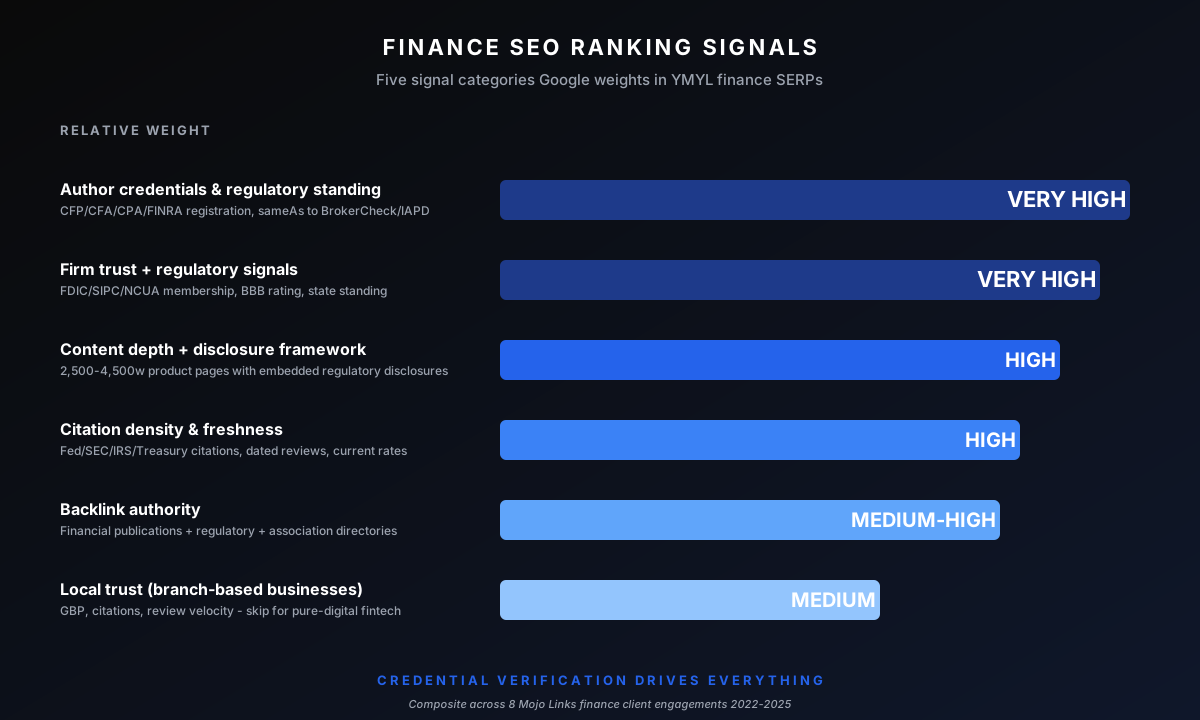
The factors that move financial rankings cluster into five areas, weighted toward trust more heavily than almost any other vertical.
E-E-A-T and Author Authority
Finance is an expertise-gated category. Google wants named, credentialed authors behind financial content, with verifiable qualifications. Attach advisors, analysts, or licensed professionals to the content they write, link bios to credentials, and add reviewer bylines on anything that touches advice.
The payoff is durability. Authority built on genuine financial expertise survives the algorithm updates that wipe out thin advice-content sites and bought links. It is the slowest signal to build and the hardest for a competitor to copy, which is precisely why it holds when rankings shuffle.
Building it is concrete work, not a trust badge. Put the author's name, role, and credentials on the page, link to a real bio and professional registrations, show a reviewer and a review date on advice content, and keep the brand's regulatory details consistent everywhere a machine reads them.
Content and Topical Authority
Content has to cover the topic comprehensively, not just target a keyword. A lender that wants to rank for "personal loans" needs the full cluster: rates, eligibility, comparisons, repayment, and the questions customers ask before applying. Thin, single-page coverage does not earn authority in finance.
Interactive content carries extra weight here. Calculators, comparison tables, and rate tools answer the question better than prose can, earn links naturally, and keep users on the page, all signals Google reads as quality in a category built on numbers.
This is where a topical map earns its keep, mapping every product, question, and comparison into one architecture before a word gets written.
The cluster also has to match how customers actually move. They research the concept, compare options, check eligibility, then apply, and each stage is a different page with a different job. A site that only builds the apply-now page wins none of the searches that happen before the decision.
Backlinks and Citations
Backlinks remain one of the strongest off-page signals, and they are scarce. Ahrefs research across millions of pages found most pages have no referring domains at all, which is why the financial brands that earn them pull ahead in a niche this competitive.
For finance, the links that count come from a short list of real sources.
Financial publications. Editorial coverage in outlets customers and Google already trust.
Regulatory and industry bodies. Membership and listing pages with genuine authority.
Comparison and data sites. Placements where customers research before they choose.
Digital PR and expert commentary. Analyst quotes in mainstream and trade press, earned not bought.
A single placement in a respected financial outlet outweighs fifty generic citations, and it doubles as a trust signal to the customer reading the SERP.
Technical SEO and Schema
Technical SEO makes the rest legible to search engines. Crawlability, speed, mobile rendering, and structured data decide whether content gets indexed and understood. A full-stack site analysis surfaces the orphan pages, redirect chains, and missing markup that quietly cap a financial site.
Security is a ranking factor here in a way it is not elsewhere. Financial sites handle sensitive data, so HTTPS, clean security headers, and a site that visibly protects user information feed both Google's quality read and the customer's willingness to convert. A site that looks insecure loses on both counts.
Keyword and Intent Mapping
Finance keyword research separates research intent from product intent. "How does refinancing work" is education. "Best refinance rates" is a customer close to converting. A real keyword map assigns every term to a page and a funnel stage, so nothing cannibalizes and nothing gets missed.
Educational terms also feed the AI answers and earn the links product pages cannot win on their own. The two layers work together: education builds the authority that lets the high-intent product pages rank, which is the opposite of the keyword-stuffed product page most financial sites lead with.
Money terms reward depth and proof, near-me terms localize automatically for branch-based brands, and question terms feed the top of the funnel. Map each to its own page and stage, because a single page trying to serve all three serves none of them well.
Finance SEO by Sub-Vertical
The strategy shifts with the sub-vertical, because the trust burden and search intent differ across financial services.
Fintech and lending. Conversion-driven and comparison-heavy. Won on product clusters, calculators, and rate transparency.
Banks and credit unions. Local plus national, where branch-level local SEO matters alongside brand authority.
Investment and trading platforms. The heaviest E-E-A-T and disclosure burden, where credentialed authorship is non-negotiable.
Advisors and insurance. Trust-led and often local, won on reviews, named experts, and education.
The adjacency to other regulated niches is close. A crypto project positioned as an investment inherits this same bar, which is why crypto SEO and finance SEO increasingly converge.
The same convergence pulls in iGaming, a regulated money vertical where gambling SEO carries an even heavier licensing and ad-restriction load.
Read the sub-vertical before setting the plan. A fintech lender lives and dies on product clusters and calculators, while an advisory practice wins on named experts and local trust. Pointing a lender's playbook at an advisor, or the reverse, wastes the budget that should have funded the work that actually moves their terms.
How To Do Finance SEO: a Step-by-Step Strategy
The work sequences in a deliberate order, because each step earns the next. Skipping ahead is the most common reason financial SEO stalls.
Audit and baseline. Technical, content, and backlink audits, plus a locked baseline of the KPIs you will measure against.
Fix the foundation. Schema, site speed, crawl issues, and any compliance gaps before a word of new content ships.
Build topical authority. Comprehensive product and education clusters, authored by credentialed experts.
Earn authoritative links. Editorial placements in financial publications and industry bodies, never bulk directories.
Tune for conversion. Calculators, comparison tables, and clear next steps that turn rankings into applications.
Measure and defend. Monthly reporting against the baseline, plus monitoring that catches toxic-link drift.
The order is not negotiable. Earning links before the foundation is fixed wastes authority on pages that cannot convert it, and publishing at scale before the architecture is locked means rebuilding later. Each step compounds the last, which is why the brands that skip straight to "make content" plateau within a quarter.
What Finance SEO Looks Like in Practice
Mojo Links ran the link-building program for debexpert.com, a finance platform, from January 2023 to January 2024. The site had content and product in hand. What it lacked was the authority to rank against entrenched competitors, which is where the link campaign came in.
Organic traffic grew 461% over the engagement, from roughly 1,500 to 8,415 visits a month. The gain came from relevant, editorial placements compounding against a site that already had its house in order, not from volume. The full campaign breakdown lives in the finance link building case study.
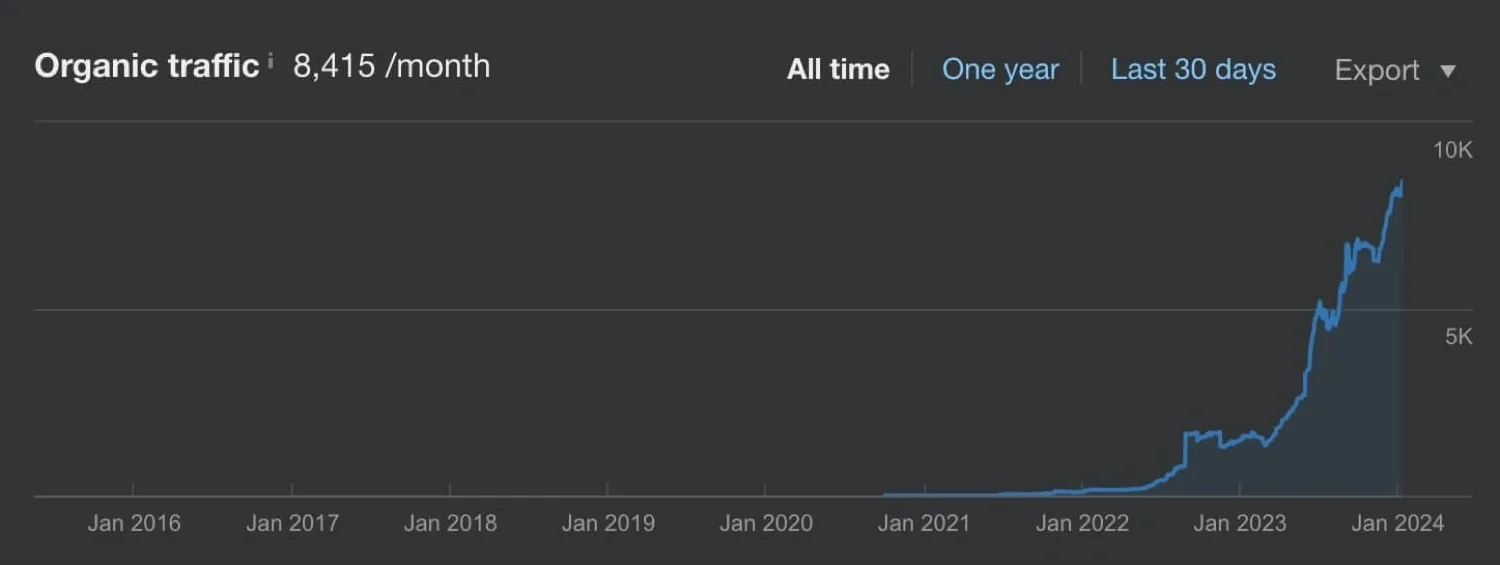
debexpert.com organic traffic, Ahrefs. The 461% climb tracks an editorial link campaign compounding against a site with its technical and content foundation already in place.
The lesson that transfers is sequencing. Debexpert grew because the links landed on a site that already deserved to rank. Pointing authority at thin or broken pages wastes it. Fix the foundation, then earn the links, and the same budget produces a multiple of the result.
How Long Finance SEO Takes
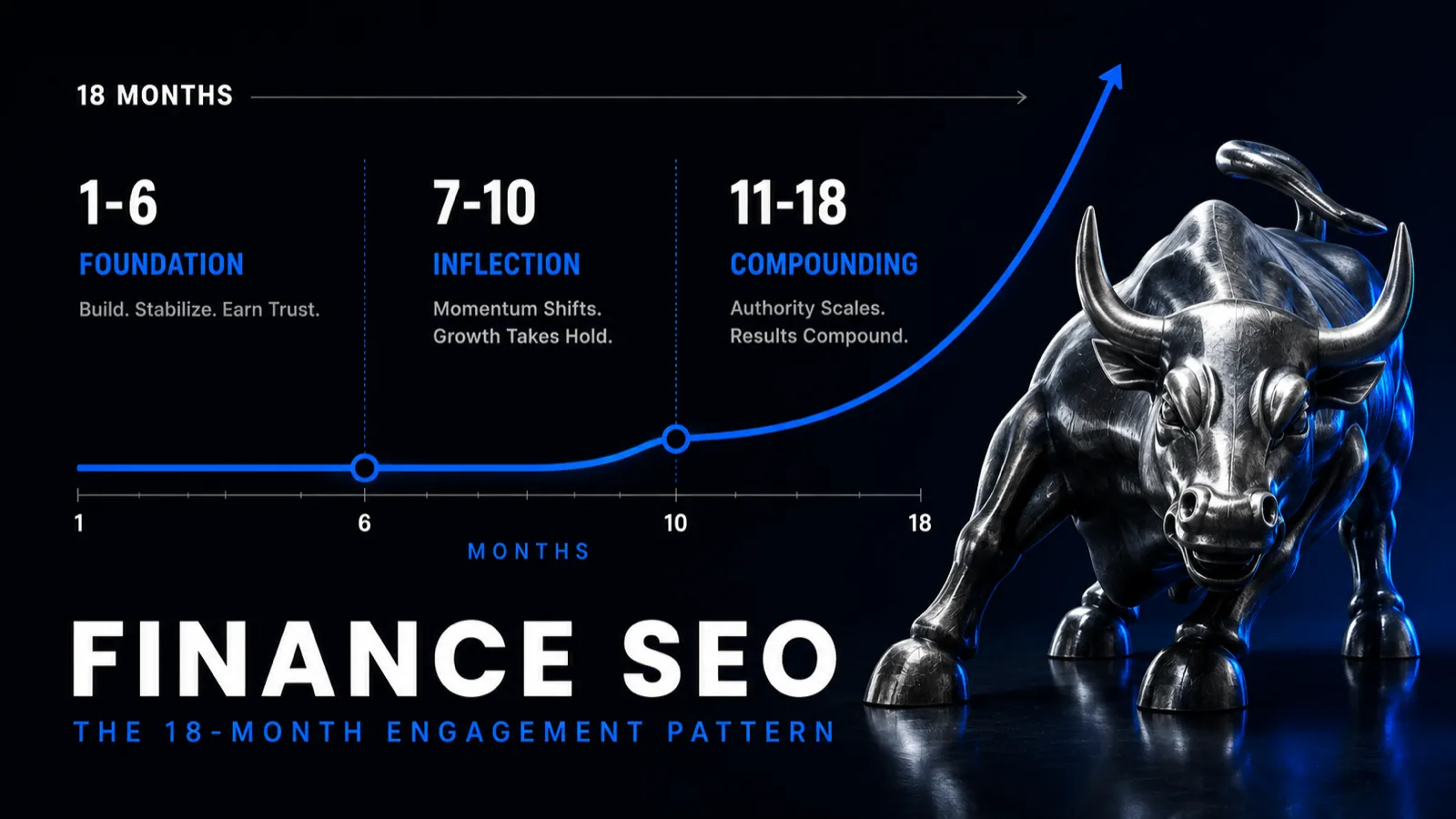
Finance SEO is a long game measured in quarters. Educational and long-tail terms can move within a few months. Competitive product terms take the better part of a year of consistent content, authority-building, and links before they hold, because Google extends less benefit of the doubt to financial sites than to most categories.
The lag is the hardest part to sit through. For the first months the work looks like spending with no return: audits, fixes, content and authority that have not paid off yet. Then the domain crosses a trust threshold and the same pages that sat flat start compounding. Brands that quit early never see the curve they paid to build.
Finance SEO and AI Search
AI answer engines now field a growing share of financial research, and they cite the brands they can verify. Google's AI Overviews, ChatGPT, and Perplexity lean on the same signals finance SEO builds: clear answers, named expertise, structured data, and credible citations.
Finance carries an extra duty here. AI engines paraphrase financial guidance to users making money decisions, so accuracy and proper disclosure are not optional. The brands an engine is willing to cite are the ones whose content a credentialed expert clearly stands behind.
This is increasingly where the research starts. A customer asks an assistant which lender or platform to consider before they ever run a search, and the model answers from what it can verify. A brand absent from those answers is invisible at the moment of choice, and no paid placement reaches into an AI recommendation.
Common Finance SEO Mistakes
Most financial sites are not failing for exotic reasons. They are making the same handful of mistakes, and each one is fixable.
Anonymous or ghostwritten content. In an expertise-gated category, no named author means no authority.
Thin product pages. A single page for "personal loans" cannot beat competitors who built the full cluster.
Ignoring compliance in the content. Claims without disclosures invite both a ranking problem and a regulatory one.
Buying bulk links. A polluted profile gets a financial domain demoted fast.
Reporting on traffic, not applications. Traffic is easy to inflate; conversions are what the business needs.
Chasing head terms first. Fighting "personal loans" before owning the long tail burns budget with nothing to show.
Fix these and most brands climb before a single new product launches. The foundation was working against them the whole time.
How To Choose a Finance SEO Partner
Choose on transparency, compliance fluency, and proof, not on guarantees. Anyone who guarantees a number-one ranking is lying to you, because no one controls Google's algorithm.
Ask who does the work, how they build author authority, where their links come from, and whether they understand the disclosure rules in your sub-vertical. Watch for the named-operator dodge, thousand-link packages, and reporting that hides behind jargon.
Compliance fluency is the differentiator most agencies fake. A partner who has worked in regulated finance knows what a page can and cannot claim before legal flags it, which keeps the program moving instead of stalling in review. One who learns your disclosure rules on your dime is a slower, riskier hire.
Ask to see a sample monthly report from a current client, names redacted. A real report ties spend to applications and ranking movement by product line. If you would rather pressure-test your current standing first, a free SEO audit shows you where your rankings, links, and content gaps sit before you commit a budget.
Capacity is the quiet tell. The agencies that churn financial clients run thin, templated work across dozens of accounts. The ones worth hiring take fewer, because compliant content and earned links in regulated finance cannot be mass-produced without either stalling in review or tripping the spam filters that demote financial domains.
Frequently Asked Questions
How Long Does Finance SEO Take To Work?
Long-tail and educational terms can move within a few months. Competitive product terms generally take most of a year of consistent content, authority-building, and links, because Google extends less benefit of the doubt to financial sites than to most categories.
Why Does E-E-a-T Matter so Much in Finance?
Because finance is a YMYL category where bad information costs people money. Google responds by demanding visible expertise, named credentialed authors, accurate content, and credible citations before it ranks a financial page competitively.
Can a Financial Site Get Penalized for SEO?
Yes. Bulk or spammy links demote a financial domain quickly, and content that violates disclosure rules creates regulatory exposure on top of the ranking risk. Editorial links and compliant content are the safe path.
Is Finance SEO Worth It Versus Paid Search?
For most brands, yes. Financial keywords carry some of the highest paid costs in search, so organic rankings that convert at a high rate compound into a far lower cost per acquisition over time. Paid is the short game; SEO is the durable one.
Does Finance SEO Work for a Small Advisory or Local Firm?
Yes, often better than for the giants. A focused firm can own the local and specialized terms national brands treat as an afterthought, where named-expert trust and reviews carry more weight than raw domain authority. The key is targeting winnable terms rather than fighting head-on for the most competitive product keywords.
What Is The Most Important Finance SEO Ranking Factor?
Demonstrated expertise and trust. In a YMYL category, named credentialed authors, accurate comprehensive content, and authoritative links decide whether a financial page ranks at all. Technical and on-page work then determine where.
Work with Mojo Links
I run these campaigns myself, which means I take a limited number of brands at a time and will not take two that compete in the same market. If you want a read on where your rankings, links, author authority, and content gaps actually stand, start with a free growth review and we will map the path from there, while the product terms you want are still winnable.

About Bart Magera
Bart Magera is the founder of Mojo Links. Ten years across YMYL verticals (legal, medical, finance, supplements, crypto, gambling). Trained under Koray Tuğberk Gübür's Topical Authority framework. Author of two SEO books and international speaker.
Want this kind of analysis on your site?
Get a free video walkthrough within 48 hours covering technical health, backlinks, content gaps, and AI visibility.
Related posts
Keep reading on adjacent topics.
- SEO
 Bart Magera9 min read
Brand Mentions for SEO: Linked, Unlinked, and AI Citations
Most SEO budgets still treat a mention without a link as a failed pitch. That math is out of date. The same editorial naming that builds your entity in Google now decides whether AI engines name you in answers. Here is the value model behind linked, unlinked, and AI-cited mentions, and the three lanes for earning more of them.
- SEO
 Bart Magera12 min read
AI Visibility Tools: 9 Trackers Ranked and Compared
Nine AI visibility tools, one yardstick: engines covered, what gets measured, competitor tracking, and price. Every page-one comparison of these trackers is written by a vendor ranking its own product first. This one is not. Here is where each tool fits, from a $29 entry plan to enterprise quotes, and the one thing none of them can do.
- SEO
 Bart Magera10 min read
ChatGPT Brand Mentions: How To Track and Earn Them
When a buyer asks ChatGPT for the best option in a category, it names a few brands inside the answer. Those ChatGPT brand mentions, not the linked citations beneath them, are what get you recommended. Here is how to track them and how to earn them.