

Gambling SEO: The Complete Guide for Igaming Brands
Listen to this article
Browser-native voice. No account required.
In iGaming, the player searching "best online casino" right now will click one of the first results and never scroll to find yours. That player has a lifetime value in the thousands. The operator ranking above you just won them, and they were not the better casino. They were the more trusted result.
Gambling SEO is how an operator earns that trust and the rankings that compound after the launch budget burns out. This guide covers what moves iGaming rankings, the keyword split that defines the vertical, and what a real campaign produced. It shares most of its DNA with crypto SEO, another category Google treats with suspicion by default.
What Is Gambling SEO?
Gambling SEO is the practice of optimizing an online gambling operator's website to rank in Google search and AI answer engines for the terms players use. It covers casinos, sportsbooks, poker rooms, and the iGaming affiliates that review them, and it leans on trust, licensing, and link authority harder than almost any vertical.
It applies whether you run the operator or the affiliate that sends it players. The mechanics hold. What rises is the trust and compliance bar, because Google treats gambling as a sensitive category and gates both its ad platform and its organic trust accordingly.
Think of it less as a checklist and more as legitimacy earned in a regulated, skeptical market. Google does not rank a casino because it optimized a title tag. It ranks the operator it has come to treat as a credible, licensed answer, and gambling SEO is the work of becoming that answer where the law allows.
It also has to be built market by market. An operator legal and licensed in one country may be barred in the next, so the same site often runs different content, different targeting, and different claims per jurisdiction. There is no single global gambling SEO strategy, only a set of market-specific ones sharing a foundation.
Why Gambling SEO Is Different
The first reason is structural: paid is largely closed to you. Google gates gambling advertising behind certification and good policy health, allowed only in specific countries and only for licensed operators who maintain a clean compliance record. Organic search is the acquisition channel that stays open, which makes ranking a survival issue rather than a nice-to-have.
The second is trust and licensing. Gambling is a your-money category, and Google wants to see a real, licensed operator before it ranks one competitively. An unlicensed or opaque site does not get the benefit of the doubt, it gets buried.
The third is the SERP itself. iGaming results are dominated by affiliates, comparison sites, and review portals, so an operator is often competing against media brands that do nothing but rank, not just against other casinos. You win by out-trusting and out-covering them, not by shouting louder.
The fourth is fragmentation. Licensing, legal status, and even whether you can operate differ by jurisdiction, so the keyword and content strategy has to flex by market in a way most verticals never need. A term worth chasing in one country is illegal to target in the next.
Stack those together and the cost of waiting compounds. The operator ranking above you is banking authority and links every month, in a niche where new trust is the slowest thing to build. The longer you delay, the more entrenched the incumbent becomes.
There is an upside buried in the difficulty. Because the bar is high and most competitors cut corners with spam that eventually gets penalized, an operator that does the trust and link work properly faces a thinner durable field than the keyword volume suggests. The compliance and trust work is the moat, and moats are expensive to cross.
The economics also reward organic disproportionately here. Player lifetime value in iGaming runs high, paid is gated or banned, and a ranked page keeps delivering depositing players at no per-click cost. One durable ranking for a money term can outperform an entire paid budget that vanishes the moment it pauses.
Gambling SEO Ranking Factors
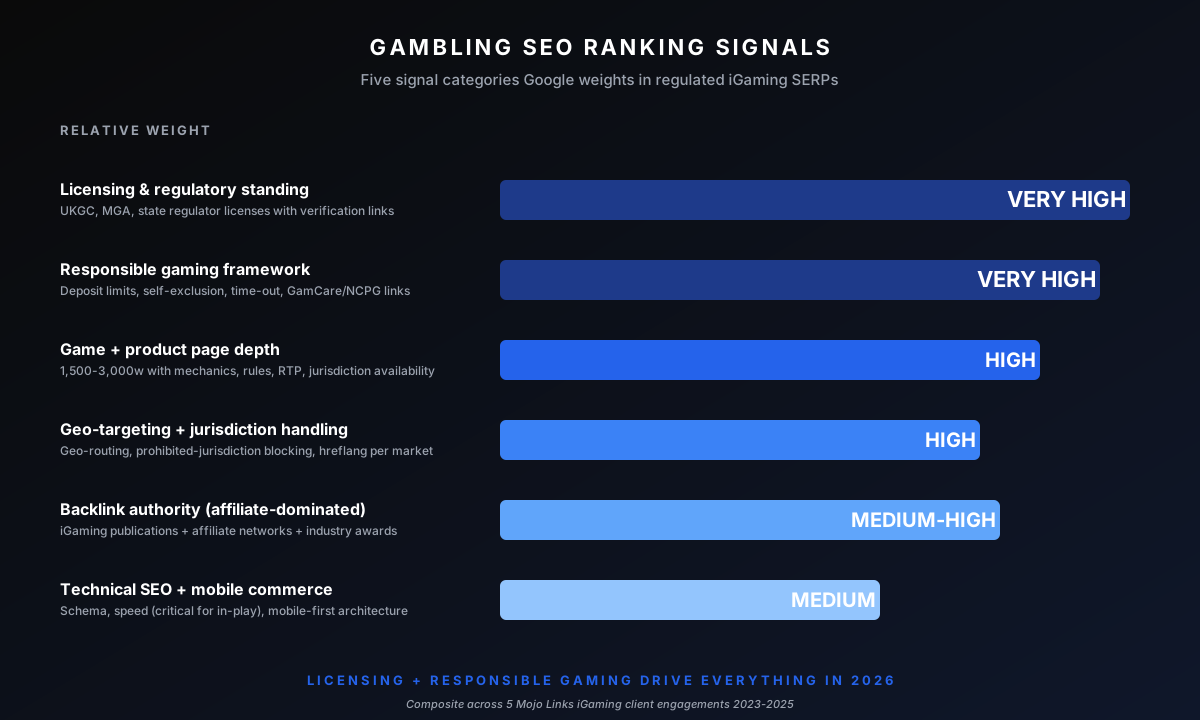
The factors that move gambling rankings cluster into four areas, and trust sits underneath all of them. In a category Google polices this hard, credibility is the foundation, not a tiebreaker.
Trust, Licensing, and Responsible-Gaming Signals
This is the gambling-specific factor, and it decides whether the rest of your SEO gets a fair hearing. Google and players both want proof the operator is legitimate and safe before they engage.
Visible licensing. Regulator and license details shown clearly, per jurisdiction.
Responsible-gambling provisions. Self-exclusion, limits, and support links, both a compliance duty and a trust signal.
Security and fairness proof. Payment security, audited RNG or odds, and transparent terms.
Reputation signals. Reviews and mentions on the portals players already trust.
None of these are optional polish. They are what separate a licensed operator from the unlicensed and scam sites Google assumes most gambling domains to be until proven otherwise. And they have to be visible on the page and in markup, not just true in a back office, or a crawler and a wary player never see them.
Players read these signals as fast as the algorithm does. A visible license badge, clear terms, and a recognizable regulator turn a first-time visitor from suspicious to willing in seconds, and Google watches that behavior. Trust is simultaneously a ranking input and the thing that converts the click, which is why it sits at the base of everything here.
Content and Keyword Strategy
Gambling content splits hard into money intent and informational intent, and the split is the strategy. Game pages, bonus pages, and "best casino" comparisons capture players ready to deposit. Guides, rules, and odds explainers capture players earlier and earn the links the money pages cannot win on their own.
The informational layer is what most operators neglect and affiliates exploit. A casino that only builds deposit pages has nothing to earn top-funnel traffic, links, or AI citations, while the comparison portal publishing strategy guides quietly accumulates the authority that lets its money pages outrank the operator's.
Backlinks and Digital PR
Backlinks remain one of the strongest off-page signals, and gambling is one of the most link-driven niches in search. The demand is real and regulated: the Gambling Commission's official participation statistics show how much play has moved online. In iGaming SERPs, the link-authority gap between the top result and the rest is wider than in mainstream niches.
The links that count come from iGaming media, sports and casino publications, and genuine editorial coverage, not the link farms that flood this niche. Spam links get gambling sites penalized fast, which is why this vertical demands editorial link acquisition and, when a profile is already polluted, penalty recovery.
The placements that move iGaming rankings come from a short list of real sources.
iGaming and affiliate media. Editorial coverage on the publications the industry actually reads.
Sports and casino publications. Mainstream-adjacent outlets that signal legitimacy beyond the niche.
Reputable review portals. Placements where players research before they deposit.
Volume without relevance is worse than useless in gambling. A burst of low-quality links is the exact footprint Google penalizes here, so the program is built on earned, relevant placements paced across the engagement, never bought in a block.
Technical SEO
iGaming sites tend to be large, with thousands of game and market pages, which makes crawl budget and indexation the technical battleground. Fast load, clean indexable URLs, structured data, and a tight internal-link structure decide whether all those pages get seen. A full-stack crawl surfaces the indexation and duplication issues that quietly cap a large operator.
Duplication is the silent killer at scale. Near-identical game and bonus pages, often generated from a template, compete with each other and dilute the signals that should concentrate on the pages you want to rank. Canonicalization and a deliberate content hierarchy turn that sprawl back into authority.
Speed and stability matter twice in gambling. Players primed to suspect scams bounce from a slow or glitchy site instantly, and Google reads those bounces as a quality signal. On large iGaming sites that load heavy game assets, performance work is not just an indexation fix, it is part of the trust the rest of the page is trying to earn.
How Long Gambling SEO Takes
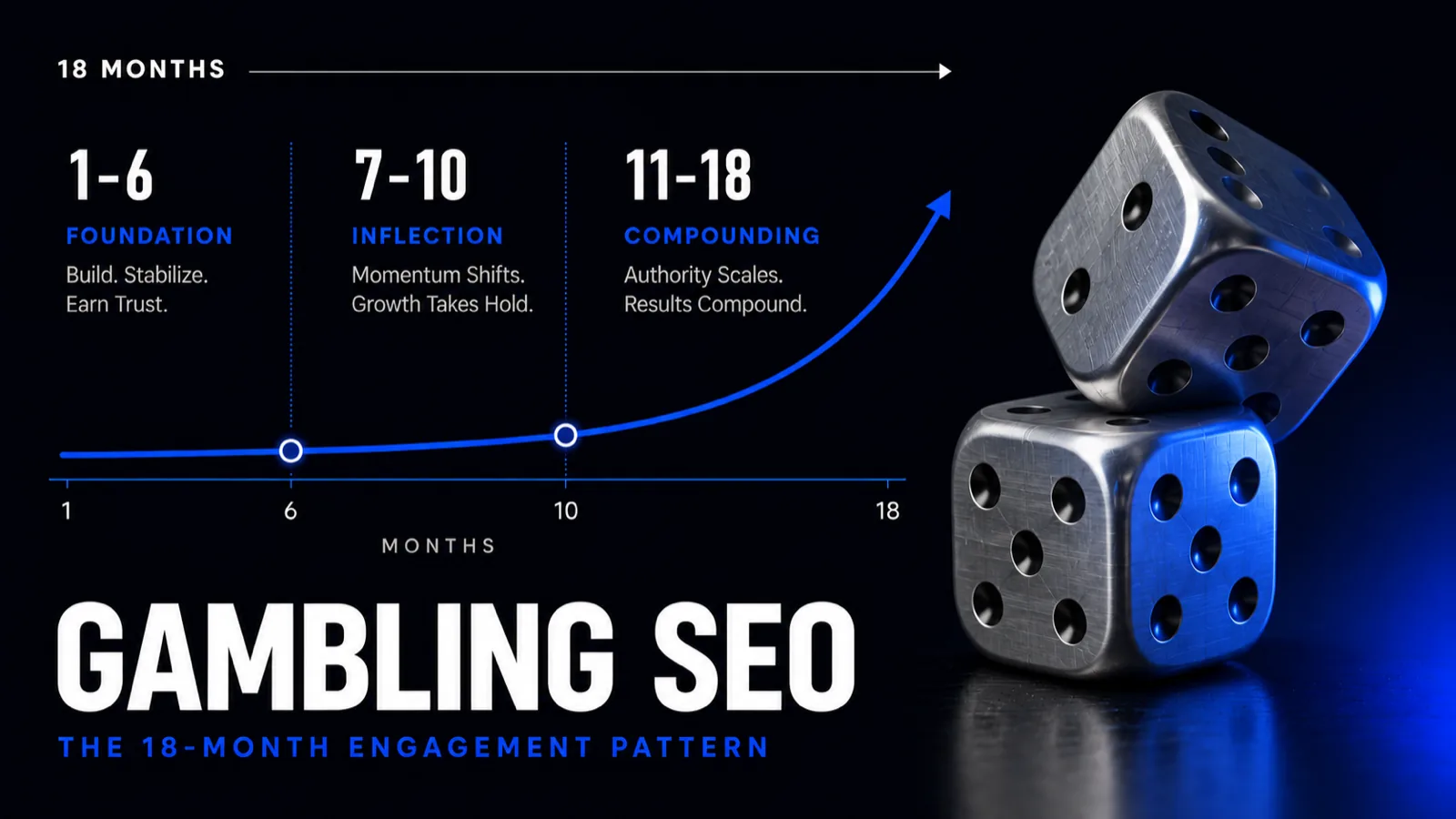
Gambling SEO is a long game, and the trust component makes it longer than a comparable build in a neutral niche. Informational and long-tail terms can move within a few months. Competitive money terms take the better part of a year of consistent content, links, and trust-building before they hold.
The lag is sharper because trust does not arrive on a schedule. You can ship the content and earn the links, then wait while Google watches whether the operator behaves like a licensed, legitimate one. Operators expecting launch-week ranking spikes are reading the wrong playbook. The curve rewards the brands still investing in month nine, which is also when most competitors quit.
That attrition is the opportunity. iGaming is full of operators who run SEO hard for a quarter, see no spike, and pull the budget. The few who hold through the trust-building stretch inherit the rankings the quitters abandoned, which is why consistency beats intensity in this niche almost every time.
Keyword Strategy for Igaming
The money-versus-informational split is sharper in gambling than almost anywhere, and mapping it correctly is half the game.
Money terms. "Best online casino", "[game] real money", bonus and comparison queries from players ready to deposit.
Informational terms. Rules, strategy, and odds guides that build topical authority and feed AI answers.
Branded and review terms. Players searching a specific operator, where reputation and reviews decide.
Local and jurisdictional terms. Market-specific queries that are only legal to target where you are licensed.
A real keyword map assigns each term to a page, a market, and a funnel stage, so nothing cannibalizes and nothing targets a jurisdiction you cannot legally serve. Cannibalization is rampant in iGaming, where dozens of near-identical bonus pages compete against each other instead of the SERP.
Seasonality and events add a layer most verticals never deal with. Sportsbook demand spikes around major fixtures, and casino interest follows new game launches and promotions. The keyword plan has to anticipate those windows and have the content ranking before the spike, not scrambling to publish during it.
Gambling SEO Across Formats
The strategy shifts with the format, because the search behavior and the trust burden differ across iGaming.
Online casinos. Game and bonus pages plus heavy review-portal competition. Trust and licensing carry the rankings.
Sportsbooks. Event-driven and seasonal, where timely odds content and speed win the spikes around major fixtures.
Poker and skill games. Strategy-content-led, with engaged communities that reward genuine depth.
iGaming affiliates. Pure SEO plays whose entire business is ranking, and the operator's toughest organic competition.
Most operators underestimate the affiliates. A comparison portal optimizing full-time will out-rank a casino treating SEO as a side project, which is why operators often win faster by partnering with the strong affiliates than by fighting them head-on.
Jurisdiction cuts across every format. The same money term is a goldmine in a regulated market and illegal to target in a banned one, so the format strategy always sits on top of a market-by-market legality map. Get that layer wrong and you are not just wasting budget, you are courting a regulator.
Operator SEO vs Affiliate SEO
Operators and affiliates play the same SERP from opposite sides, and the strategy differs accordingly. An operator is selling its own brand and has to carry the full trust and licensing burden. An affiliate ranks reviews and comparisons of many operators, and its entire business is search visibility.
Affiliates usually win the broad "best casino" and comparison terms, because that is all they do and they build authority full-time. Operators win their branded terms, their specific games and bonuses, and the trust-led queries where a licensed first party beats a review portal. Fighting affiliates on their home turf is rarely the move.
The smarter operator play is to own what only a first party can own, then earn placements on the strong affiliates rather than trying to out-rank all of them. The affiliate sends the player; the operator closes them. Treated as a channel rather than an enemy, the affiliate ecosystem becomes a distribution network instead of a wall.
For affiliates the math inverts. The site is the product, so content depth, freshness, and link authority are the entire business, and a single algorithm update can make or break the year. Affiliates that survive treat trust and genuine usefulness as the moat, because thin comparison pages built only to monetize are exactly what Google's reviews and helpful-content systems target.
What Gambling SEO Looks Like in Practice
Mojo Links ran the full SEO program for bspin.io, a crypto casino, from January 2023 to January 2024. The brand sat in the two hardest categories at once, gambling and crypto, so licensing, trust, and link quality carried everything. Scope was end to end: technical, content, site architecture, and 200 editorial backlinks.
The sequence mattered as much as the work. Technical and architecture first, so the large site could be crawled and trusted. Then content built around the terms real players searched. Then the link campaign, 200 placements earned across the year, not bought in a block that would have tripped every spam filter Google points at this niche. The crypto link building case study shows the same principle on a crypto publisher: solid content first, then the links that make it move.
By the close of the engagement the site was pulling roughly 9,167 organic visits a month, worth about $17,330 in equivalent traffic value. That is what compounding looks like when the trust and technical foundation is built before the links land, in a category where most sites never clear the trust gate.
The lesson that transfers is the ordering, not the numbers. Trust and crawlability first, then content built for real player intent, then links earned over time. Reverse it, lead with a block of bought links on a site Google does not trust, and you get a penalty instead of a curve. Bspin worked because every layer was in place before the next loaded on top.
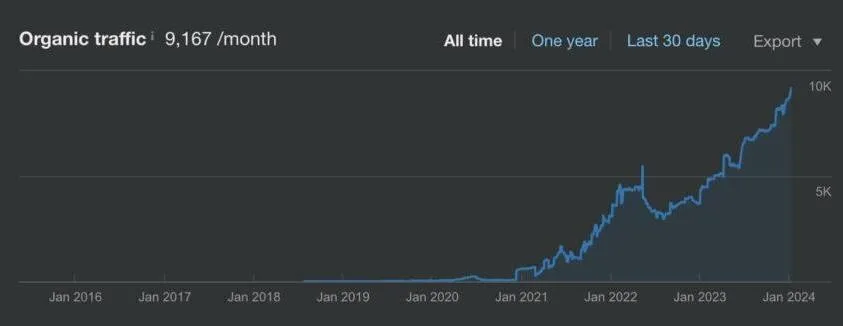
bspin.io organic traffic, Ahrefs. The growth tracks the full-stack engagement: technical and architecture first, then content and 200 editorial links compounding through the year.
Responsible Gambling and Compliance
Responsible-gambling provisions are not just an ethics box, they are a ranking and trust requirement. Visible self-exclusion tools, deposit limits, age verification, and links to support services signal to both Google and the player that the operator is legitimate and safe.
Compliance also governs the content itself. Claims about winnings, bonus terms, and targeting all sit inside jurisdiction-specific rules, and content that ignores them risks both a regulator and a ranking. In gambling, the compliant operator and the rankable operator are usually the same operator.
This is why compliance has to sit inside the SEO process, not bolt on after. A bonus page written for maximum click appeal and then flagged by legal is wasted work twice over. Building the disclosures and responsible-gambling framing into the content from the first draft keeps the program moving and keeps the rankings durable.
Gambling SEO and AI Search
AI answer engines now field a growing share of "where should I play" research, and they recommend the operators they can verify. Google's AI Overviews, ChatGPT, and Perplexity lean on the same signals gambling SEO builds: licensing, clear answers, structured data, and credible third-party coverage.
In a category this full of unlicensed and scam sites, the operators an AI engine is willing to name are the ones that already look legitimate and safe to a machine. Build the trust, licensing, and structure and you become the citable recommendation, not the one the model warns players away from.
This is increasingly where the player journey starts. A newcomer asks an assistant which casino or sportsbook is reputable and legal in their country before they ever run a search, and the model answers from what it can verify. An operator absent from those answers is invisible at the moment of choice, and no promotion buys a place in an AI recommendation.
Common Gambling SEO Mistakes
Most gambling sites are not failing for exotic reasons. They are making the same handful of mistakes, and each one is fixable.
Hiding or omitting licensing. No visible license, and Google and players assume the worst.
Buying links in bulk. The fastest route to a penalty in one of the niches Google polices hardest.
Cannibalized bonus pages. Dozens of near-identical pages competing with each other instead of the SERP.
Thin responsible-gambling provisions. A compliance gap and a trust gap at once.
Ignoring crawl budget. Thousands of game pages left unindexed because the crawler never reaches them.
Targeting illegal markets. Ranking for terms in jurisdictions where the operator is not licensed invites a regulator, not just a ranking risk.
Fix these and most operators climb before a single new game launches. The foundation was working against them the whole time.
How To Choose a Gambling SEO Partner
Choose for niche expertise and a clean methodology, not promises. Gambling SEO is specialized and risky, and a generalist who treats it like any other site will either underperform or get you penalized with the spam links this niche is drowning in.
Anyone who guarantees a number-one ranking is lying to you, because no one controls Google's algorithm. Ask how they handle licensing and responsible-gambling signals, where their links come from, and whether they have ranked an operator in a regulated market. Watch for the named-operator dodge, thousand-link packages, and reporting that tracks traffic but not depositing players.
Capacity is the quiet tell. The agencies that churn gambling clients run thin, templated link work across dozens of sites, the exact footprint that gets operators penalized. The ones worth hiring take fewer accounts, because earned links and compliant content in a regulated niche cannot be mass-produced safely. Ask to see results from a real licensed operator, names redacted, before you sign.
If you want a read on where your operator stands first, a complimentary site audit covers your technical health, backlink profile, content gaps, and trust signals before you commit a budget.
Frequently Asked Questions
Is SEO Worth It for a Gambling Site That Cannot Run Ads?
Yes, and the ad restrictions are exactly why. With paid channels gated behind certification and banned outright in many markets, organic search becomes the primary scalable way to acquire players. Ranking is one of the few growth levers a licensed operator fully controls.
How Long Does Gambling SEO Take To Work?
Informational and long-tail terms can move within a few months. Competitive money terms like "best online casino" take the better part of a year of consistent content, links, and trust-building, because Google extends little benefit of the doubt to gambling sites.
Can a Gambling Site Get Penalized for SEO?
Easily. iGaming attracts spam-link sellers, and a polluted backlink profile gets a gambling domain demoted or penalized faster than most niches. Editorial links and a clean profile are survival, not caution.
Does Google Rank Gambling Sites Lower by Default?
Not lower by rule, but with more scrutiny and only where it is legal. Google applies stricter trust and licensing standards to gambling, so credibility and compliance signals that are optional elsewhere are decisive here.
Should An Operator Compete with Affiliates or Partner with Them?
Usually partner. Affiliates rank the broad comparison terms full-time and are hard to beat there, but they also send qualified players to operators. The stronger play is to own your branded, game, and trust-led terms while earning placements on the best affiliates, treating them as a distribution channel rather than a rival.
What Is The Most Important Gambling SEO Ranking Factor?
Trust and licensing, by a wide margin. In a category Google treats as guilty until proven licensed, visible regulation, responsible-gambling provisions, and reputable coverage decide whether your content ranks at all. Everything else builds on that.
Work with Mojo Links
I run these campaigns myself, in categories most agencies will not touch. If you want a read on where your rankings, links, trust signals, and content gaps actually stand, start with a free video review and we will map the path from there, while the terms your competitors have not locked down are still winnable.

About Bart Magera
Bart Magera is the founder of Mojo Links. Ten years across YMYL verticals (legal, medical, finance, supplements, crypto, gambling). Trained under Koray Tuğberk Gübür's Topical Authority framework. Author of two SEO books and international speaker.
Want this kind of analysis on your site?
Get a free video walkthrough within 48 hours covering technical health, backlinks, content gaps, and AI visibility.
Related posts
Keep reading on adjacent topics.
- SEO
 Bart Magera9 min read
Brand Mentions for SEO: Linked, Unlinked, and AI Citations
Most SEO budgets still treat a mention without a link as a failed pitch. That math is out of date. The same editorial naming that builds your entity in Google now decides whether AI engines name you in answers. Here is the value model behind linked, unlinked, and AI-cited mentions, and the three lanes for earning more of them.
- SEO
 Bart Magera12 min read
AI Visibility Tools: 9 Trackers Ranked and Compared
Nine AI visibility tools, one yardstick: engines covered, what gets measured, competitor tracking, and price. Every page-one comparison of these trackers is written by a vendor ranking its own product first. This one is not. Here is where each tool fits, from a $29 entry plan to enterprise quotes, and the one thing none of them can do.
- SEO
 Bart Magera10 min read
ChatGPT Brand Mentions: How To Track and Earn Them
When a buyer asks ChatGPT for the best option in a category, it names a few brands inside the answer. Those ChatGPT brand mentions, not the linked citations beneath them, are what get you recommended. Here is how to track them and how to earn them.