

What Is a Backlink? Definition, Types, and Why They Matter
Listen to this article
Browser-native voice. No account required.
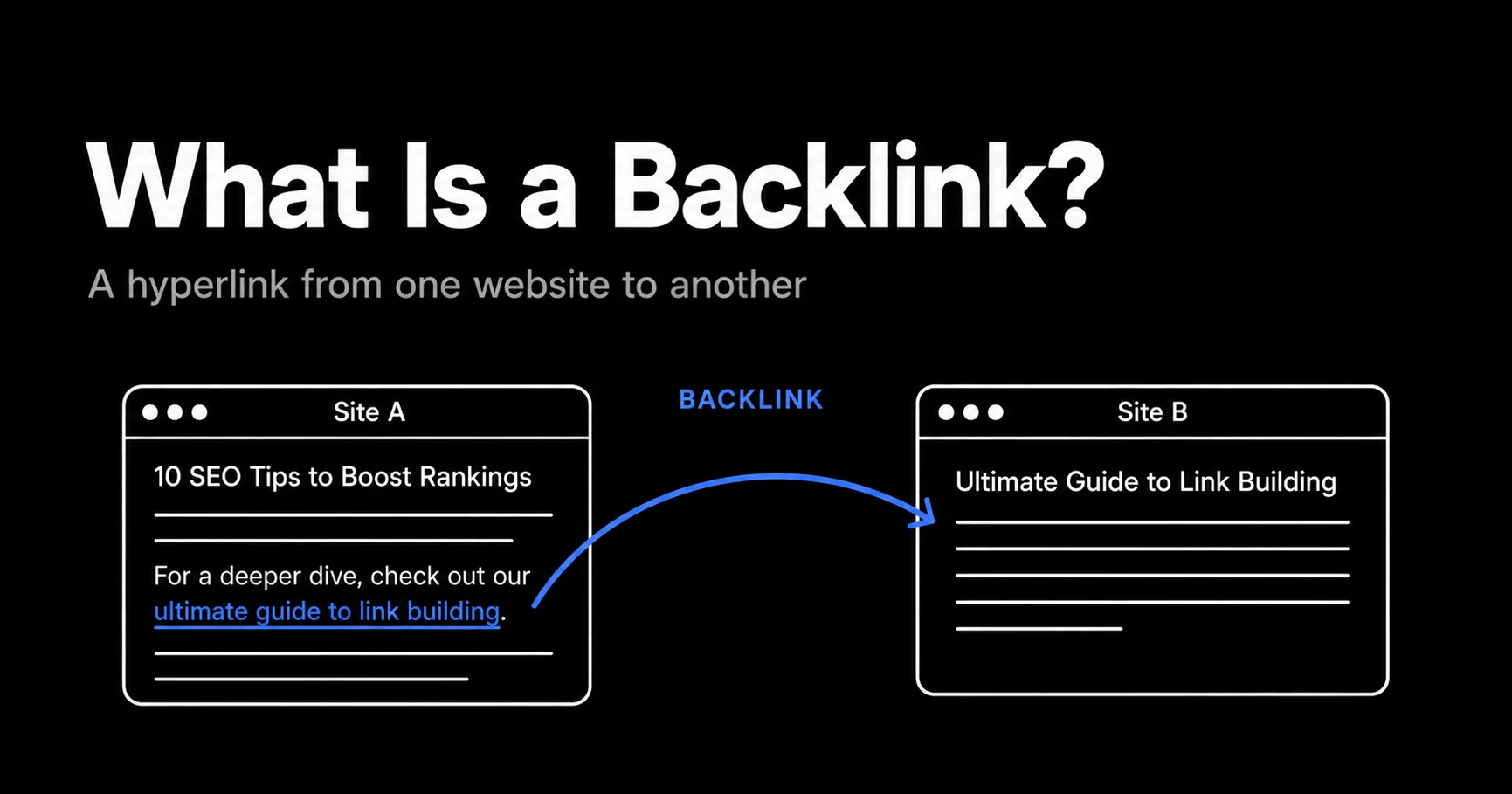
A backlink is a hyperlink from one website to another. Every external link pointing at your site is a backlink, also called an inbound link. Backlinks are the single strongest ranking signal Google uses in 2026, and they now feed AI Overview citations as well. This guide defines what a backlink is, explains how Google uses them, breaks down the types and quality criteria, and points you to the operator-depth Mojo Links cluster posts for everything you need to do next.
What Is a Backlink?
A backlink is a hyperlink from one website to another. From the receiving site's perspective, every external link pointing at it is a backlink, also called an inbound link or incoming link. Google uses backlinks as votes of confidence between websites: more high-quality backlinks signal to Google that a page deserves higher ranking on related search queries. The mechanism dates back to Google's original 1996 PageRank algorithm and remains the strongest single ranking signal in 2026.
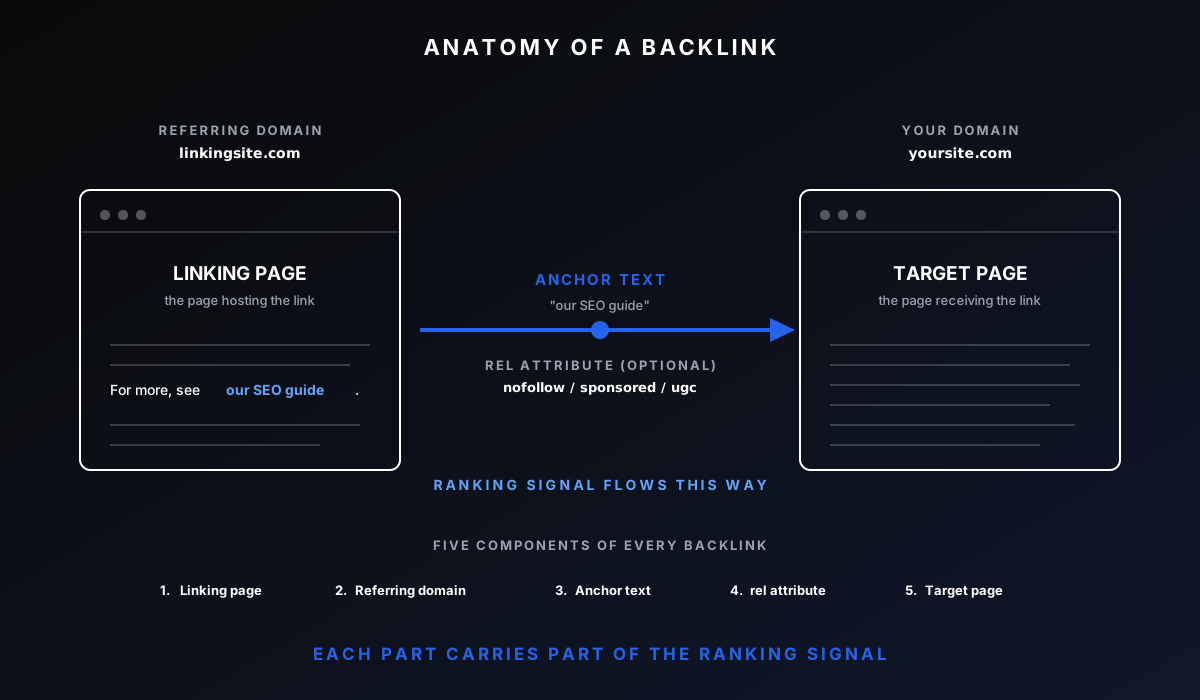
The structure is straightforward:
Linking page: the source page that contains the link
Linking site (referring domain): the website hosting the linking page
Target page: the page being linked to (also called the destination)
Anchor text: the visible clickable text inside the link
rel attribute: optional HTML attribute (nofollow, sponsored, ugc) that modifies how Google treats the link
Why Do Backlinks Matter for SEO in 2026?
Backlinks matter because Google's ranking algorithm uses them as the primary mechanism for assigning topical authority and ranking weight to pages. Top-10 Google results carry 3.8x more referring domains than pages in positions 11-20, and pages with zero backlinks rarely rank for competitive commercial queries regardless of how good their content is. In 2026, the same backlink signal also feeds AI Overview citations and large-language-model answer engines, which means link assets now drive both classical search and generative-search visibility. The ranking weight is the most visible of the outcomes link building produces, though referral traffic and faster indexation arrive sooner.
Three forces strengthened the backlink signal in the 2022-2026 window:
AI Overview citation patterns favor pages with strong backlink profiles - LLM-powered search surfaces preferentially cite editorially-validated content.
Pattern-based devaluation (2024 link spam update) raised the value of clean editorial links by automatically discounting manipulated networks.
Topical authority weighting added relevance modifiers on top of raw link signal - same total backlinks, more or less ranking impact depending on niche fit.
For the full numeric breakdown, see the link building statistics covering 50 sourced data points.
What's The Difference Between a Backlink and An Internal Link?
A backlink is an external hyperlink pointing at your site from another domain. An internal link is a hyperlink within your own site pointing from one page to another. Backlinks carry ranking signal through Google's authority transfer model; internal links pass topical-authority signal between pages on the same site. Both matter for SEO; they serve different functions and the same site needs both to rank competitively.
The four link types every SEO encounters:
Backlink (inbound link): external site → your site
Outbound link: your site → external site
Internal link: your site → another page on your site
External link (umbrella term): any link crossing domain boundaries, whether inbound or outbound
How Does Google Use Backlinks To Rank Pages?
Google uses backlinks through three mechanisms: link equity transfer (the algorithmic descendant of PageRank, where authority flows from linking pages to target pages), topical relevance signal (anchor text and surrounding context tell Google what the target page is about), and trust signal (the source domain's quality reputation transfers a discount of itself to the target). These three signals combine multiplicatively, which is why one editorial link from a high-authority in-niche source can outweigh fifty links from low-quality off-niche sources.
Backlinks feed multiple Google ranking systems that run in combination (Ahrefs' explainer on backlinks covers the fundamentals). The signal a backlink passes is layered: relevance, authority, and quality each get a sub-score, and the layers combine multiplicatively.
The three signals broken out:
Link equity (authority transfer). Algorithmic descendant of the original 1996 PageRank. Authority flows from linking page to target page, modified by the source page's own authority and the number of outbound links it carries.
Topical relevance signal. The anchor text and the surrounding paragraph tell Google what the target page is about. A backlink from a niche-aligned page transfers stronger topical signal than an equivalent backlink from outside the niche.
Trust signal. Google tracks the source domain's quality reputation independently of any single page. High-trust domains transfer stronger backlink signal even when the specific linking page is mid-quality.
What Are The Different Types of Backlinks?
Backlinks fall into multiple overlapping classification systems: by rel attribute (dofollow vs nofollow vs sponsored vs ugc), by acquisition method (editorial vs paid vs reciprocal), by placement context (contextual vs sitewide vs footer), and by direction (inbound vs outbound vs internal). Every backlink carries one classification from each system, and the combination determines its ranking weight.
Dofollow vs Nofollow vs Sponsored vs UGC
The rel attribute on the <a> tag tells Google how to treat the link. Dofollow (default, no rel attribute) passes full ranking signal. Nofollow passes partial signal as a "hint" since 2020. Sponsored marks paid placements. UGC marks user-generated content. For the full breakdown, see the dofollow backlinks guide and nofollow links guide.
Editorial vs Paid vs Reciprocal
Editorial backlinks are placed by a publisher's editorial discretion because the linked content adds value to their readers. Paid backlinks are placements purchased through guest post fees, niche edit fees, or sponsorship deals. Reciprocal backlinks are mutual link exchanges between sites. Editorial links carry the strongest ranking signal; paid links require sponsored or nofollow disclosure under Google guidelines; reciprocal links work at small scale but trigger algorithmic devaluation when patterns become detectable.
Contextual vs Sitewide vs Footer
Contextual backlinks sit inside the body content of an article, surrounded by relevant prose. Sitewide backlinks appear on every page of the source site (typical in navigation or sidebar widgets). Footer backlinks live in the page footer, usually sitewide. Contextual links pass the strongest signal because they sit inside topical context; sitewide and footer links are systematically devalued in 2026 ranking signals.
Inbound vs Outbound vs Internal
Inbound links point AT your site from external sources (these are your backlinks). Outbound links point FROM your site to external sources. Internal links point within your site between pages. Each direction serves a different function: inbound links accumulate ranking authority; outbound links pass authority to others (used carefully for relevance signal); internal links distribute authority across your own site.
What Makes a Backlink High Quality?
A high-quality backlink combines four criteria: the source domain has measurable organic traffic, the source covers topics relevant to your niche, the linking page is indexed in Google, and the link sits in editorial body content (not footer or sidebar). Links failing two of four criteria deliver minimal ranking lift even when acquired through legitimate methods. The four-criteria filter is the standard Mojo Links uses across audits.
Public correlation studies have long found that top-10 ranking pages carry more referring domains than pages in positions 11-20, with stronger topical relevance and faster page experience as compounding factors.
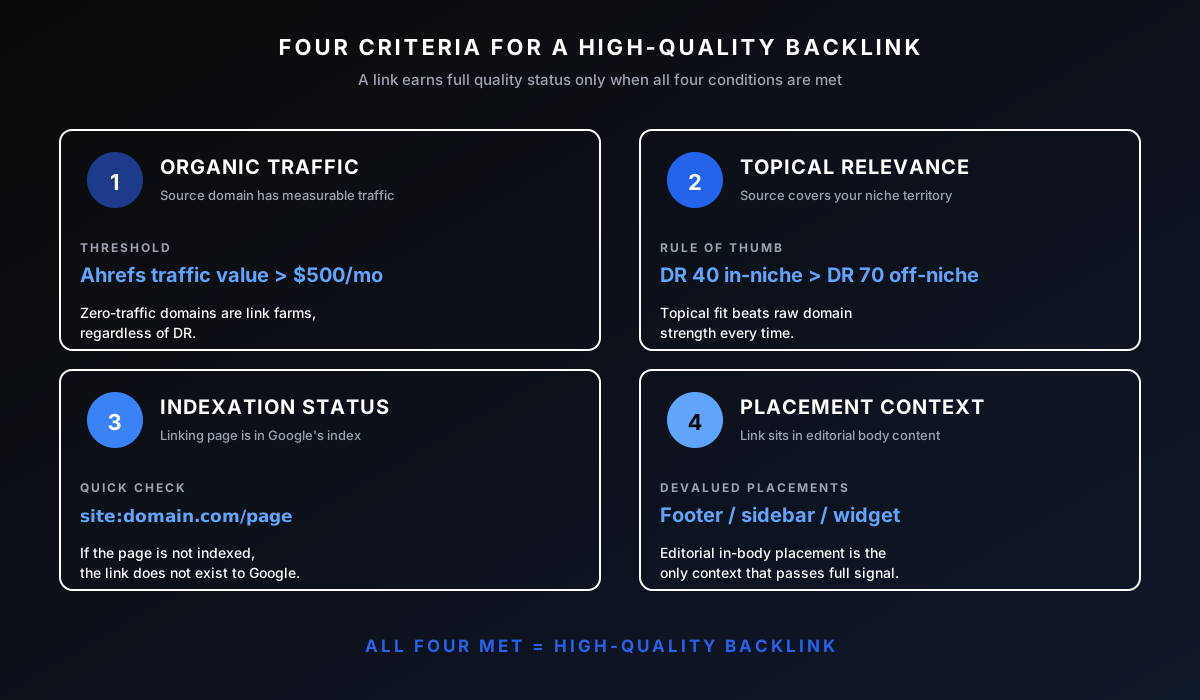
The four-criteria filter:
Organic traffic. Source domain has measurable monthly organic traffic (Ahrefs traffic value above $500/month). Zero-traffic domains are link farms regardless of DR.
Topical relevance. Source covers topics adjacent to your niche. A DR 70 site outside your topic produces less ranking lift than a DR 40 site inside it. See niche-relevant backlinks.
Indexation status. Linking page is indexed in Google. Use a site:domain.com/page query to confirm in 5 seconds.
Placement context. Editorial in-body placement. Footer, sidebar, and widget placements are systematically devalued.
What Is a Referring Domain and Why Does It Matter More Than Total Backlink Count?
A referring domain is one unique source domain pointing at your site, regardless of how many individual backlinks that domain provides. Five backlinks from the same source equal one referring domain. Google's ranking algorithm weights referring domain count more heavily than raw backlink count because additional links from the same source produce diminishing returns. Top-ranking pages typically carry 80-200 referring domains; the raw backlink count behind that can vary from 100 to 10,000.
Why referring domain count matters:
Diminishing returns from same source. The second, third, fourth link from the same domain each transfer less authority than the first.
Topical diversity signal. Multiple distinct domains linking to a page signals broader editorial validation than concentrated links from few sources.
Velocity normalization. Sudden acquisition of many backlinks from one source looks like manipulation; broad referring domain growth looks like organic recognition.
For the per-niche referring domain benchmarks, see how many backlinks should a website have.
What Is Link Equity and How Does It Pass Between Pages?
Link equity is the ranking authority a backlink passes from the source page to the target page. The concept is the algorithmic descendant of Google's 1996 PageRank: each page carries some quantity of authority based on its own backlinks, and when it links out, a portion of that authority flows to the linked target. Outbound links divide the source page's authority among them, which is why pages with many outbound links pass less per-link equity than pages with few.
Four factors modify the equity that passes per link:
Source page authority. Higher-authority pages have more equity to pass.
Number of outbound links. More outbound links on the source page divides the available equity among more targets.
rel attribute. Nofollow attribute reduces or blocks equity transfer (now a hint in 2026).
Topical relevance. Equity transfers more efficiently between topically-aligned pages.
How Are Backlinks Measured? (DR, Da, URL Rating, Trust Flow)
Third-party SEO tools measure backlink quality through proprietary domain-level metrics: Ahrefs Domain Rating (DR), Moz Domain Authority (DA), Ahrefs URL Rating (UR), and Majestic Trust Flow (TF). None of these are Google's own metrics; they are estimates calculated from the tool's own backlink index. DR is the most widely used in 2026 because of Ahrefs' market position, but using any single metric in isolation produces worse outcomes than combining two or three with the four-criteria filter.
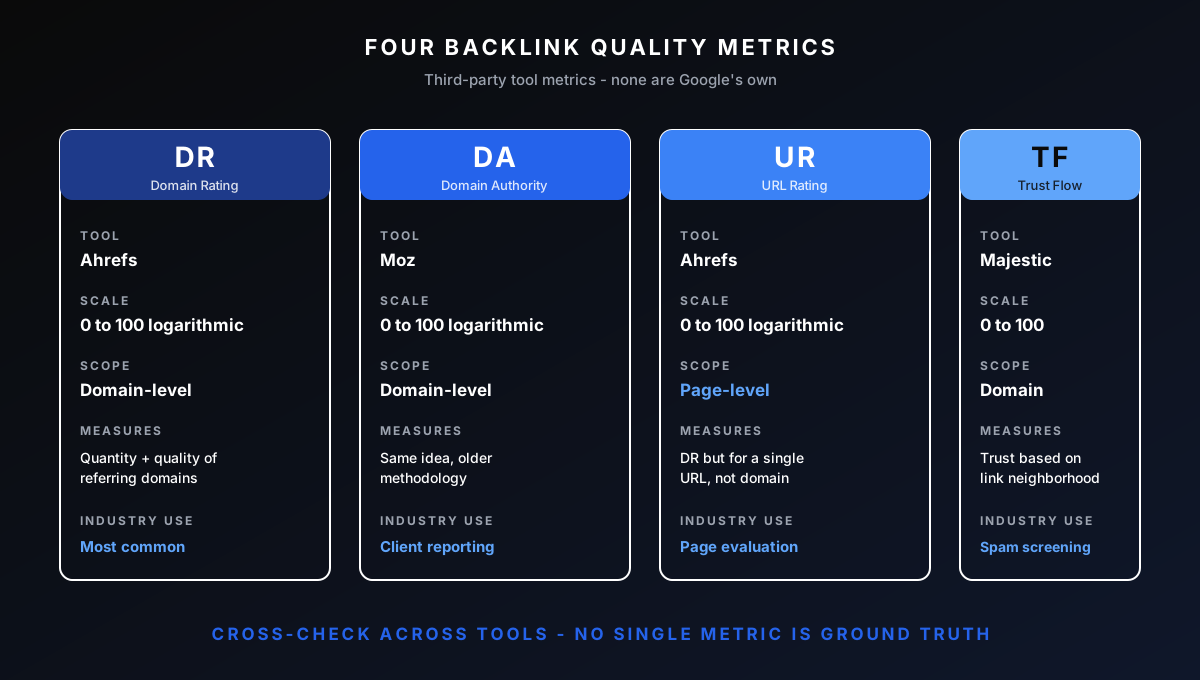
Four tool metrics every SEO encounters:
Ahrefs Domain Rating (DR): 0-100 logarithmic scale. Most-used metric in the industry.
Moz Domain Authority (DA): 0-100 logarithmic scale. Older metric, still common in agency reporting.
Ahrefs URL Rating (UR): page-level equivalent of DR. Useful for evaluating specific source pages.
Majestic Trust Flow (TF): measures source-domain trust based on link neighborhood quality.
How Do You Check The Backlinks Pointing To Your Site?
Check your site's backlinks through three sources: Google Search Console (the Links report shows Google's own attribution), paid backlink tools (Ahrefs Site Explorer or Semrush Backlink Analytics for complete external visibility), and manual checking for spot verification. For the full manual workflow without paid tools, see the manual backlink checking guide. For competitor backlink discovery, see find your competitor backlinks.
How Do You Build Backlinks?
Backlink acquisition runs through five primary tactics in 2026: guest posts on real-traffic publishers, niche edits inside indexed articles, digital PR through journalist outreach, broken link replacement on relevant publishers, and unlinked brand mention reclamation. Each tactic delivers different ranking signals and converts at different rates. A campaign using only one tactic underperforms a campaign using three to four.
Tactic conversion rates from Mojo Links' campaigns:
Guest posts: 8-15 percent conversion on filtered prospect lists
Niche edits: 5-10 percent conversion
Digital PR: 1-4 percent conversion (lowest rate, highest placement quality)
Broken link replacement: 5-12 percent conversion
Unlinked brand mention reclamation: 25-40 percent conversion (highest rate, smallest available volume)
For the full operator workflow on each tactic, see the manual link building workflow. For the strategic foundations under every campaign, see the 7 link building fundamentals.
What Is a Toxic Backlink?
A toxic backlink is a link from a spam, low-trust, irrelevant, or manipulative source domain that signals manipulation to Google. The algorithm devalues toxic links automatically in 2026 via the 2024 link spam update's pattern-based detection. Toxic patterns include zero-traffic source domains, foreign-language anchor text on unrelated pages, sitewide footer placements, PBN (private blog network) footprints, and sudden acquisition spikes from negative SEO attacks.
Common toxic backlink sources to identify:
Domains with whois privacy and no organic traffic
Expired-domain networks (legacy authority repurposed for paid placement)
Comment-spam pages and forum-link-injection patterns
Auto-generated content sites with widget-based linking
Sites with sitewide outgoing links to unrelated commercial pages
For the full identification and removal workflow, see the backlink audit procedure, the full cleanup workflow, and the disavow procedure.
Do Backlinks Still Matter in The AI Search Era?
Yes. Backlinks now drive both classical Google rankings and AI Overview citations. The 2026 generative-search algorithms (Google AI Overviews, ChatGPT search, Perplexity, Gemini) preferentially cite pages with strong backlink profiles because backlinks remain the most reliable signal of editorial validation that LLM-powered surfaces have available. Sites that invested in link assets between 2023 and 2025 are the ones currently appearing in AI Overview citations across competitive queries.
Three reasons AI search reinforces rather than replaces backlinks:
Citation transparency. AI Overviews surface citations with source links. The sites being cited had to be discoverable and credible at the citation moment.
Hallucination mitigation. LLMs are trained to cite higher-authority sources to reduce factual errors. Backlinks are the proxy authority signal.
Inference from training data. LLMs absorb knowledge from web content; the most-linked sources appear most often in training corpora and shape model outputs.
What Are The Most Common Myths About Backlinks?
Five myths dominate beginner thinking about backlinks: more links is always better (false - quality compounds, quantity diminishes), nofollow links are worthless (false - they pass partial signal and feed brand mentions), backlinks are the only ranking signal (false - they are the strongest but not the only signal), guest posting is dead (false - it remains 8-15% conversion on filtered lists), and AI killed link building (false - AI reinforced it by adding generative-search citation as a new use case).
"More backlinks is always better." False. Referring domain count matters more than raw backlink count, and quality multiplier outweighs quantity at every tier.
"Nofollow links are worthless." False. Nofollow passes partial signal through referral traffic and the 2020 hint reclassification. Wikipedia citations are all nofollow and produce measurable lift.
"Backlinks are the only ranking signal." False. Strongest single signal, but topical relevance, technical health, content quality, and user behavior also feed rankings.
"Guest posting is dead." False. Mass-scale templated guest posts triggered algorithmic devaluation in 2022-2024. Targeted personalised guest posts on real-traffic publishers remain a primary tactic.
"AI killed link building." False. AI Overview citations weight backlink signal, which means link assets now serve more discovery surfaces than they did pre-AI.
Frequently Asked Questions About Backlinks
How Many Backlinks Do I Need To Rank?
Site-wide referring domains for first-page commercial rankings: 300 to 1,500 depending on niche. Per-page referring domains for first-page commercial rankings: 80 to 200. For the full per-niche breakdown, see how many backlinks should a website have.
Can I Buy Backlinks?
Buying backlinks is acceptable under Google guidelines when properly disclosed with rel="sponsored" or rel="nofollow". Buying placements without disclosure violates Google's spam policies and triggers algorithmic devaluation. The legitimate paid-link market covers guest posts, niche edits, and digital PR retainers - all within compliance when disclosure happens at the source level.
Are Backlinks Free?
Backlinks can be free when earned through unlinked brand mention reclamation, broken link replacement, or organic editorial citations. Most acquisition campaigns combine free tactics (mention reclamation, broken link replacement) with paid tactics (guest posts $200-500, niche edits $150-400, digital PR retainers).
How Long Until New Backlinks Show Ranking Results?
Initial ranking movement begins 4-6 weeks after Google indexes new placements. Full ranking impact materializes over 3-6 months for algorithmic gains, 6-12 months for sites recovering from manual actions or algorithmic suppression.
What Is a "natural" Backlink Profile?
A natural backlink profile shows broad referring domain diversity (300+ unique sources), branded anchor text dominance (50-70 percent branded), steady acquisition velocity (no spikes), and topical relevance concentration (60+ percent in-niche or adjacent-niche sources). Profiles outside these ranges suggest either undervaluation (artificial restraint) or manipulation (artificial growth).
A single backlink is one signal inside a longer program. For the end-to-end program this fits into, see Link Building: The Operations Guide.
Want Us To Build Your Backlink Profile?
A Mojo Links campaign manages the full backlink acquisition workflow across regulated and competitive verticals - including the four-criteria prospect filter, tactical mix, anchor text planning, and ongoing profile monitoring. For a free 20-minute audit covering current backlink health, content gaps, and AI visibility, request a growth audit walkthrough. Senior strategist on the call. No junior PMs.

About Bart Magera
Bart Magera is the founder of Mojo Links. Ten years across YMYL verticals (legal, medical, finance, supplements, crypto, gambling). Trained under Koray Tuğberk Gübür's Topical Authority framework. Author of two SEO books and international speaker.
Want this kind of analysis on your site?
Get a free video walkthrough within 48 hours covering technical health, backlinks, content gaps, and AI visibility.
Related posts
Keep reading on adjacent topics.
- Link Building
 Bart Magera10 min read
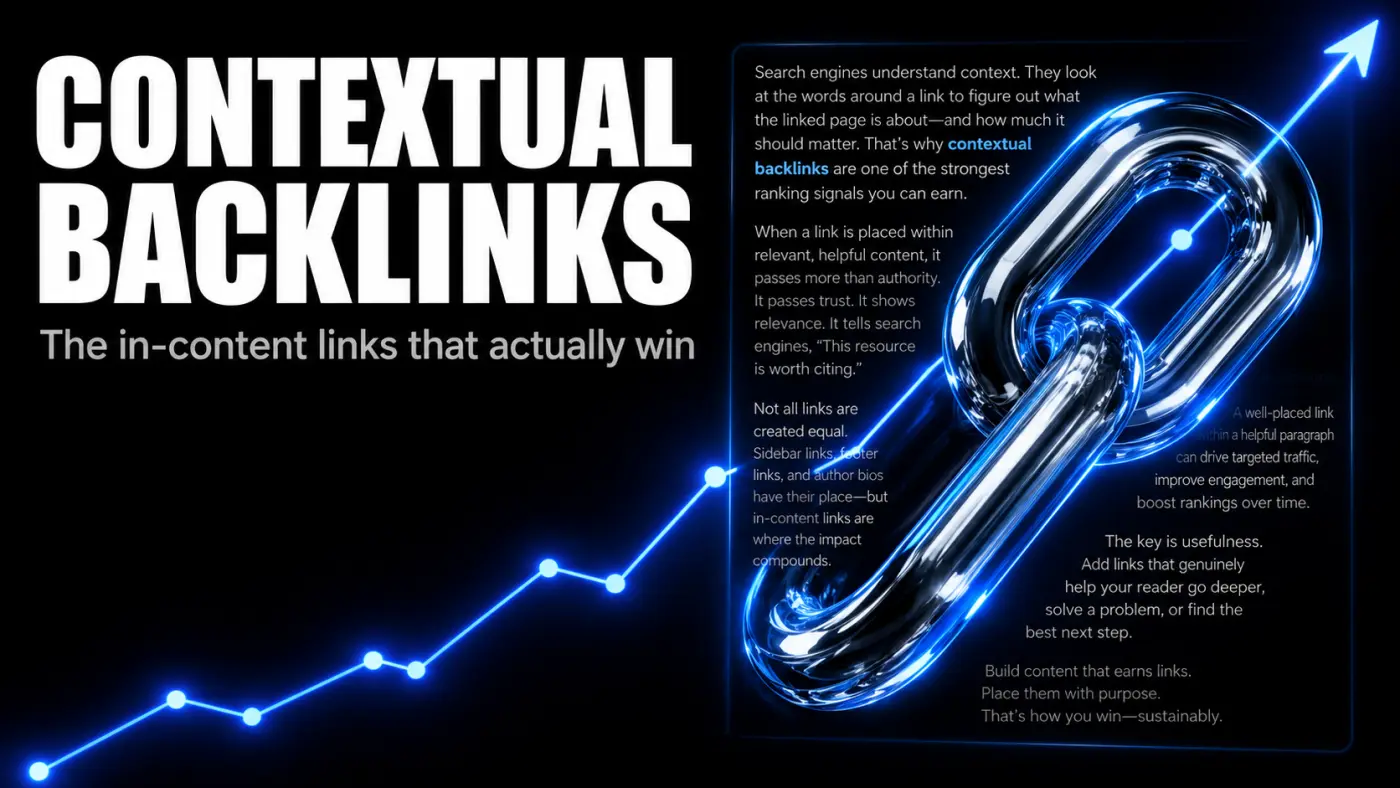
Contextual Backlinks: What They Are, Why They Win, and How To Earn Them
A contextual backlink sits inside the body of an article, surrounded by relevant text, not in a footer or author bio. That placement is what gives it weight. Here is what contextual backlinks are, what makes one high quality, how to earn them, and how to spot the cheap fakes.
- Link Building
 Bart Magera12 min read
What Is White Hat Link Building? Techniques That Work in 2026
The Problem: Why Most Link Building Fails Your SEO You wrote great content. It’s relevant. It’s useful. It even has infographics. But guess what? Crickets. Nobody’s linking. Google’s not ranking. And your “ultimate guide” is buried somewhere on page 7 under a recipe blog and a…
- Link Building
 Bart Magera10 min read
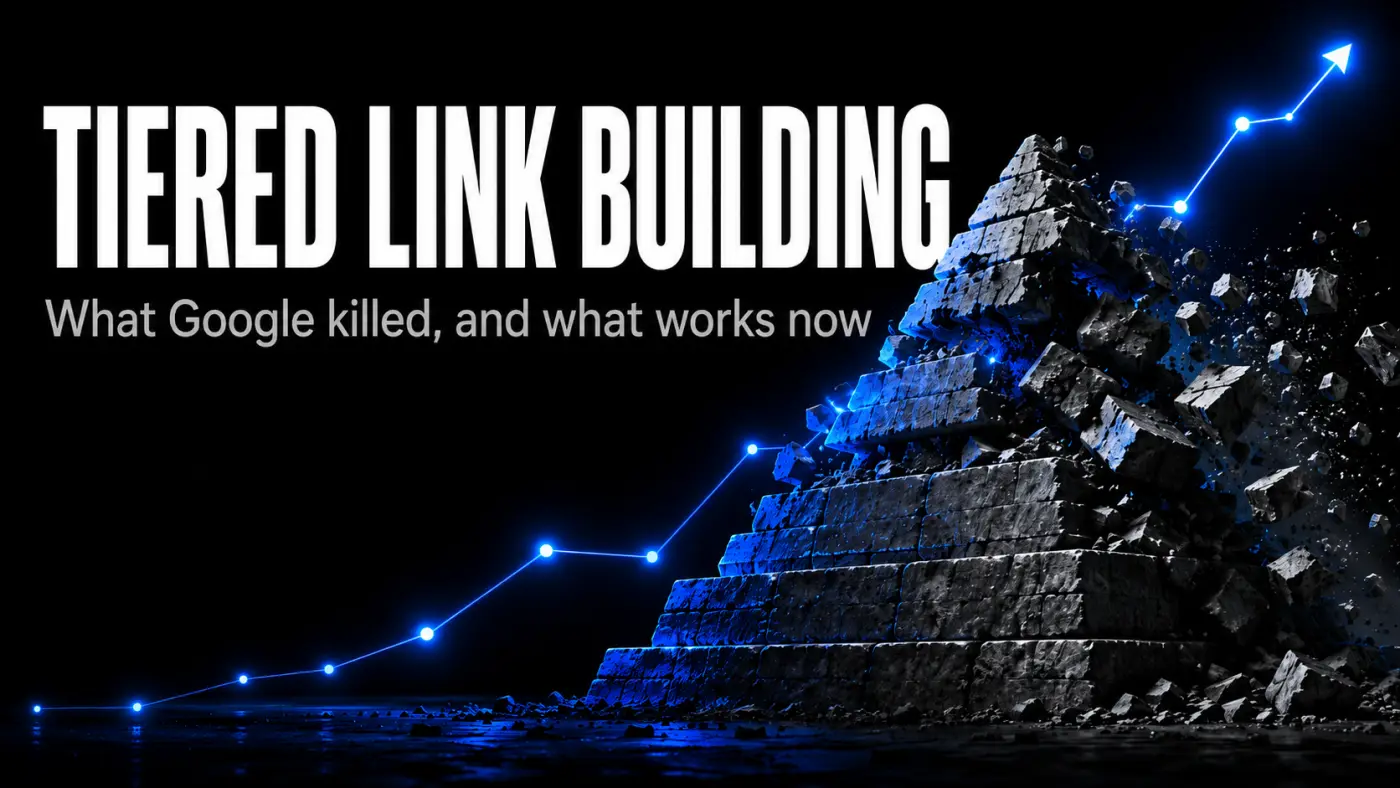
Tiered Link Building: How It Works and How To Do It Safely
Tiered link building layers weaker links behind your strongest ones to pass more authority to your money pages. Here is how the pyramid works, how to build one, which links are worth tiering, the risk SpamBrain introduced, and the lower-risk path I use on client sites.