

Supplement SEO: The Complete Guide for Wellness Brands
Listen to this article
Browser-native voice. No account required.
A shopper searching for the supplement you sell will buy from whoever ranks first and looks trustworthy. Not the better formula. The brand Google decided to surface, while yours sits on page two where nobody scrolls.
Supplement SEO is how a brand earns that ranking and the compliance-grounded trust behind it. This guide covers what moves wellness rankings, the FDA constraints that shape the content, and what a real campaign produced. The trust bar sits close to the one for medical search, because supplements are a health-adjacent YMYL category.
What Is Supplement SEO?
Supplement SEO is the practice of optimizing a supplement or nutraceutical brand's website to rank in Google search and AI answer engines for the terms shoppers and researchers use. It blends e-commerce SEO for product pages with health-content SEO for the education that earns trust, under the compliance rules that govern health claims.
It applies to single-product brands, full supplement lines, and the retailers that stock them. The mechanics are familiar e-commerce and content SEO. What changes is the regulatory ceiling on what the content can claim and the trust bar Google applies to anything touching health.
Think of it less as a checklist and more as credibility you build in a skeptical, regulated market. Google does not rank a supplement brand because it stuffed keywords into a product title. It ranks the brand it has come to treat as honest and well-sourced, and supplement SEO is the work of becoming that brand inside the rules.
Why Supplement SEO Is Different
Supplements live in the gap between e-commerce and health, and both sides constrain the SEO. Three forces make it its own discipline.
Compliance comes first. The FDA's structure/function claim rule limits supplement marketing to structure/function claims, not disease claims, so a page can say a nutrient "supports focus" but not that it "treats ADHD." Cross that line and you risk a warning letter, and Google's health-quality systems distrust the page regardless. The compliant phrasing and the rankable phrasing are usually the same.
Trust comes second. Supplements are YMYL adjacent, so Google wants credible sourcing, real reviews, and transparency about ingredients and dosing. Thin product pages with hype and no substance start at a disadvantage.
Restricted ads come third. Health-claim and supplement advertising is limited across Google and the social platforms, so organic search carries more of the acquisition load than it does for an unrestricted e-commerce brand. Ranking is not a supplement to paid here, it is often the main channel.
There is a fourth, quieter advantage. The supplement SERP is thin compared to its search volume, dominated by hype pages and light agency pitches rather than genuine authority. A brand that publishes compliant, well-sourced, genuinely useful content faces far less real competition than the keyword difficulty scores imply. The gap is wide open for whoever does the work properly.
The cost of waiting still applies. The brand ranking above you is banking reviews and links every month, and in a trust-led category that head start compounds. The thin field is an opening, but only until a competitor decides to take it seriously first.
Supplement SEO Ranking Factors
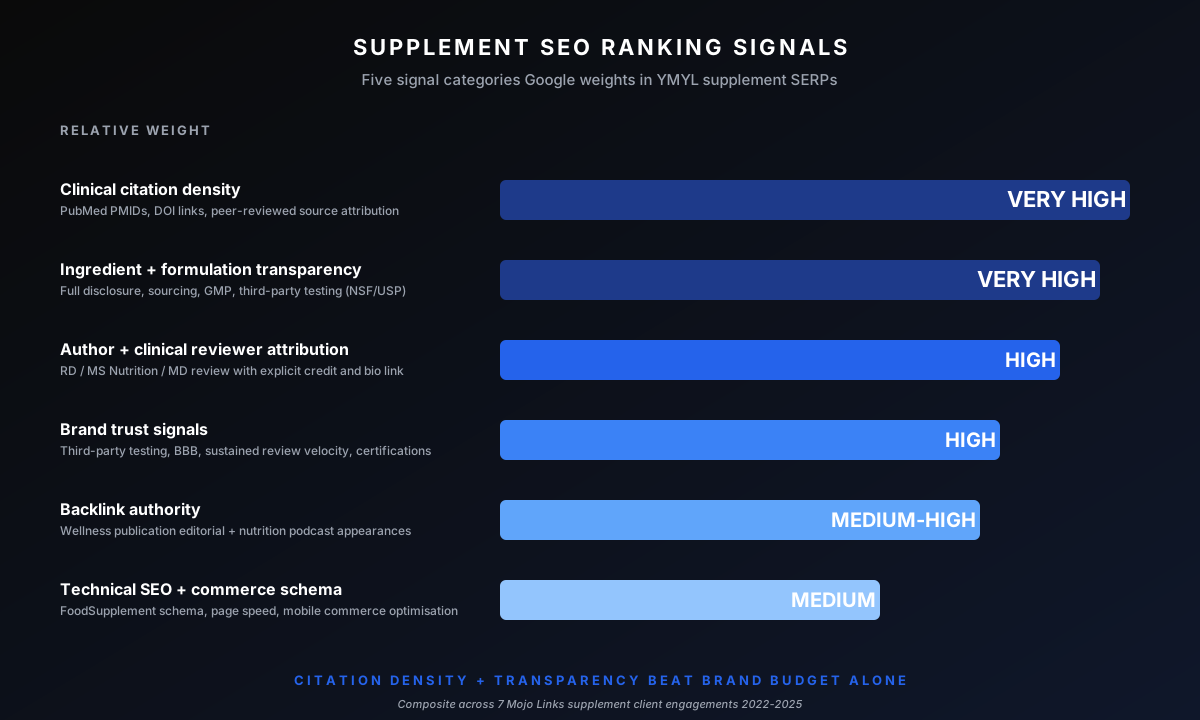
The factors that move supplement rankings cluster into four areas, weighted toward trust because of the health adjacency.
Trust and Compliance Signals
This is the factor most supplement sites get wrong. Google and shoppers both want proof the brand is credible and the claims are honest.
Ingredient transparency. Full labels, dosing, and sourcing, not a proprietary-blend black box.
Compliant claims. Structure/function language with the required disclaimer, never disease claims.
Real reviews. Genuine, specific customer reviews, which carry heavy weight in a trust-driven purchase.
Citations and expert input. References to research and named reviewers on health content.
These signals do double duty. They are what Google's health-quality systems look for, and they are what a cautious shopper checks before trusting a supplement with their body. Surfacing the label, the sourcing, and the evidence on the page satisfies both at once, which is why trust outranks clever keyword work in this niche.
Product and Content Pages
Supplement SEO needs both halves. Product pages have to be optimized for commercial intent: clear titles, benefits in compliant language, reviews, and structured data. Content pages, the ingredient guides and "does X work" explainers, capture researchers earlier and earn the links product pages cannot.
The buying journey is research-heavy in supplements, more than most e-commerce. Shoppers read about an ingredient, check whether the evidence holds, compare brands, then buy. A brand with only product pages meets them at the last step and misses every search that happens before the decision, which is where trust is actually won.
This is where a semantic architecture earns its keep, connecting each product to the ingredient, benefit, and comparison questions shoppers ask before they buy.
Backlinks and Authority
Backlinks remain one of the strongest off-page signals, and in supplements the substantiation bar raises the stakes. The FTC's Health Products Compliance Guidance requires competent and reliable scientific evidence behind every health benefit a supplement page claims, and the same evidence is what earns editorial links and the trust signals search rewards.
For supplements, the links that count come from health and wellness publications, genuine review sites, and editorial coverage, not the bulk directories that flood this space. Editorial link campaigns build the authority that lets a supplement brand outrank bigger e-commerce competitors.
Technical and E-Commerce SEO
Supplement sites are usually e-commerce builds, so the technical work is e-commerce work: fast product pages, clean faceted navigation that does not generate thin duplicate URLs, Product and Review schema, and a structure that keeps the catalog crawlable. A full-stack crawl surfaces the duplicate-URL and indexation issues that quietly cap a supplement store.
Speed and mobile experience matter more here than the average store. Supplement shoppers browse on their phones and abandon slow pages fast, and Google reads those abandonments as a quality signal. A fast, clean product page is both a conversion lever and a ranking one.
What Supplement SEO Looks Like in Practice
Mojo Links ran a link-building campaign for mindlabpro.com, a nootropic supplement brand, condensed into a two-month window. The site had strong product and content foundations. What it needed was the authority to compete, which is what the campaign delivered.
The result was not a two-month spike that faded. The brand sustained growth to over 26,000 monthly organic visits and held it, because the links landed on a site that already deserved to rank. That is the difference between renting traffic and building it. The full campaign breakdown lives in the supplement link building case study.
The lesson that transfers is sequencing, not the link count. Mind Lab Pro had compliant content, transparent labels, and real reviews before the campaign started, so the new authority had something to amplify. Point links at thin or non-compliant pages and you amplify nothing, or worse, you accelerate a page Google already distrusts.
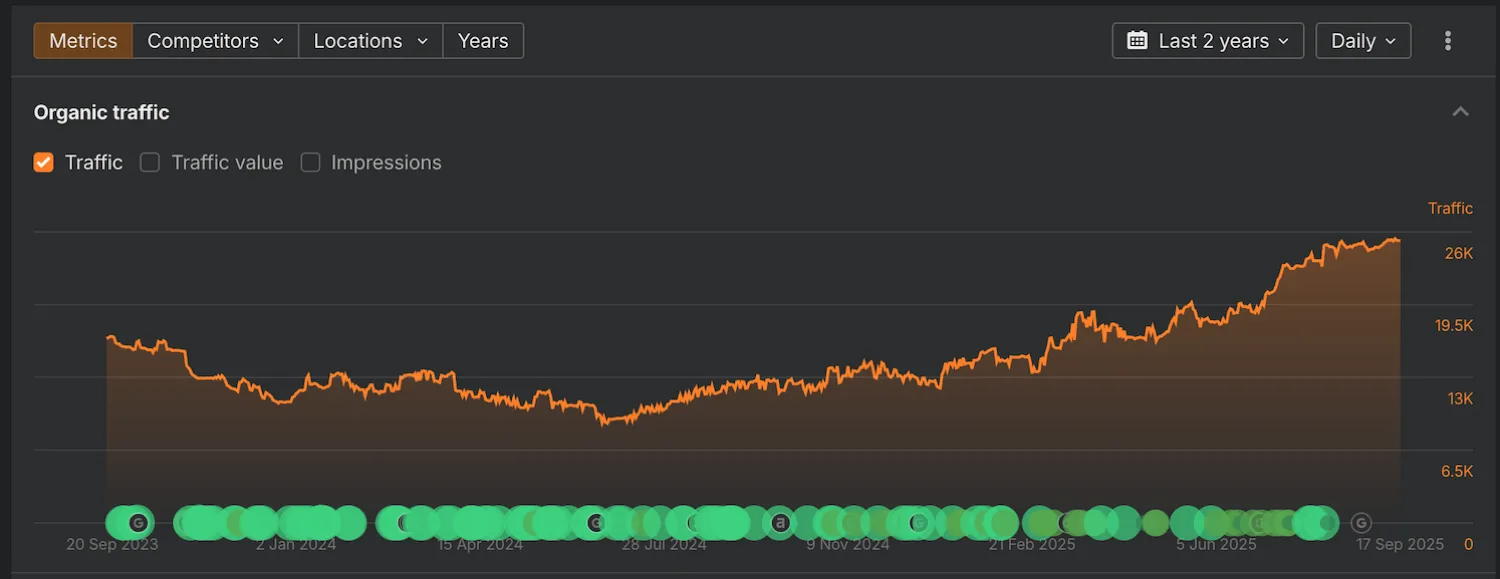
mindlabpro.com organic traffic, Ahrefs. A focused two-month link campaign compounding on a brand that already had its product and content foundation in place, sustaining 26,000+ monthly visits.
Supplement SEO and AI Search
AI answer engines now field a large share of "does X supplement work" and "best supplement for Y" research, and they cite the brands and sources they can verify. They lean on the same signals supplement SEO builds: compliant, accurate content, ingredient transparency, citations, and real reviews.
In a category full of hype and dubious claims, the brands an AI engine is willing to name are the ones that look honest and well-sourced to a machine. Compliant, evidence-based content is not just safer, it is what gets cited while the disease-claim pages get filtered out.
This is increasingly where the purchase starts. A shopper asks an assistant whether an ingredient works or which brand is reputable before they ever open a store, and the model answers from what it can verify. A brand absent from those answers is invisible at the moment of intent, and no promotion buys a place in an AI recommendation.
Common Supplement SEO Mistakes
Most supplement sites are not failing for exotic reasons. They are making the same handful of mistakes, and each one is fixable.
Disease claims. The fastest way to a warning letter and a distrusted page at once.
Hype-only product pages. No ingredient detail, no sourcing, no reviews, nothing Google or a shopper can trust.
Thin, duplicate product URLs. Faceted navigation generating hundreds of near-identical pages.
No educational content. Nothing to earn top-funnel traffic, links, or AI citations.
Buying bulk links. A polluted profile drags a health-adjacent domain down fast.
Proprietary-blend opacity. Hiding doses behind a blend label reads as evasive to both shoppers and Google.
Fix these and most brands climb before a single new product launches. The foundation was working against them the whole time.
How To Choose a Supplement SEO Partner
Choose for compliance fluency and a clean methodology, not promises. A partner who does not understand structure/function rules will either write claims that draw a warning letter or play it so safe the content says nothing.
Anyone who guarantees a number-one ranking is lying to you, because no one controls Google's algorithm. Ask how they keep claims compliant, where their links come from, and whether they can show results from a real supplement or health brand. Watch for the named-operator dodge and thousand-link packages.
Compliance fluency is the differentiator most generalists fake. A partner who has worked supplements knows where the structure/function line sits before legal flags it, which keeps the content both safe and persuasive. One learning the FDA rules on your dime is slower and riskier, and the warning letter lands on your brand, not theirs.
If you want a read on where your brand stands first, a free site audit covers your technical health, backlink profile, content gaps, and compliance exposure before you commit a budget.
Frequently Asked Questions
What Can a Supplement Brand Legally Claim in Its Content?
Structure/function claims, which describe how an ingredient supports normal body function, with the required FDA disclaimer. Brands cannot claim a supplement diagnoses, treats, cures, or prevents a disease. Compliant phrasing also tends to be the phrasing Google trusts, so the constraint rarely costs rankings.
How Long Does Supplement SEO Take To Work?
Long-tail ingredient and educational terms can move within a few months. Competitive product and "best supplement" terms take longer, especially against established retailers, but the field is often thinner than the search volume suggests, which makes focused brands competitive faster than in most e-commerce niches.
Do Reviews Matter for Supplement SEO?
Heavily. In a trust-driven, health-adjacent purchase, genuine reviews influence both rankings and the buying decision. Review schema can also earn rich results, and the volume and recency of reviews feed the credibility Google looks for.
Is Supplement SEO Worth It Given Restricted Ads?
Yes, and the ad restrictions are part of why. With supplement and health-claim advertising limited across major platforms, organic search becomes the most reliable scalable channel a brand can own and control.
What Is The Most Important Supplement SEO Ranking Factor?
Trust, expressed as compliant content, ingredient transparency, and real reviews. In a health-adjacent category, those signals decide whether a page ranks competitively. Product-page optimization and links then determine where.
Work with Mojo Links
I run these campaigns myself, which means I take a limited number of brands at a time and will not take two that compete in the same market. If you want a read on where your rankings, links, compliance, and content gaps actually stand, start with a personalized Loom video and we will map the path from there, while the ingredient and product terms you want are still winnable.

About Bart Magera
Bart Magera is the founder of Mojo Links. Ten years across YMYL verticals (legal, medical, finance, supplements, crypto, gambling). Trained under Koray Tuğberk Gübür's Topical Authority framework. Author of two SEO books and international speaker.
Want this kind of analysis on your site?
Get a free video walkthrough within 48 hours covering technical health, backlinks, content gaps, and AI visibility.
Related posts
Keep reading on adjacent topics.
- SEO
 Bart Magera9 min read
Brand Mentions for SEO: Linked, Unlinked, and AI Citations
Most SEO budgets still treat a mention without a link as a failed pitch. That math is out of date. The same editorial naming that builds your entity in Google now decides whether AI engines name you in answers. Here is the value model behind linked, unlinked, and AI-cited mentions, and the three lanes for earning more of them.
- SEO
 Bart Magera12 min read
AI Visibility Tools: 9 Trackers Ranked and Compared
Nine AI visibility tools, one yardstick: engines covered, what gets measured, competitor tracking, and price. Every page-one comparison of these trackers is written by a vendor ranking its own product first. This one is not. Here is where each tool fits, from a $29 entry plan to enterprise quotes, and the one thing none of them can do.
- SEO
 Bart Magera10 min read
ChatGPT Brand Mentions: How To Track and Earn Them
When a buyer asks ChatGPT for the best option in a category, it names a few brands inside the answer. Those ChatGPT brand mentions, not the linked citations beneath them, are what get you recommended. Here is how to track them and how to earn them.