

Roofer SEO: How Roofing Companies Win Local Jobs from Search
Listen to this article
Browser-native voice. No account required.
Almost every roofing job now starts the same way. A homeowner with a fresh leak or storm damage searches "roof repair near me," looks at the three companies in the map pack, reads a few reviews, and calls one. If your company is not in that shortlist, you were never in the running.
Roofer SEO is the work of being the company they call at each of those steps, and it is mostly a local game, not a national one. This is how it actually works for a roofing company, what moves it, and how to tell a real approach from a packaged one. It is the same local-first approach that works for heating and cooling companies and other local service businesses.
What Is Roofer SEO?
Roofer SEO is the practice of optimizing a roofing company's online presence so it appears when local homeowners search for roof repair, replacement, or storm-damage help. It spans the Google Business Profile and map pack, the company website, reviews, and local content, with the goal of turning local searches into booked jobs. It is local SEO applied to a home-services business.
Unlike a national retailer chasing broad keywords, a roofing company competes inside a service radius. The whole job is to be the most visible, most trusted option for the homeowners who are actually inside the area you serve. The same local-first job runs behind other outdoor home services like landscaping SEO.
Why Does Roofer SEO Matter for a Roofing Company?
Roofer SEO matters because the homeowners searching right now have high intent and call whoever shows up first. A full roof replacement can be worth tens of thousands of dollars, so one position in the map pack compounds into real revenue. Miss it, and that job goes to the roofer across town, just as it does for the electrical companies serving the same market.
It is also durable. Paid ads stop the moment the budget does, but a strong local presence and a deep review base keep producing leads month after month. A polished roofing website that ranks on page three is a very expensive brochure.
How Roofer SEO Is Different
Roofer SEO is local-first in a way most SEO is not. The biggest lever is not a blog post or a backlink; it is the Google Business Profile, the reviews, and the proximity signals that decide the map pack. National content strategy matters far less than local trust.
Most roofing companies are also service-area businesses, the same as the plumbers and contractors next door. You serve a radius and often work from a truck rather than a storefront customers visit, which changes how the profile is set up: you hide the street address and define service areas instead.
Roofing demand is also unusually event-driven. A large share of searches follow storms, hail and high wind, and many of those jobs are insurance claims rather than out-of-pocket repairs. That shapes both the timing of demand and the questions homeowners ask.
It is also a trust-sensitive market. Storm-chasers and fly-by-night crews have made homeowners wary, so reviews, real local presence, and trust signals carry even more weight than in other trades. The competition is hyper-local, and with replacement jobs worth five figures, even a modest lift in local visibility pays for the work several times over. It is the same local trust that underpins contractor SEO across every trade.
How Homeowners Find a Roofer
The path from search to phone call is short and decided early. A homeowner searches "roof repair near me" or "storm damage roof [town]," sees the map pack of three local results, scans the star ratings and recent reviews, then taps to call one before dialing anyone else. SEO either wins or loses the job at each of those steps.
The decision is also cautious. Roofing is a big, infrequent purchase in a market full of bad actors, so homeowners lean hard on reviews and signs of a real, established local company before they trust anyone on the roof. The companies that win have already built that proof.
Most of the filtering happens in the map pack and the reviews, before the homeowner ever reaches a website. A company can have a great site and still lose because it never made the local shortlist.
Roofer SEO Ranking Factors
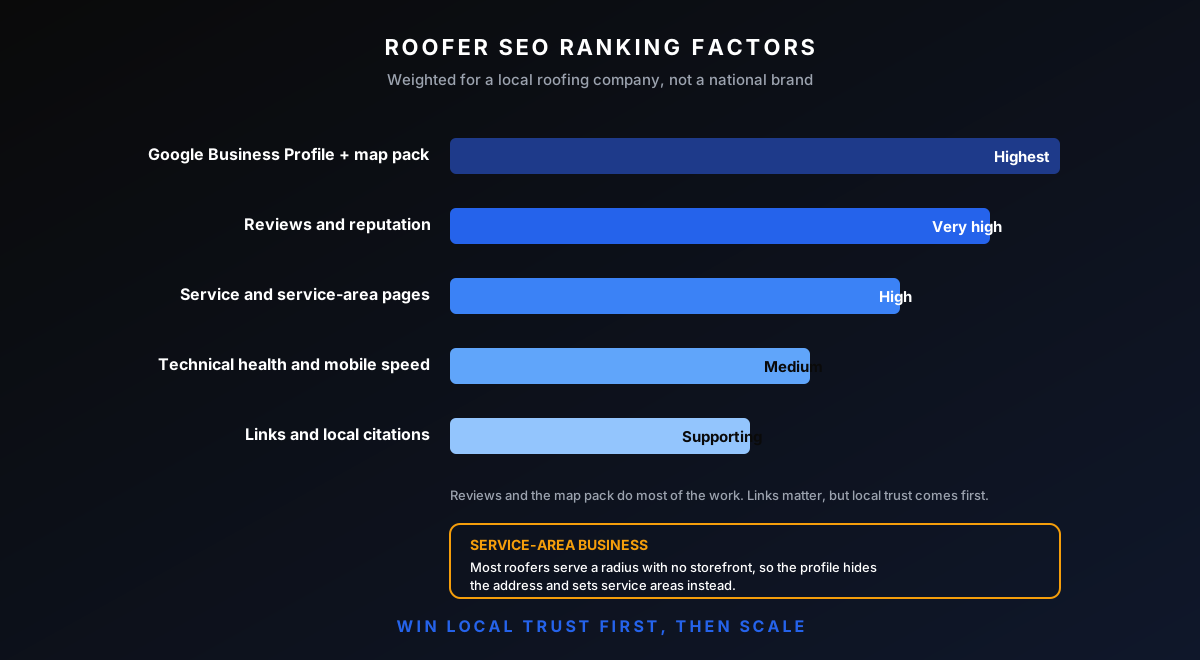
The factors that move roofing rankings are weighted differently than general SEO. Local trust signals dominate, content and technical health support them, and links play a smaller but real role. Here is the order to work them in.
Google Business Profile and The Map Pack
The Google Business Profile is the single most important asset in roofer SEO. A complete, accurate, active profile, with the right primary category, services, service areas, hours, photos, and a consistent name, address, and phone number, is what gets a company into the map pack. Google's local-ranking signals come down to relevance, distance, and prominence, and the profile is where you influence all three.
Most roofers treat the profile as set-and-forget, which is the opening. Keeping the primary category correct, defining service areas accurately, posting updates, adding real job photos, and answering questions all signal an active, legitimate business, and that activity is what separates the three companies in the map pack from the ones below them.
Reviews and Reputation
Reviews are both a ranking factor and the deciding factor for homeowners. Star rating, review volume, recency, and how the company responds all feed local prominence and customer trust. Reviews carry the kind of credibility membership in the National Roofing Contractors Association is meant to signal, and in a trade with a trust problem they weigh even heavier.
For roofing specifically, recent reviews that name the crew and the work counter the storm-chaser reputation. A simple, consistent process, where the crew asks at completion and a follow-up text sends the link, earns more genuine reviews than any one-off push.
Service and Service-Area Pages
Beyond the profile, the website needs clear pages for each service and each area the company covers. A dedicated roof repair page, a replacement page, a storm-damage page, and a page per town or region give Google something specific to rank and give homeowners the answer they searched for. Generic "our services" pages lose to specific ones.
The content also has to answer the questions homeowners actually ask: what a repair or replacement costs, whether damage is worth filing a claim for, how the insurance process works, how long a roof lasts. Pages that answer those win the long-tail searches and the customer's trust at the same time.
Technical Health and Mobile Speed
Most roofing searches happen on a phone, often right after a homeowner spots damage, so a fast, mobile-friendly site with click-to-call is non-negotiable. Local business schema, clean indexable pages, and quick load times remove the friction between a search and a booked inspection. Technical problems here quietly cap everything above them.
It does not take much to lose the lead: a slow page, a phone number that is not tappable, a quote form that breaks on mobile. These are unglamorous fixes that an audit surfaces fast, and they turn searches you already earn into actual calls.
Links and Local Citations
Links and consistent local citations, listings in directories and on local sites with matching company details, build the prominence Google looks for. The bar is lower than in national SEO: a handful of relevant local and trade links does more than a large generic profile. The same off-site authority fundamentals apply, but local relevance carries more of the weight than raw authority.
Name, address, and phone number should match exactly everywhere they appear. A company that changed its number or service area and never cleaned up its old listings sends Google conflicting signals, which quietly suppresses the map pack. The cleanup is tedious and worth it.
How Storm and Insurance Demand Shapes Roofer SEO
More than most trades, roofing demand is driven by weather events, and the SEO has to account for it. A hail or wind storm sends a surge of homeowners searching at once, and whoever already owns the map pack catches that surge. The work to rank has to be done before the storm, not after it hits.
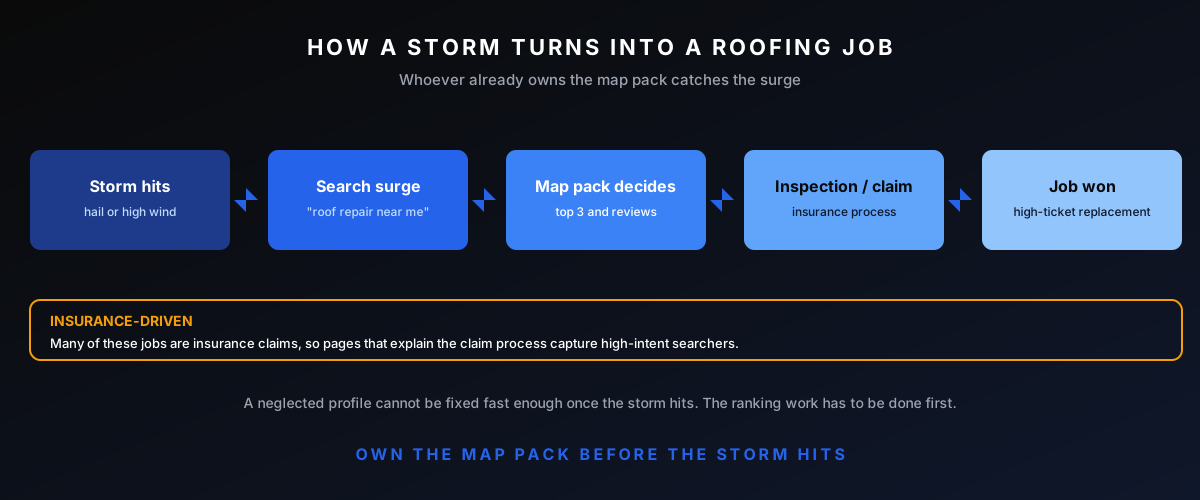
Many of those jobs are insurance claims, which changes the content that wins. Homeowners search whether damage is worth a claim, how the deductible works, and what the process looks like, so pages that answer the insurance questions honestly capture high-intent searches competitors ignore.
The companies that win storm season are the ones treating SEO as always-on. A neglected profile cannot be fixed fast enough when the storm arrives, but a company that has kept its profile, reviews, and storm-damage pages strong year-round is already ranked when the surge comes.
Roofer SEO by Service Line
Not every roofing search is equal, and the high-value jobs deserve their own dedicated pages. Each service line has its own intent, competition, and job value, and a company that wins the profitable ones outperforms one chasing only "roofer near me."
Roof repair. High-volume and often urgent; a reliable entry point that leads to larger jobs.
Roof replacement. The highest-ticket job and heavy research intent; a thorough page with costs and options wins these.
Storm and hail damage. Event-driven and insurance-heavy; a page that explains the claim process captures wary, high-intent searchers.
Roof inspection. Low-commitment entry point; a free or low-cost inspection page feeds the pipeline.
Gutters and related work. Add-on revenue; a dedicated page captures searches the roof pages miss.
Commercial and flat roofing. A separate buyer and sales cycle; worth its own track if the company serves it.
Metal and specialty roofing. Higher-margin niche; a focused page wins the homeowners specifically searching for it.
A company does not need to win all of these at once. Prioritize the service lines with the best mix of job value and winnable competition for that specific company and market.
Multi-location and multi-brand operators add a layer: each location needs its own profile, its own service-area pages, and locally consistent details, or the locations compete with each other and confuse the map pack. The fundamentals are the same, just repeated cleanly per location rather than merged into one generic page.
Roofer SEO and AI Search
AI is starting to answer "who is the best roofer near me" directly, pulling from the same local signals, reviews, profiles, and trusted mentions, that drive the map pack. A company strong in local SEO tends to be the one these answers surface, and the path to being cited mirrors ranking in AI Overviews.
The reassuring part is that there is no separate AI strategy for a roofing company. The local trust, reviews, and accurate information that win the map pack are the same signals the AI answers lean on. Do the local basics well and you show up in both.
How Long Roofer SEO Takes
Local SEO tends to move faster than national SEO. Profile and review improvements can shift map-pack visibility within weeks, while competitive service-page rankings take a few months to build. Most companies see meaningful movement in three to six months, with results compounding from there.
The timeline depends on the starting point and the market. A company with a neglected profile and few reviews can see quick early wins; one in a saturated metro fighting established roofers takes longer. Anyone promising page-one results in a few weeks is describing ads, not SEO.
Common Roofer SEO Mistakes
The most common mistake is neglecting the Google Business Profile while pouring budget into the website. The profile drives the map pack, and the map pack drives most leads, so an incomplete profile caps everything else. Fix the profile first.
The other recurring errors: inconsistent company details across listings; the wrong primary category or vague service areas; no system for earning steady reviews; one generic services page instead of dedicated service and storm-damage pages; and a slow mobile site that loses the lead.
The deeper mistake is only doing SEO reactively after a storm. Local rankings reward consistency, and a company that starts when the surge is already happening has missed it. Tie roofer SEO to booked inspections and jobs, not vanity rankings, because that is the only number that pays for the crews.
Choosing a Roofer SEO Approach
A company has three options: do it in-house, hire a generalist agency, or work with one that knows home services. In-house can work for the profile and reviews if someone owns it consistently. A generalist often misses the local-first, service-area weighting that roofing needs. A specialist gets to results faster but costs more.
Whichever you choose, judge it on booked inspections and jobs, not vanity rankings, and insist on transparency about what is actually being done. The work runs through monthly SEO built for revenue and, where authority is the gap, link building that compounds. Be wary of anyone guaranteeing rankings or selling a fixed package with no audit first.
Frequently Asked Questions
How Much Does Roofer SEO Cost?
It varies widely by market and scope, typically a few hundred to a few thousand dollars a month for ongoing local SEO. The right spend depends on how competitive your service area is and how many service lines you are targeting. Be cautious of very cheap packages; local SEO done badly can waste months. Judge cost against job value, not rank reports.
How Long Until a Roofing Company Sees Results?
Profile and review work can move map-pack visibility within weeks, while competitive service-page rankings take a few months. Most companies see meaningful lead growth in three to six months, compounding after that. The starting point and local competition set the pace; a neglected profile often shows quick early wins.
Is Local SEO The Same as Roofer SEO?
Local SEO is the biggest part of roofer SEO, but not all of it. Roofer SEO adds service-line content, service-area-business profile setup, storm and insurance-driven demand, and a trust-sensitive market on top of the local foundation. For most single-location companies, getting local SEO right is the majority of the work and the fastest path to leads.
Do Online Reviews Affect Roofer SEO?
Yes, significantly, and more than in most trades. Reviews influence local ranking through prominence and are often the deciding factor for a wary homeowner choosing between companies. Star rating, volume, recency, and your responses all matter. A steady flow of recent, genuine reviews outperforms a large but stale collection.
Can a Roofer Do SEO Themselves?
Parts of it, yes. A company can maintain its Google Business Profile, ask for reviews, and keep details consistent without an agency. The harder parts, competitive service-page content, technical health, and links, take time and expertise most roofers lack in-house. Many do the local basics themselves and bring in help for the rest.
Work with Mojo Links
Roofer SEO rewards companies that win local trust before they chase rankings, which is the work we run for clients in competitive local verticals. We start with where the jobs are actually decided, the profile, the reviews, the service-area pages, and build from there. A free local SEO audit includes a read on your local visibility, your reviews, and the gaps a competitor is exploiting.

About Bart Magera
Bart Magera is the founder of Mojo Links. Ten years across YMYL verticals (legal, medical, finance, supplements, crypto, gambling). Trained under Koray Tuğberk Gübür's Topical Authority framework. Author of two SEO books and international speaker.
Want this kind of analysis on your site?
Get a free video walkthrough within 48 hours covering technical health, backlinks, content gaps, and AI visibility.
Related posts
Keep reading on adjacent topics.
- SEO
 Bart Magera9 min read
Brand Mentions for SEO: Linked, Unlinked, and AI Citations
Most SEO budgets still treat a mention without a link as a failed pitch. That math is out of date. The same editorial naming that builds your entity in Google now decides whether AI engines name you in answers. Here is the value model behind linked, unlinked, and AI-cited mentions, and the three lanes for earning more of them.
- SEO
 Bart Magera12 min read
AI Visibility Tools: 9 Trackers Ranked and Compared
Nine AI visibility tools, one yardstick: engines covered, what gets measured, competitor tracking, and price. Every page-one comparison of these trackers is written by a vendor ranking its own product first. This one is not. Here is where each tool fits, from a $29 entry plan to enterprise quotes, and the one thing none of them can do.
- SEO
 Bart Magera10 min read
ChatGPT Brand Mentions: How To Track and Earn Them
When a buyer asks ChatGPT for the best option in a category, it names a few brands inside the answer. Those ChatGPT brand mentions, not the linked citations beneath them, are what get you recommended. Here is how to track them and how to earn them.