

How To Rank in Google's AI Overviews: What Actually Gets You Cited
Listen to this article
Browser-native voice. No account required.
Half the advice on ranking in AI Overviews is invented. There is no AI Overviews schema to add and no setting to flip, no matter what the LinkedIn carousel promised.
The honest version is simpler and less sellable: AI Overviews cite pages that already rank well in normal search, and Google says there is no special optimization beyond good SEO. So the work is to earn the ranking, then be the cleanest, most trustworthy source for the question. This is how to do both, and how it fits the wider LLM SEO picture.
What Are Google's AI Overviews?
Google's AI Overviews are AI-generated summaries that appear at the top of some search results, answering the query directly and citing a handful of source pages. They show up most on informational and complex queries, where Google judges a synthesized answer more useful than a plain list of links. The cited sources get a visible link and the attention that comes with it.
They are not a separate search engine. They sit on top of normal Google results, drawn from the same index, which is the single most important fact for anyone trying to appear in them.
How Does Google Choose AI Overview Sources?
Google assembles an AI Overview from pages that already rank well for the query and its related sub-questions, favoring sources it considers trustworthy and that answer the question cleanly. Independent analysis backs this up: an Ahrefs study of what actually works in AI Overviews found that cited pages overwhelmingly already rank in the classic top results for the query.
In other words, the AI Overview is not picking obscure pages out of nowhere. It is summarizing the same pages that were already winning, then attributing them. That reframes the whole task: the lever is your organic ranking, not a hidden AI setting.
The wrinkle is query fan-out. Google breaks one query into a set of related sub-questions and pulls from pages that answer each, so an overview can cite several sources, not just the single top result. A page that answers the main question and its obvious follow-ups gives Google more entry points to cite it.
Rank in The Classic Top 10 First
If citations come from pages that already rank, the first and biggest lever is obvious: rank for the query in normal search. A page sitting at position 30 is not in the running, no matter how cleanly it is written. The AI Overview draws from page one.
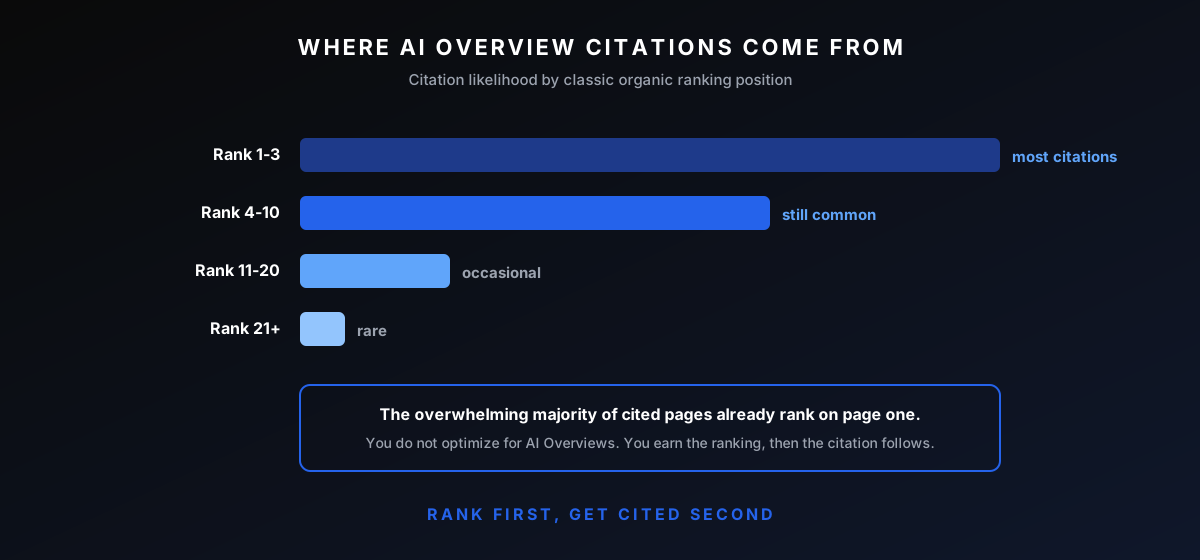
That means the foundation of AI Overview visibility is the same foundation as everything else: relevant content, technical health, and authority. The off-site authority building that gets you into the top 10 is the same work that gets you cited, which is why AI search did not make link building obsolete. It raised the prize for ranking.
This is also why any AI Overview strategy that skips the ranking conversation deserves distrust. If a page is not competitive in normal search, the honest first step is to make it competitive, not to tweak it for a box it is not eligible for. Ranking is not a prerequisite you can optimize around.
What Gets a Page Cited
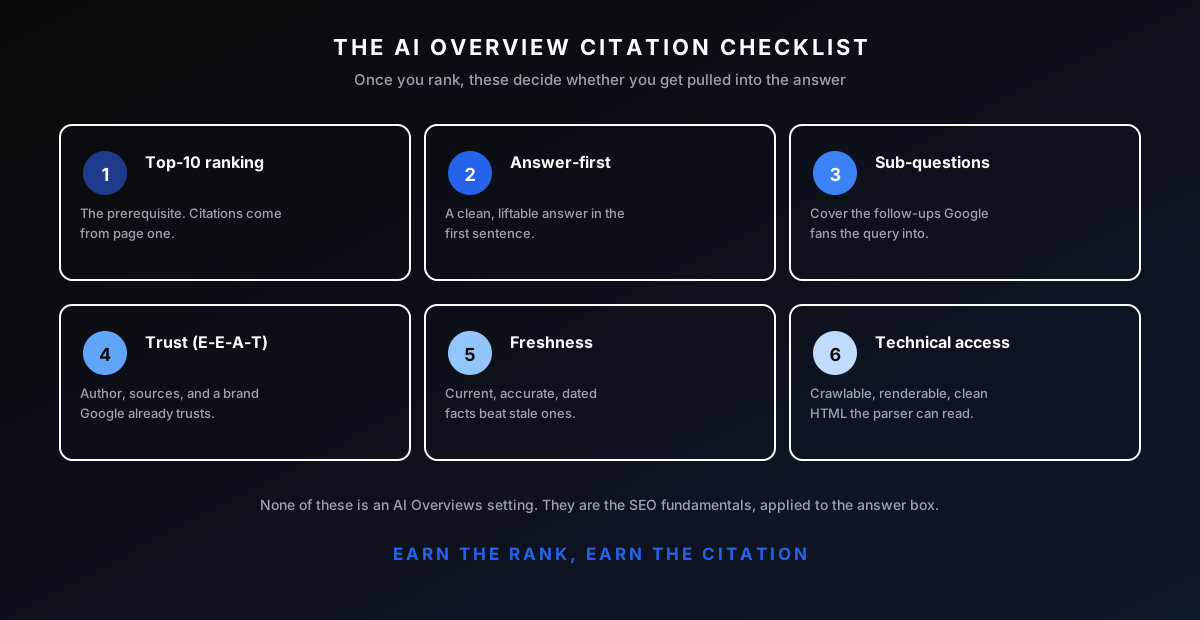
Once you rank, a second set of factors decides whether Google lifts your page into the answer. None of these is an AI Overviews setting. They are the SEO fundamentals, the ones GEO and SEO share, pointed at the answer box.
Answer The Question, Fast and Clean
The system lifts self-contained answers. A page that states the answer in the first sentence under a clear heading is far easier to extract and attribute than one that buries it after three paragraphs of preamble. Write so a single passage can stand alone as the answer, the same structure that wins featured snippets.
Google's guide to optimizing for AI features sets the eligibility baseline: a page has to be indexed and eligible to show with a snippet before it can be cited. The GEO research on generative engines covers the content side: clear citable statements, statistics, and quotations get surfaced more often than vague prose. Concrete beats hand-wavy, for the parser as much as for the reader.
Cover The Query's Sub-Questions
Google fans a single query into a cluster of related questions and assembles the overview from pages that answer them. A page that covers the main question plus the obvious follow-ups gives the system more reasons to cite it. Thin pages that answer only the literal query get passed over for more complete ones.
In practice this rewards genuinely thorough pages over thin ones, which is the opposite of the "keep it short for AI" advice making the rounds. Depth that answers the whole question cluster is what earns the citation, as long as the key answer is still easy to find up top.
Demonstrate Trust
Google leans on sources it already trusts, so experience, expertise, authoritativeness, and trust signals matter as much here as anywhere. A named author with credentials, cited data, and a brand the web already vouches for all help. Unlinked brand mentions and a strong reputation feed the same trust the overview relies on.
Stay Fresh and Accurate
AI Overviews favor current, verifiable information, and a stale page gets passed over for an updated competitor. Dated statistics and unsupported claims are a fast way to lose a citation you once had. Keep your cornerstone pages current, dated, and sourced.
Accuracy matters more than usual here because Google is putting its own name on the answer. A page it can trust to be factually right is a safer source to summarize than one that might embarrass the overview, so verifiable, well-sourced claims get the nod.
Be Technically Accessible
Google cannot summarize what it cannot render. Clean, crawlable, server-rendered HTML is the baseline, which is the heart of JavaScript SEO, and the rest of the technical foundation is what a full SEO audit confirms before any of this is worth chasing.
There Is No AI Overviews Trick
Google has said this plainly. Its guidance on succeeding in AI search states there is nothing special to do for AI features beyond the SEO you should already be doing: helpful, reliable, people-first content with a good technical foundation. There is no markup, no file, and no setting that opts you in.
This is worth repeating because the opposite is being sold hard. Anyone offering an "AI Overviews optimization" service that is not just strong SEO is selling you a trick that does not exist. The research agrees that structure and credibility help; it does not support any magic lever.
How AI Overviews Fit The Bigger AI-Search Picture
AI Overviews are Google's version of a shift happening across every answer engine. The same content that gets cited here, extractable, trustworthy, frequently referenced, is what gets surfaced by ChatGPT and Perplexity too. That wider game is covered in the LLM SEO pillar, of which AI Overviews are one important surface.
The practical upside is that you do not optimize separately for each engine. Earn the ranking and the trust, structure the content to be lifted, and you tend to show up across the board rather than chasing one box at a time.
How To Track Your AI Overview Presence
Measurement is honest work here, because Search Console does not break out AI Overview citations cleanly. The reliable method is to run the queries you care about and record whether an AI Overview appears and whether your page is cited, then repeat on a schedule to see movement. Dedicated AI visibility trackers can scale that sampling once the manual routine proves the queries worth watching.
Watch your top-ranking informational pages especially, since those are the ones eligible to be cited. Pair the manual checks with the AI-visibility trackers that are emerging, the same ones used to track brand mentions in Google Gemini, but treat any single "AI Overview score" with suspicion. The trustworthy signal is whether you appear when real queries are run.
It also helps to test from a clean, signed-out session, because results personalize. Run the queries the way a new prospect would, not the way you would, or you will measure your own history instead of the overview a stranger actually sees.
Common Mistakes
The first mistake is chasing AI Overviews while ignoring the ranking that feeds them. Optimizing a page-three result for the answer box is effort spent on the wrong problem; get it onto page one first. The second is believing the trick-sellers and buying markup or files that do nothing.
The third is panic-stripping content to be "concise for AI" and gutting the depth that earned the ranking in the first place. Add a clean answer up top; do not delete the substance underneath it. The page still has to be the best result, not just the most quotable sentence.
Are AI Overviews Worth Optimizing For?
Yes, but not as a separate project. AI Overviews can reduce clicks by answering in place, which is a real concern, but being the cited source keeps your brand visible even when the click does not happen, the payoff of AI brand mentions explained, and it sends qualified traffic when it does. Being absent from the answer is the worse outcome.
Because the work is just strong SEO pointed at the answer box, the cost of "optimizing for AI Overviews" is mostly the cost of doing SEO well, which you should be doing anyway. The brands that rank and earn trust get the citations; the ones looking for a shortcut get neither.
Frequently Asked Questions
How Do I Get My Content in An AI Overview?
Rank in the top 10 for the query first, then make the page easy to cite: answer the question cleanly up top, cover the related sub-questions, show clear expertise and current data, and keep the page technically accessible. There is no separate AI Overview submission or markup; citation follows ranking and trust.
Does Ranking #1 Guarantee An AI Overview Citation?
No. Ranking well makes you eligible, not guaranteed. Google still chooses which ranking pages best answer the query and its sub-questions, and not every query even triggers an AI Overview. A strong rank plus extractable, trustworthy content gives you the best odds, but it is odds, not a switch.
Do I Need Structured Data for AI Overviews?
Structured data helps Google understand your page and can support eligibility for rich results, but it is not a required AI Overviews lever and adding it does not force a citation. Use schema where it genuinely fits the content. Do not expect it alone to put you in the answer box.
Can I Opt Out of AI Overviews?
You can use the nosnippet and related meta tags to limit how your content is used in Google features, which can keep you out of AI Overviews, but it also tends to cost you the visibility entirely. For most brands the better move is to be cited well, not to opt out. Weigh it carefully.
Are AI Overviews Killing Organic Traffic?
They are changing it. AI Overviews can answer simple queries without a click, which reduces traffic on those, but they also send qualified clicks when the user wants more, and being cited preserves brand visibility. The bigger risk is being absent from the answer entirely while a competitor is named.
Want Mojo Links To Win You AI Overview Citations?
Getting cited in AI Overviews is not a separate service; it is ranking well and being the most trustworthy, extractable source, which is the work we run every day. We get pages into the top results and structured to be cited. A free AI visibility audit includes a read on where you rank, where you are cited, and the gaps between the two.

About Bart Magera
Bart Magera is the founder of Mojo Links. Ten years across YMYL verticals (legal, medical, finance, supplements, crypto, gambling). Trained under Koray Tuğberk Gübür's Topical Authority framework. Author of two SEO books and international speaker.
Want this kind of analysis on your site?
Get a free video walkthrough within 48 hours covering technical health, backlinks, content gaps, and AI visibility.
Related posts
Keep reading on adjacent topics.
- SEO
 Bart Magera9 min read
Brand Mentions for SEO: Linked, Unlinked, and AI Citations
Most SEO budgets still treat a mention without a link as a failed pitch. That math is out of date. The same editorial naming that builds your entity in Google now decides whether AI engines name you in answers. Here is the value model behind linked, unlinked, and AI-cited mentions, and the three lanes for earning more of them.
- SEO
 Bart Magera12 min read
AI Visibility Tools: 9 Trackers Ranked and Compared
Nine AI visibility tools, one yardstick: engines covered, what gets measured, competitor tracking, and price. Every page-one comparison of these trackers is written by a vendor ranking its own product first. This one is not. Here is where each tool fits, from a $29 entry plan to enterprise quotes, and the one thing none of them can do.
- SEO
 Bart Magera10 min read
ChatGPT Brand Mentions: How To Track and Earn Them
When a buyer asks ChatGPT for the best option in a category, it names a few brands inside the answer. Those ChatGPT brand mentions, not the linked citations beneath them, are what get you recommended. Here is how to track them and how to earn them.