
AI Brand Mentions: What They Are and Why They Matter
Listen to this article
Browser-native voice. No account required.
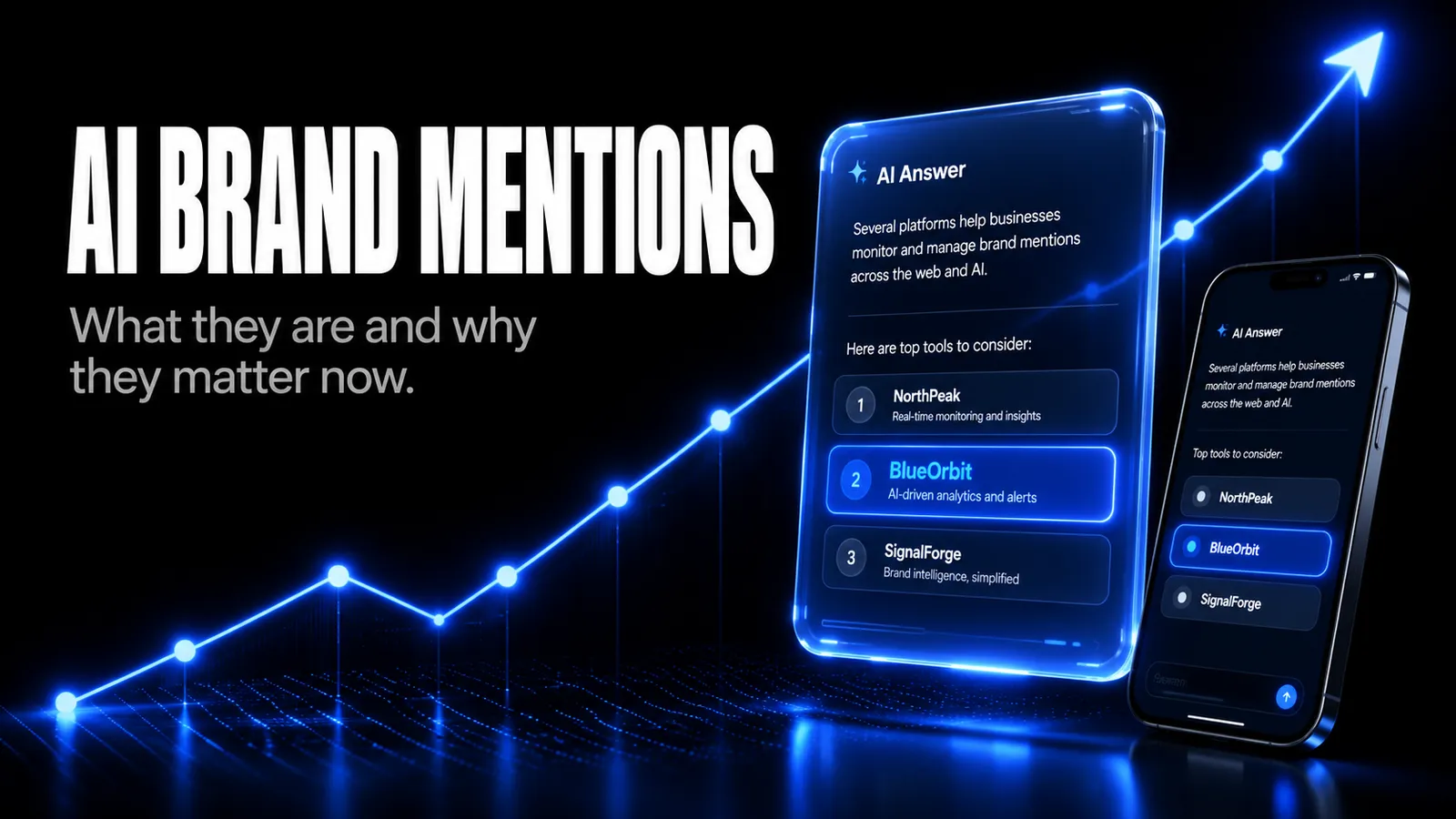
Ask ChatGPT for the best CRM for a small agency and it answers with a short list of names. It does not hand you ten blue links to sort through. It names a few brands and moves on, and that list is the whole game now.
An AI brand mention, sometimes called a brand mention in generative AI, is your name making that list. It is a different unit from a ranking or a backlink, it behaves differently, and it is fast becoming the visibility metric that decides whether buyers ever hear of you. Here is what AI brand mentions are and why they matter.
What Are AI Brand Mentions?
AI brand mentions, also called brand mentions in generative AI, are instances where an AI assistant like ChatGPT, Perplexity, Gemini, or Google AI Overviews names your brand inside an AI generated answer. They are how a brand gets discovered in AI search, the same role a top-three ranking used to play for classic search engines.
The unit is the brand as an entity, not a page, the same shift to entity-based optimization that defines semantic SEO. A model does not rank your URL; it decides whether your brand belongs in the answer, then names it. That shift, from page to entity, is the foundation of LLM SEO, and it changes what you optimize for.
In plain terms, an AI brand mention is your business turning up by name in the content an AI system generates. It works as a visibility signal, the same off-site currency behind brand mentions and SEO more broadly: the more often credible information names you, the more readily an AI platform and other AI systems surface your brand when buyers search. A new brand with little coverage stays invisible no matter how good its own pages are.
All of it rests on content. AI platforms and LLMs learn your brand from the content and information published about you across the web, then surface that learning in their responses. The brands that appear when a buyer's search becomes a question are the ones whose information the platforms have already seen and trusted.
Explicit vs Implicit Mentions
An explicit mention names you outright: "tools like Acme Flow, Linear, and Asana." An implicit mention describes you without the name: "a lightweight tracker built for small agencies that bills per seat." Explicit mentions are the ones you want, because the buyer leaves with your name, not a description they have to go match.
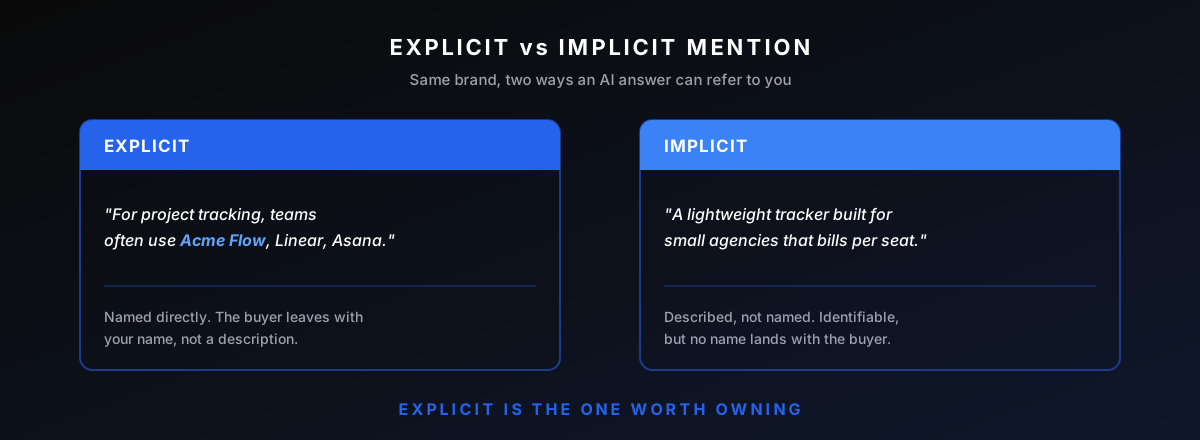
Both shape how a model understands your category, but only the explicit one puts your brand in the buyer's head. A lot of placement work is about converting the implicit, the brand that gets described but not named, into the explicit.
In practice a brand usually starts implicit, described but unnamed, and the job is to earn enough explicit, named coverage that the model stops hedging and says the name. That move, from described to named, is the entire point of AI brand mention work. Across the industry these are also called AI mentions, and context matters: an AI system can identify your product from a description alone, or name it outright.
How Are AI Brand Mentions Different from Backlinks and Citations?
A mention names your brand in the text, a citation attributes a statement to a source page, and a backlink is a clickable link from one site to another. They overlap, but they are three different things, and AI search values them in that order more than classic SEO ever did.
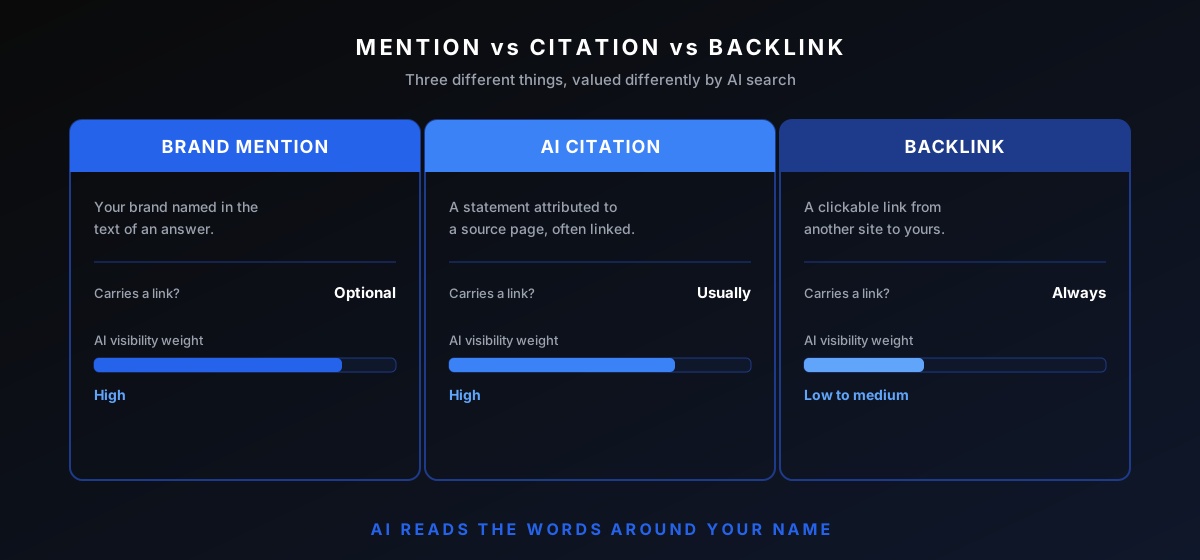
A backlink is a vote between pages. A citation is an AI engine showing its work by pointing at a source. A mention is the model simply knowing your brand exists and belongs in an answer, which is the part that decides whether you get named at all.
The practical point: a mention does not need a link to count. That is why unlinked brand mentions stopped being an SEO footnote and became a primary lever. The model is reading the sentence your name sits in, not just following hyperlinks out of it.
A concrete version: a journalist writes "we tested Acme Flow" with no link, and that is a mention. ChatGPT later answers a question and footnotes that article, and that is a citation. The article also links the word Acme to your site, and that is a backlink. One sentence can produce all three, or just the first, and the first is the one that gets you named.
Why does the distinction matter in practice? Because you can rack up citations and still lose the buyer, or carry almost no links and still get named in every answer. Optimizing only for the linked citation is optimizing for the narrowest of the three signals.
It pays to be precise about citations. A citation is the AI system showing its work, linking the content and information it pulled from, while a mention is simply your brand named in the text. Both build AI visibility, but a page can collect citations while the brand still struggles for visibility, which is why counting citations alone misreads your real reach.
Why Do AI Brand Mentions Matter Now?
AI brand mentions matter now because buyers increasingly end their research inside the answer. When ChatGPT names three project tools and yours is not one, there is no page two to climb onto and no second chance to be discovered. The answer is the result.
This is the zero-click shift, accelerated. Featured snippets started it; AI answers finished it. The same move toward being the named source, not just a ranked link, runs through GEO and SEO, because the brands cited in AI answers are overwhelmingly the ones already trusted in classic search.
Picture the difference. A classic results page hands the buyer ten links to compare and rank for themselves; an AI answer hands them three names and stops there. If your brand is not one of the three, the buyer never learns it exists.
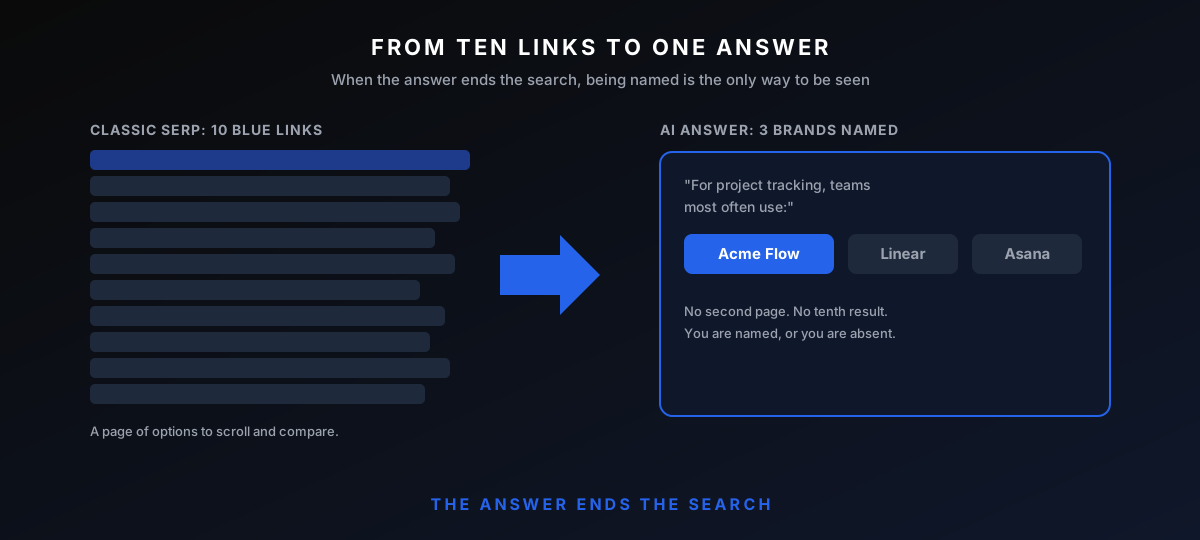
There is a compounding angle too. The brands an engine names are the ones it has already learned from, and that footprint takes months to build. A brand that waits until AI search is obviously dominant is starting a race everyone else began a year earlier.
Which Businesses Need AI Brand Mentions Most?
Businesses whose buyers research before they purchase need AI brand mentions most: software, agencies, professional services, B2B, and any considered purchase. Those buyers open an assistant first, and the brands it names shape the shortlist before a human visits a single website.
The urgency is lower for pure local or impulse businesses. A nearby plumber still wins on the map pack and reviews more than on a ChatGPT citation. A SaaS competing for "best tool for X," a law firm, or a clinic whose patients ask AI about treatments is already being filtered inside answers it cannot see.
A simple test: type the question your best customer would ask an assistant, in your category, and read the answer. If a competitor is named and you are not, that gap is costing you pipeline right now, quietly, every day it stands.
How Do AI Brand Mentions Influence Buying Decisions?
AI brand mentions influence buying decisions because buyers treat a named recommendation as a ready-made shortlist. When an AI system answers a high-intent query by naming three businesses, those names carry the weight a top ranking once did. To appear there lifts your AI visibility immediately, and the buyer rarely looks further.
That influence compounds for a new brand. A business that appears in AI responses gains a kind of borrowed trust, because the AI platform, not the company, made the introduction. The brands that show up early shape how buyers frame the whole category and which options they include at all.
Where Do AI Brand Mentions Show Up?
AI brand mentions show up anywhere an assistant generates an answer: ChatGPT, Perplexity, Google AI Overviews and AI Mode, Gemini, and Microsoft Copilot. Each leans on a different mix of sources, so the same brand can be named in one and missing from another.
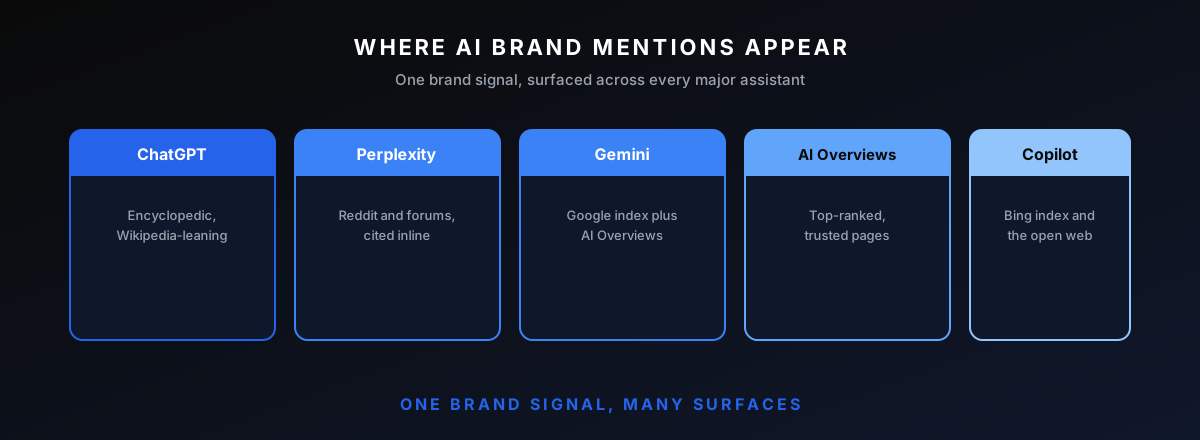
ChatGPT. Leans encyclopedic, with Wikipedia and established reference sources weighted heavily.
Perplexity. Leans on Reddit, forums, and fresh editorial, with its sources cited inline.
Gemini and AI Overviews. Pull from Google's index and favor pages that already rank and are trusted.
Microsoft Copilot. Draws on the Bing index and the open web, including news and reference sites.
That source split is why visibility work cannot target a single engine. A brand strong on Reddit may surface in Perplexity yet stay invisible in ChatGPT, which leans more on reference sites. Broad, credible coverage is what gets a brand named across all of them.
How Does AI Decide Which Brands To Mention?
AI decides which brands to mention by leaning on the brands it sees ranked, referenced, and trusted across the web, not the ones with the most backlinks. Strong organic presence and frequent, credible mentions are what teach an AI system that your brand answers a given query, the same way they earn citations in AI generated content.
Seer Interactive's study of what drives brand mentions in AI answers found Google page-one rankings correlate around 0.65 with brand mentions in LLM answers, while backlinks showed weak or neutral impact. The signal is presence and trust across the web, not raw link volume.
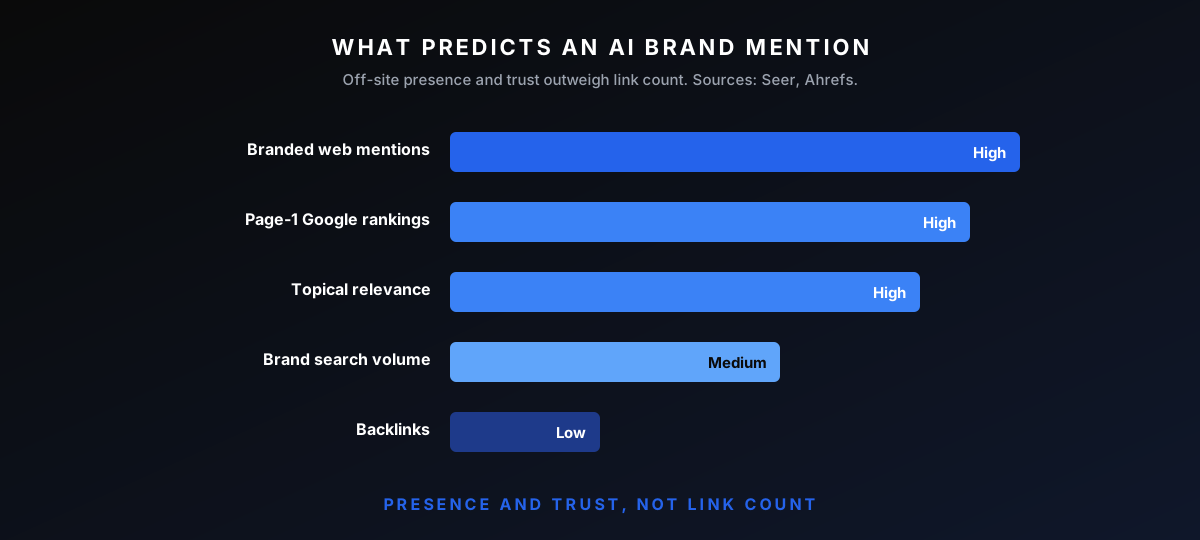
So the inputs are familiar, just reweighted. Authority, topical relevance, and a brand that credible sources and LLMs keep naming all feed the decision, with mention frequency carrying more weight than it ever did for a blue-link ranking.
The signals are familiar from traditional search. LLMs and other AI systems build an understanding of your category from patterns across the web: which businesses search engines already rank, which names credible content repeats, and how often. Strong, consistent signals teach the models to include you in the answer.
None of this is unique to one engine. The same patterns drive mentions in AI search across LLMs and traditional search engines alike: an AI system that has seen your brand in high-quality content, again and again, builds an understanding that you belong in the answer. That is why brand mentions in AI answers track so closely with broad organic visibility.
The pattern holds across media types. Mentions in trusted editorial, on Reddit, and in video reviews all feed the same brand signal, which is why a single press hit rarely changes the AI generated answer and a steady drumbeat of content does.
That also explains why on-page tricks fall flat. No tag forces a mention, because the decision is made from your brand's footprint across the web, not from anything on the page being judged. You earn the mention upstream, in the coverage, long before the prompt is typed.
What this means in practice is simple. Earn the rankings and earn the mentions, and the AI citations follow, because the same trusted, well-referenced brand is the one the model reaches for. There is no separate AI tactic hiding underneath.
How Do You Earn and Track AI Brand Mentions?
You earn AI brand mentions by getting named in genuine editorial on credible, topically relevant publishers, and you track them by prompt-testing the AI platforms on the queries your buyers ask. One is the work; the other is the scoreboard.
The earning side is a placement and digital-PR job, covered step by step in how to get mentioned in AI search. It is also what AI brand mention placement runs as a done-for-you campaign, scoped by domain rating, with no PBNs or link farms.
To be clear about the split: this page explains what AI brand mentions are and how they work. If you would rather have them earned for you, scoped and managed end to end, that is the done-for-you service, not a guide to follow yourself.
The tracking side is its own discipline, because there is no Search Console for AI answers. The reliable method is to track brand mentions by running your buyer queries across the major AI platforms on a schedule and recording when you appear, engine by engine, from brand mentions in Google Gemini to ChatGPT.
Tracking is its own discipline. Run a fixed set of prompts, the real queries your buyers type, across the platforms, then record where you appear, your share of each answer, and the positive or negative sentiment of the mention. Keep the prompts stable so the numbers compare cleanly month to month. Watching that trend over time is how you know the work is improving your AI visibility. To improve the numbers, note which prompts and search engines surface you, and read each AI generated answer in context.
Run that check on a fixed cadence, monthly at least, and log the movement per engine. The point is not a single vanity score but a trend: are you named in more answers, against more competitors, than you were last quarter?
What Are Common Mistakes with AI Brand Mentions?
The most common mistake is treating them as a technical task, chasing an llms.txt file or a schema tweak instead of the editorial coverage that actually earns them. The second is counting citations alone and missing the unlinked mentions, which are the larger share of how a brand gets named.
The other recurring errors: buying cheap PBN or link-farm placements that the engines discount, expecting to pay an assistant for a slot that does not exist, and tracking one engine while ignoring the rest. Genuine coverage on credible, topically relevant sites beats all of it.
The deepest mistake is waiting. Because the footprint compounds slowly, a brand that delays until AI search obviously dominates hands a head start to every competitor already being named today.
Frequently Asked Questions
What Is An AI Brand Mention?
An AI brand mention is any instance where an AI assistant like ChatGPT, Perplexity, or Gemini names your brand inside an AI generated answer. It is how brands get discovered in AI search, whether the mention carries a link or not.
What Is The Difference Between a Brand Mention and a Citation?
A mention names your brand in the text of an answer. A citation attributes a statement to a specific source page, usually with a link. A brand can be mentioned without being cited, and most are.
Do AI Brand Mentions Need a Link To Count?
No. The model reads the words around your brand name, so an unlinked mention still teaches it that your brand belongs in the answer. Linked mentions add referral value, but the visibility signal does not depend on the link.
Why Do AI Brand Mentions Matter for SEO?
Because AI answers increasingly replace the click. When the assistant names a short list and the buyer stops there, being named is the only way to be seen, and the brands named are the ones referenced and trusted across the web.
How Do You Get More AI Brand Mentions?
Get your brand named in credible, topically relevant editorial across the web, the sources these models learn from. Consistent third-party coverage, organized by domain strength, is what moves you from described to named.
Which AI Assistants Show Brand Mentions?
All the major ones: ChatGPT, Perplexity, Google AI Overviews and AI Mode, Gemini, and Microsoft Copilot. Each weights sources differently, so a brand can be named in one and missing from another, which is why tracking covers several engines.
Are AI Brand Mentions The Same as AI Citations?
No. An AI brand mention names your brand in the answer; an AI citation links to or attributes a source page. Assistants mention brands far more often than they cite sources, so counting only citations undercounts your real AI visibility.
How Many AI Brand Mentions Do You Need To Get Cited?
There is no fixed number. It depends on your category, your competitors, and how trusted the sources are. The practical bar is enough consistent coverage that your brand is one of the names a model reliably reaches for, which compounds over months.
Work with Mojo Links
AI brand mentions reward the brands that credible publishers keep naming, which is the work we run for clients. We earn your brand genuine editorial mentions on vetted sites, scoped by domain rating, so the engines learn to name you when buyers ask. The AI Brand Mentions service lays out the spread by domain strength.

About Bart Magera
Bart Magera is the founder of Mojo Links. Ten years across YMYL verticals (legal, medical, finance, supplements, crypto, gambling). Trained under Koray Tuğberk Gübür's Topical Authority framework. Author of two SEO books and international speaker.
Want this kind of analysis on your site?
Get a free video walkthrough within 48 hours covering technical health, backlinks, content gaps, and AI visibility.
Related posts
Keep reading on adjacent topics.
- SEO
 Bart Magera9 min read
Brand Mentions for SEO: Linked, Unlinked, and AI Citations
Most SEO budgets still treat a mention without a link as a failed pitch. That math is out of date. The same editorial naming that builds your entity in Google now decides whether AI engines name you in answers. Here is the value model behind linked, unlinked, and AI-cited mentions, and the three lanes for earning more of them.
- SEO
 Bart Magera12 min read
AI Visibility Tools: 9 Trackers Ranked and Compared
Nine AI visibility tools, one yardstick: engines covered, what gets measured, competitor tracking, and price. Every page-one comparison of these trackers is written by a vendor ranking its own product first. This one is not. Here is where each tool fits, from a $29 entry plan to enterprise quotes, and the one thing none of them can do.
- SEO
 Bart Magera10 min read
ChatGPT Brand Mentions: How To Track and Earn Them
When a buyer asks ChatGPT for the best option in a category, it names a few brands inside the answer. Those ChatGPT brand mentions, not the linked citations beneath them, are what get you recommended. Here is how to track them and how to earn them.