

LLM SEO: How To Get Your Site Cited in AI Answers
Listen to this article
Browser-native voice. No account required.
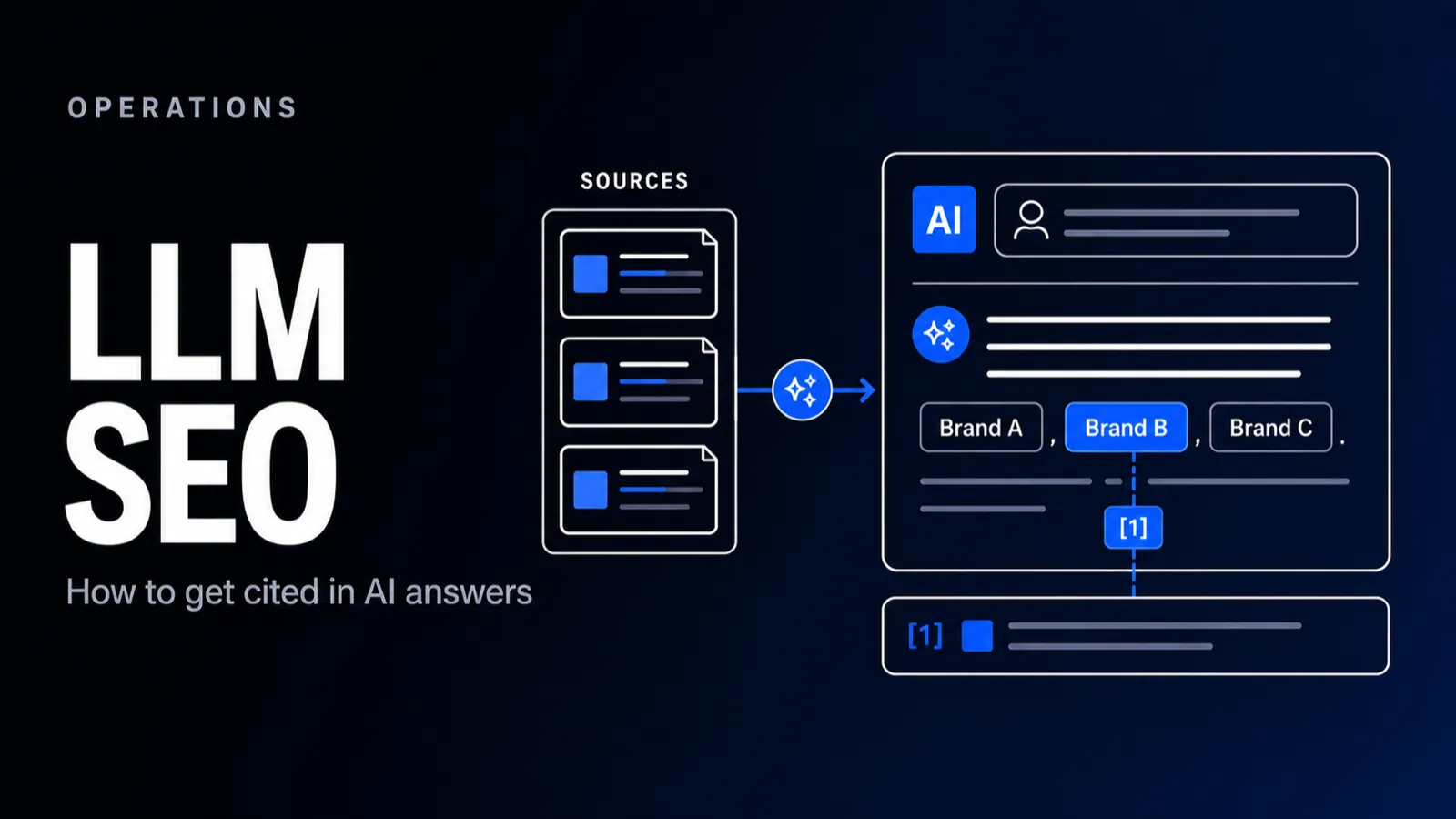
More people are asking ChatGPT and Perplexity for recommendations instead of scrolling a page of blue links. When the answer names three providers and yours is not one of them, you did not lose a ranking. You were never in the room.
LLM SEO is the work of getting your brand into that room: cited, recommended, and named in AI answers. It is less a new discipline than a new finish line, because the same authority and structure that win in Google largely decide what the models surface. This is how to run it, and how it reframes the link building workflow underneath it.
What Is LLM SEO?
LLM SEO is optimizing a brand to be surfaced, cited, and recommended by large-language-model answer engines such as ChatGPT, Perplexity, Gemini, and Google's AI features. The goal is not a ranking position but inclusion in the generated answer, the named appearances known as AI brand mentions. It overlaps heavily with traditional SEO, because the same authority, relevance, and structure feed both.
It goes by several names. Generative engine optimization (GEO), answer engine optimization (AEO), and AI SEO all describe the same shift: search is increasingly answered, not just listed, and the brands that get named in those answers win the attention that used to go to the top result. How it stacks up against classic search is the GEO vs SEO comparison.
How Is LLM SEO Different from Traditional SEO?
Traditional SEO ranks a page in a list of links; LLM SEO gets a brand cited inside a generated answer. The unit shifts from the URL to the brand as an entity, and measurement shifts from rank position to whether you appear when people ask. The signals, though, overlap far more than the hype suggests.
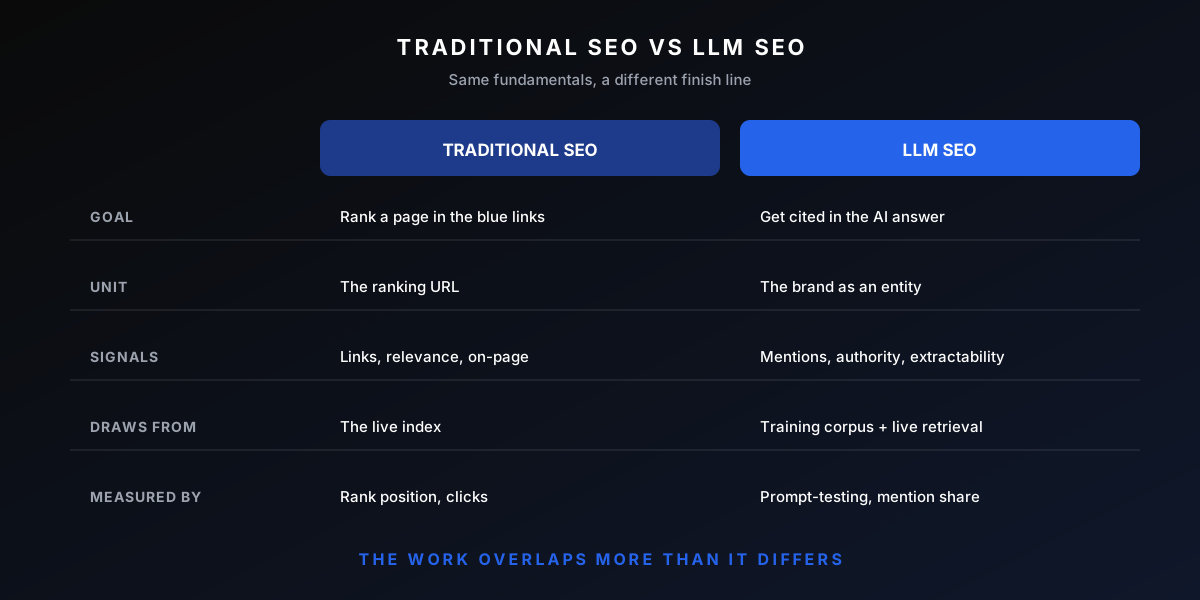
That overlap is the part most "AI is killing SEO" takes miss. Authority, relevance, clear structure, and a trusted brand were always the point. AI answers just raised the cost of not having them, because there is no page two to limp onto. You are in the answer or you are invisible.
How LLMs Choose What To Cite
An LLM answer is assembled from two sources: what the model absorbed during training, and what it retrieves live from the web at query time. The live step, retrieval-augmented generation, is why fresh, well-structured pages can show up in an answer even if the base model never saw them. The GEO research from Princeton and Georgia Tech formalizes how source content influences what generative engines surface.
Both paths reward the same thing: being a source the system can find, trust, and lift cleanly. The model learned your brand from text it read across the web, and it retrieves pages that are authoritative and easy to extract from. Neither path has a submit button. You earn your way into both.
Google has been blunt that there is no special trick for its AI features. Google's guidance on performing well in AI search says the way to show up in AI experiences is the helpful, reliable, people-first content you should already be producing, with no additional requirements or special optimizations. That is the honest baseline under all the noise.
What The Research Says Actually Moves Citations
The GEO study tested what changes a brand's visibility in generative answers and found that adding credible citations, direct quotations, and relevant statistics to content increased how often it was surfaced, by as much as 40 percent in their tests. Keyword-stuffed, source-free copy did the opposite. Vercel's account of adapting its own SEO for LLMs points the same way: structured, factual, well-sourced content is what gets pulled into answers.
The takeaway is a standard, not a trick. Content built to be cited, with real numbers, named sources, and clear claims, is what both the research and the platforms reward. That is the same content that earns links from human editors, which is exactly why the two goals converge instead of competing.
The Levers of LLM Visibility
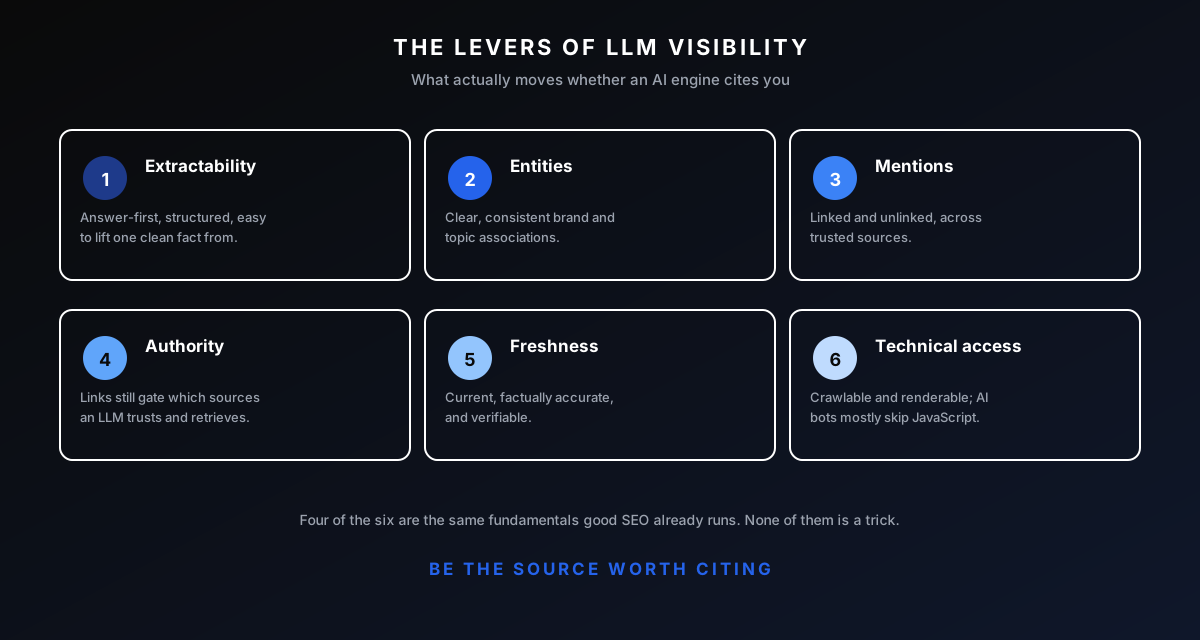
Six levers move whether an AI engine cites you. Four of them are the same fundamentals good SEO already runs, which is the reassuring part. None of them is a trick, which is the part the trick-sellers leave out.
Extractable, Answer-First Content
LLMs lift clean, self-contained facts. Content that answers the question in the first sentence, uses clear headings, and states facts plainly is far easier to extract and cite than the same information buried in a wandering introduction. Write so a single paragraph can be quoted without the rest of the page for context.
This is the same answer-first structure that wins featured snippets, which is not a coincidence. Question-shaped headings with a 40-to-60-word answer underneath give both Google and an LLM a clean unit to lift. The format that earned snippets is the format that earns citations, including in Google’s AI Overviews.
Clear, Consistent Entities
The model needs to understand what your brand is and what it is known for. Consistent naming, a clear description of what you do, and repeated association with your topic across the web build that entity picture. A brand the web describes the same way everywhere is one a model can confidently place in an answer.
Schema markup, an accurate Wikipedia or Wikidata presence where warranted, and a consistent one-line description across your profiles all reinforce the entity. The goal is that when the model thinks about your category, your brand is one of the names it has firmly attached to it.
Brand Mentions, Linked and Unlinked
AI engines surface brands they have seen referenced often. That makes mentions, including the ones with no link, a direct LLM-visibility lever rather than just a link-building near-miss. The mechanics are covered in unlinked brand mentions, but the short version is: the more the web talks about you in relevant contexts, the more the models repeat your name.
Authority and Links Still Matter
Links did not stop mattering; they decide which sources a model trusts enough to retrieve and repeat. A page from an authoritative domain is more likely to be both in the training data and chosen during live retrieval. The types of backlinks that build real authority are the same ones that make you a citable source.
Freshness and Factual Accuracy
Models and their retrieval layers favor current, verifiable information, and they penalize you implicitly by citing someone else when your content is stale or wrong. Dated statistics and unsupported claims do not get repeated. Accurate, dated, sourced facts are what an answer engine is comfortable putting its name behind.
This rewards a maintenance habit most sites lack. Refreshing your cornerstone pages with current data and dates, and correcting anything that has gone out of date, keeps you in the answer set. A page that was authoritative in 2024 and never touched since quietly drops out of the citations.
Technical Access for AI Crawlers
None of this matters if the crawler cannot read the page. Most AI crawlers are far less capable than Googlebot and many do not execute JavaScript, so client-side-rendered content can be invisible to them. Get the content into the initial HTML, which is the core of making JavaScript-dependent content crawlable, and confirm the technical foundation with a full SEO audit.
Where You Need To Show Up
LLMs lean disproportionately on a handful of trusted sources. Wikipedia, Reddit, established industry publications, and high-authority review sites show up again and again in the citations, because the models learned to trust them. Your own site is necessary but rarely sufficient on its own.
The practical implication is that LLM SEO is partly an off-site game. Being accurately represented on Wikipedia, mentioned in the right subreddits and forums, and cited by the publications your audience reads does more for AI visibility than another page on your blog. You have to exist in the places the models already trust.
This is uncomfortable for brands used to controlling their own site and nothing else. You cannot publish your way to AI visibility from your own domain alone, because the models weight third-party corroboration over self-description. What others say about you, across sources the model trusts, is doing the heavy lifting.
So the off-site work is deliberate: get listed accurately where your category gets discussed, earn coverage in the trade publications, and make sure the facts about your brand are consistent everywhere the models read. A contradiction between sources weakens the entity; consistency strengthens it.
How Link Building Fits LLM SEO
Here is the reframe. In classic SEO, a link passed PageRank. In the age of AI, a link does that and doubles as a citation and a mention that teaches the models your brand belongs in the answer. Earning a placement in a trusted publication now pays twice: ranking authority and AI visibility from the same effort.
That is why AI visibility is an extension of link building, not a replacement for it. Digital PR for link building that lands your brand and your data in trusted publications is one of the most effective AI-visibility tactics there is, because it produces exactly the mentions and citations the models reward.
How To Measure LLM Visibility
Measurement is the honest weak point of LLM SEO, and anyone who shows you a single tidy score is overselling it. There is no Search Console for AI answers. What works is prompt-testing: running the questions your buyers actually ask across ChatGPT, Perplexity, Gemini, and Google's AI features, and recording whether and how your brand appears.
Alongside that, track brand-mention volume and share against competitors, because mention frequency is the leading indicator of AI presence. The combination, prompt-testing for the outcome and mention monitoring for the signal, is the closest thing to a reliable read until the tooling matures. Treat anyone promising a precise AI ranking number with suspicion.
Dedicated AI-visibility trackers are emerging that run prompt sets across the engines on a schedule and report your share of answers against rivals. They are worth using once a program is underway, but the manual prompt test is enough to establish a baseline and prove movement. Start by writing down the ten questions your buyers actually ask, and run them today.
How To Run An LLM SEO Engagement
The work sequences like any other audit-to-execution program. First, confirm the technical foundation, because a site AI crawlers cannot read is a dead end. Then make the priority content extractable and accurate, fix the entity picture so the brand is described consistently, and identify where the brand is absent from the trusted sources the models cite.
From there it is a link and mention campaign aimed at those trusted sources, run through strategic link acquisition and digital PR, with prompt-testing to measure movement. It is not a separate product bolted on. It is the same operations, pointed at a new finish line.
The sequence matters because the steps depend on each other. There is no point earning citations to a page AI crawlers cannot read, and no point fixing extractability on a brand the trusted sources never mention. Baseline the prompt tests first, fix the foundation, then run the off-site campaign, and re-test on a cadence to see the answers shift.
Common Mistakes
The biggest mistake is chasing tricks. Adding an llms.txt file and waiting for ChatGPT to notice is the 2026 version of stuffing meta keywords; it is unproven, and it is not what gets you cited. The second is abandoning SEO fundamentals on the theory that AI changed everything, when AI mostly raised the stakes on the fundamentals.
The third is skipping measurement entirely, publishing into the void and assuming it is working. Without prompt-testing you have no idea whether you appear in the answers that matter. Run the prompts, track the mentions, and treat AI visibility as something you verify, not something you hope for.
Is SEO Dead in The Age of Ai?
No. SEO is changing its finish line, not dying. The skills that earned rankings, authority, relevance, clear structure, and a trusted brand, are the same skills that earn AI citations. What is dying is the assumption that a thin page can rank, or get cited, without any of that behind it.
The brands that win the AI era are the ones that were doing real SEO already and pointed it at the new surfaces. The shift rewards substance and punishes shortcuts harder than ever, because there is no page two of an AI answer to hide on.
Frequently Asked Questions
What Is LLM in SEO?
LLM stands for large language model, the technology behind ChatGPT, Gemini, Perplexity, and similar tools. In SEO, "LLM" refers to optimizing so these models surface and cite your brand in their answers. LLM SEO is the practice of earning that visibility, distinct from ranking a page in traditional search results.
Does LLM SEO Replace Traditional SEO?
No. It extends it. The authority, relevance, and content quality that drive rankings are the same signals that get a brand cited by AI engines. LLM SEO adds new surfaces and a new way to measure, but it runs on the same fundamentals. Treating it as a replacement, and dropping SEO, is a mistake.
How Do I Get My Site Cited in ChatGPT?
Be a trusted, frequently-mentioned source with extractable, accurate content. Earn links and mentions from the authoritative sites the models retrieve from, make sure your pages are crawlable without JavaScript, and structure content so a clean fact can be lifted. There is no submit button; you earn citation the way you earn rankings.
What Is The Difference Between LLM SEO, GEO, and AEO?
They largely describe the same shift. Generative engine optimization (GEO) and LLM SEO both mean optimizing to be surfaced by AI answer engines. Answer engine optimization (AEO) is slightly broader, covering featured snippets and voice answers too. In practice the tactics overlap heavily, and the labels matter less than the work.
Which LLMs Should I Optimize For?
Optimize for the ones your buyers use, which for most businesses means ChatGPT, Perplexity, Google's AI features, and Gemini. The good news is that the underlying levers, authority, mentions, extractable content, are shared across all of them, so optimizing well for one tends to help across the board rather than requiring separate campaigns.
Want Mojo Links To Make You Visible in AI Search?
AI visibility is not a separate trick; it is authority, mentions, and clean content pointed at a new finish line, which is exactly the work we already run. We audit where you stand in AI answers, fix the foundation, and build the citations that get you named. A video audit includes a read on your current AI visibility and the gaps holding it back.

About Bart Magera
Bart Magera is the founder of Mojo Links. Ten years across YMYL verticals (legal, medical, finance, supplements, crypto, gambling). Trained under Koray Tuğberk Gübür's Topical Authority framework. Author of two SEO books and international speaker.
Want this kind of analysis on your site?
Get a free video walkthrough within 48 hours covering technical health, backlinks, content gaps, and AI visibility.
Related posts
Keep reading on adjacent topics.
- SEO
 Bart Magera9 min read
Brand Mentions for SEO: Linked, Unlinked, and AI Citations
Most SEO budgets still treat a mention without a link as a failed pitch. That math is out of date. The same editorial naming that builds your entity in Google now decides whether AI engines name you in answers. Here is the value model behind linked, unlinked, and AI-cited mentions, and the three lanes for earning more of them.
- SEO
 Bart Magera12 min read
AI Visibility Tools: 9 Trackers Ranked and Compared
Nine AI visibility tools, one yardstick: engines covered, what gets measured, competitor tracking, and price. Every page-one comparison of these trackers is written by a vendor ranking its own product first. This one is not. Here is where each tool fits, from a $29 entry plan to enterprise quotes, and the one thing none of them can do.
- SEO
 Bart Magera10 min read
ChatGPT Brand Mentions: How To Track and Earn Them
When a buyer asks ChatGPT for the best option in a category, it names a few brands inside the answer. Those ChatGPT brand mentions, not the linked citations beneath them, are what get you recommended. Here is how to track them and how to earn them.