

GEO vs SEO: How They Differ, and Why You Need Both
Listen to this article
Browser-native voice. No account required.
GEO and SEO get pitched as a fight, as if you have to choose a side and move your budget. That framing sells courses. It does not match how either one actually works.
Generative engine optimization is built on the same fundamentals as search engine optimization. It adds a layer for AI answers; it does not replace the base. This is what they share, where they genuinely differ, and how to run both without doubling the work. For the full AI-answer playbook underneath this comparison, see LLM SEO.
What Is The Difference Between GEO and SEO?
SEO optimizes a site to rank in classic search results; GEO optimizes a brand to be cited and recommended in AI-generated answers from tools like ChatGPT, Perplexity, and Google's AI features. The surface and the win differ, a ranking versus a citation, but both run on the same authority, relevance, and content quality. GEO is the newer, narrower layer.
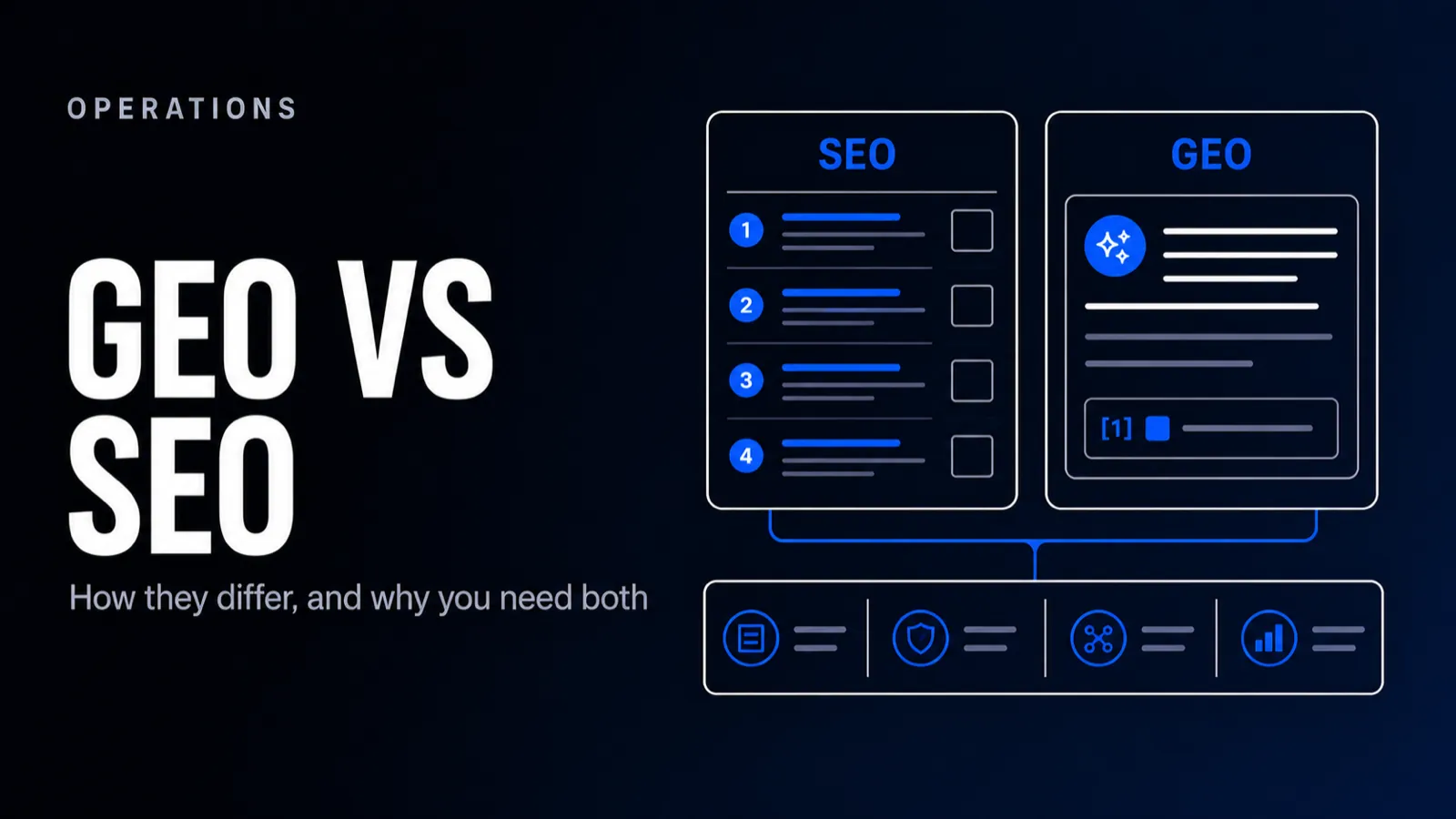
The cleanest way to hold it: SEO is about being found in a list of links, GEO is about being named in an answer. Those are different outcomes, but you reach them with mostly the same work.
The term itself is recent. The research that coined generative engine optimization framed it as optimizing content to be surfaced by AI answer engines, and found that citations, statistics, and clear sourcing lift visibility, the same things that make content good for search. SEO has decades of practice behind it; GEO is the few-year-old layer responding to AI answers.
Is GEO Replacing SEO?
No. GEO is replacing SEO about as much as mobile replaced having a website: it changes where you need to show up, not whether the fundamentals matter. AI answers are largely assembled from sources that already rank and are already trusted, and Google's own guidance on AI features says there is no special optimization beyond good SEO.
So the brands winning in AI answers are overwhelmingly the ones that did real SEO first. Treating GEO as a replacement, and cutting the SEO that feeds it, is how you lose on both surfaces at once.
What GEO and SEO Share
The overlap is most of the work. Authority and links, topical relevance, extractable and well-structured content, technical health, and a trusted brand all feed both classic rankings and AI citations. Get these right and you are competing on both surfaces from the same effort.
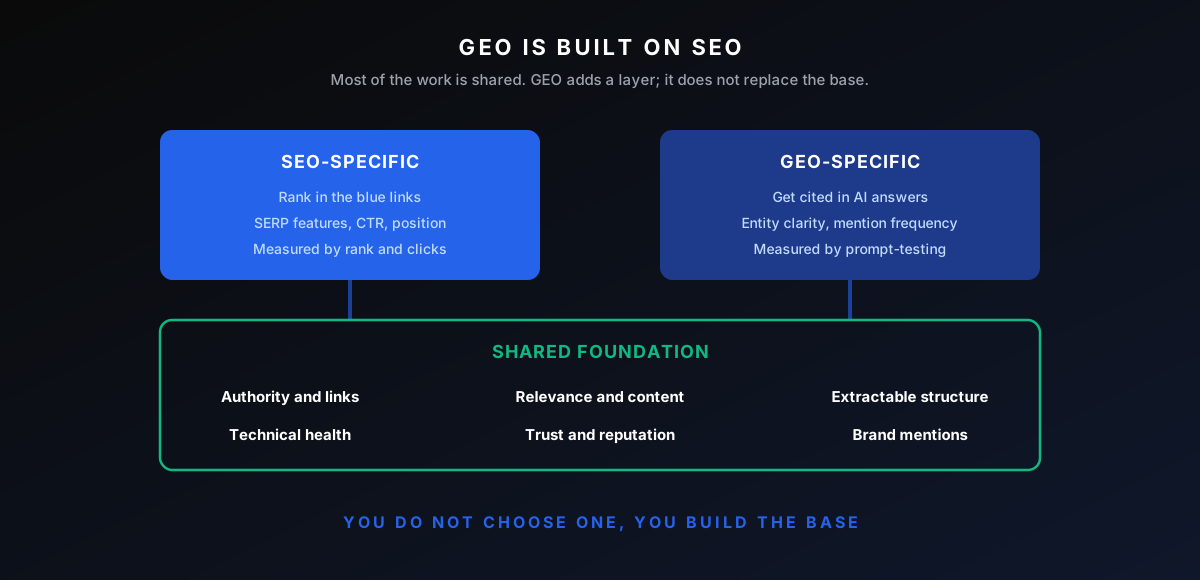
This is the part the "GEO vs SEO" debate keeps missing. A page that is authoritative, relevant, and easy to extract is the page that ranks AND the page an AI engine quotes. The SEO audit checklist that fixes a site for search is the same work that makes it citable.
Technical access is shared and underrated here. An AI crawler that cannot render your JavaScript sees an empty page, exactly as a search crawler would, so the rendering and crawlability fixes that help SEO are a prerequisite for GEO too. Neither surface can cite or rank what it cannot read.
Where GEO and SEO Differ
The genuine differences sit at the edges. SEO cares about the ranking position, SERP features, and click-through; GEO cares about whether your brand is named in a synthesized answer, which is what AI brand mentions are, and that depends more on entity clarity and how often you are mentioned across the web than on a single page's position.
GEO leans harder on three things: a consistent brand entity, frequent brand mentions (including unlinked ones) across trusted sources, and content structured so a model can lift a clean fact. Those matter for SEO too, but for GEO they move from helpful to decisive.
Measurement differs as well. SEO has rank tracking and Search Console; GEO has prompt-testing across engines and mention monitoring, with no tidy dashboard yet. That gap is real, and anyone selling a precise "GEO score" is overselling it.
The competitive dynamics differ too. In classic search you fight for one of ten positions; in an AI answer the engine names a handful of sources and synthesizes the rest, so the win is being one of the cited few rather than holding a rank. That makes brand authority and being mentioned everywhere matter more than chasing a single keyword position.
Where AEO Fits In
You will also see AEO, answer engine optimization, in the same conversation. It is the same shift under a slightly broader label: optimizing to win the direct answer, whether that is a featured snippet, an AI Overview, or a voice result. In practice GEO and AEO overlap so heavily that the distinction is mostly academic.
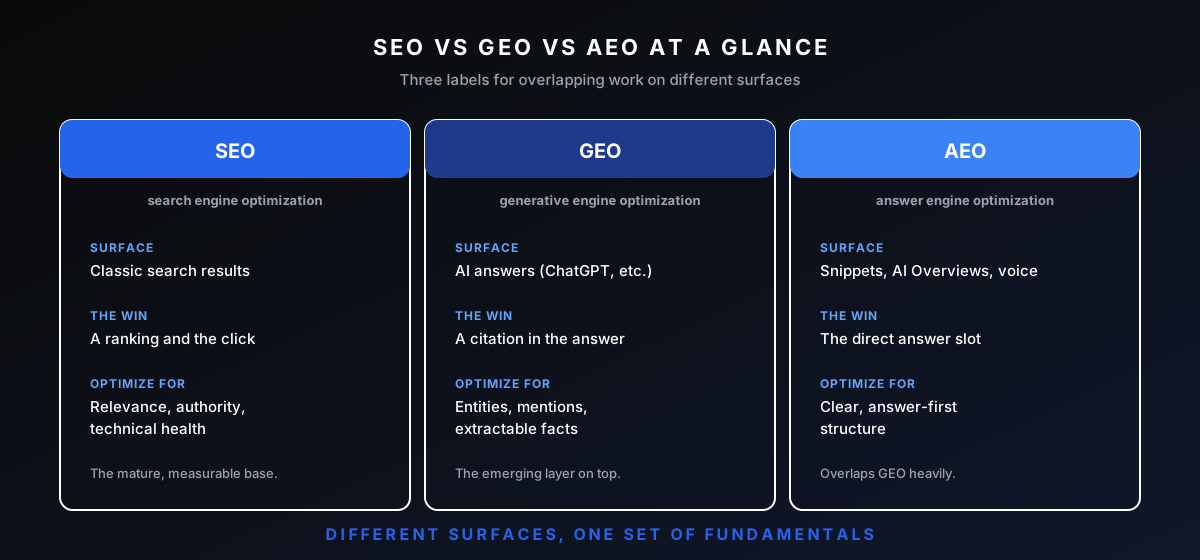
The useful takeaway is that all three are different surfaces fed by one set of fundamentals. AEO's clearest battleground, Google's AI Overviews, is covered in how to rank in AI Overviews, and the same answer-first, trusted content wins there as in GEO.
Do You Need Both?
Yes, and that is good news, not double the work. Because GEO is built on the SEO foundation, doing SEO well gets you most of the way to GEO for free. The incremental GEO work, tightening your entity, earning mentions, structuring for extraction, is a layer on top, not a separate program.
The mistake is treating them as two budgets competing for the same dollar. The right model is one program, one foundation, with a GEO layer added where it matters. Splitting them into rival initiatives is how agencies sell two retainers for what should be one coherent effort.
Weight the GEO layer harder in categories where buyers already ask AI for recommendations: software, services, anything researched before purchase. A local plumber needs the map pack far more than a ChatGPT citation today; a B2B SaaS being compared in AI answers needs the GEO layer now. The mix follows the audience, not the trend.
How To Run GEO and SEO Together
Run them as a single program. The foundation work, technical health, authority through earning links, and genuinely useful content, serves both surfaces. On top of that, tighten the brand entity, earn mentions in the sources AI engines trust, and structure key pages to be lifted cleanly.
Then measure both: rank and traffic for SEO, prompt-testing and mention share for GEO. One foundation, two scoreboards. It is the same operations, pointed at one more surface, which is exactly why the "versus" framing does not hold up.
GEO vs SEO for Revenue
For most businesses today, SEO still drives the larger share of measurable revenue, because classic search volume dwarfs AI-answer traffic and the tracking is mature. GEO is a growing slice and a hedge against where attention is moving, but it is not yet where most of the money is for most niches.
So the revenue-honest answer is to keep investing in SEO as the engine while building GEO as the position you will need as AI search grows. Abandoning SEO for GEO today trades a proven revenue channel for an emerging one, which is the wrong trade for almost everyone.
There is also a compounding case for starting GEO now even at low volume. The brands cited in AI answers are the ones the models already learned from, and that footprint takes time to build. Waiting until AI search is obviously big means arriving after your competitors are already the cited default. The cheap time to plant the tree was a while ago; the second-cheapest is now.
Common Misconceptions
The loudest misconception is that SEO is dead and GEO is the replacement. SEO is not dead; it is the foundation GEO stands on, and the brands cited by AI are the ones doing SEO well. The "SEO is dead" headline has been wrong every year for a decade.
The second is that GEO is a separate set of tricks. It is not a trick at all; it is authority, relevance, mentions, and structure, the same substance SEO rewards, applied to a new surface. If a tactic would not help your SEO, it is unlikely to be the secret to GEO either.
Frequently Asked Questions
Is GEO Just SEO with a New Name?
Largely, but not entirely. GEO runs on the same fundamentals as SEO, so much of it is SEO applied to AI answers. It does add genuine emphasis on entity clarity, mention frequency, and extractable structure that matter more for AI citation than for classic ranking. Same foundation, a meaningful new layer on top.
Is SEO Dead?
No. SEO is the foundation AI answers are built on; the brands cited by AI engines are overwhelmingly the ones already ranking and trusted in classic search. AI changed where you need to appear, not whether authority, relevance, and technical health matter. The "SEO is dead" claim has been wrong for over a decade.
Should I Move My Budget from SEO To GEO?
No, not as a wholesale switch. SEO still drives the larger, more measurable share of revenue for most businesses, and it feeds GEO directly. Keep SEO as the engine and add a GEO layer on top. Cutting the SEO foundation to chase GEO weakens both, because GEO depends on the same signals SEO builds.
Does SEO Help GEO?
Yes, directly. AI engines pull from sources that already rank and are already trusted, so strong SEO is the single biggest input to GEO visibility. Authority, relevance, and clean structure earn rankings and citations from the same work. Doing SEO well gets you most of the way to GEO before you do anything GEO-specific.
What Is GEO and Not SEO?
The GEO-specific work is the layer SEO does not strictly require: a tightly consistent brand entity, a deliberate push for mentions across the sources AI engines trust, and content structured so a model can extract a self-contained fact. These help SEO too, but for being cited in AI answers they move from useful to essential.
Want Mojo Links To Run Both?
GEO and SEO are one program, not a choice, and running them as one is the efficient way to win both surfaces. That is how we build, on a foundation that ranks and gets cited. If you want a read on where you stand in classic search and AI answers, start with a free AI visibility audit and we will show you the gaps in both.

About Bart Magera
Bart Magera is the founder of Mojo Links. Ten years across YMYL verticals (legal, medical, finance, supplements, crypto, gambling). Trained under Koray Tuğberk Gübür's Topical Authority framework. Author of two SEO books and international speaker.
Want this kind of analysis on your site?
Get a free video walkthrough within 48 hours covering technical health, backlinks, content gaps, and AI visibility.
Related posts
Keep reading on adjacent topics.
- SEO
 Bart Magera9 min read
Brand Mentions for SEO: Linked, Unlinked, and AI Citations
Most SEO budgets still treat a mention without a link as a failed pitch. That math is out of date. The same editorial naming that builds your entity in Google now decides whether AI engines name you in answers. Here is the value model behind linked, unlinked, and AI-cited mentions, and the three lanes for earning more of them.
- SEO
 Bart Magera12 min read
AI Visibility Tools: 9 Trackers Ranked and Compared
Nine AI visibility tools, one yardstick: engines covered, what gets measured, competitor tracking, and price. Every page-one comparison of these trackers is written by a vendor ranking its own product first. This one is not. Here is where each tool fits, from a $29 entry plan to enterprise quotes, and the one thing none of them can do.
- SEO
 Bart Magera10 min read
ChatGPT Brand Mentions: How To Track and Earn Them
When a buyer asks ChatGPT for the best option in a category, it names a few brands inside the answer. Those ChatGPT brand mentions, not the linked citations beneath them, are what get you recommended. Here is how to track them and how to earn them.