

Legal SEO: The Complete Guide for Legal Practices
Listen to this article
Browser-native voice. No account required.
Every legal search you do not rank for is a prospect calling someone else. Not a better lawyer. The one whose page Google decided to trust more than yours.
Legal SEO is how a practice earns that trust and the rankings that follow. This guide covers how it works across every practice area, from the ranking factors that decide legal searches to the expertise signals Google demands of legal sites. For the firm-level, month-by-month version, see the law firm SEO engagement.
What Is Legal SEO?
Legal SEO is the practice of optimizing a law practice's website and online presence to rank in Google search, the local map pack, and AI answer engines for the terms prospective clients use. It spans technical health, practice-area content, local optimization, authoritative backlinks, and the expertise signals Google demands of legal sites.
It applies to any legal practice: multi-office firms, solo attorneys, and online legal services alike. The mechanics hold across all of them. What changes is the scale and the practice-area mix.
Think of it less as a checklist and more as authority you accumulate. Google does not rank a practice because it ticked boxes. It ranks the practice it has come to treat as a credible answer to the search, and legal SEO is the work of becoming that answer.
Why Legal SEO Matters
Because legal buyers start in search, and organic visibility converts the highest-intent traffic a practice can get. Clients research their lawyer online before they ever call, and every firm in town is competing for the same rankings.
Paid clicks stop the day the budget stops. Rankings you earn keep working. A practice that owns its core practice-area terms collects qualified intent every week without paying per click.
The economics compound in your favor. A ranked page carries no per-click cost, so as it climbs, your cost per signed client falls. A competitor still buying every click watches theirs hold flat, then resents the bill.
Here is the part that should worry you. The practice ranking above you is not standing still. Every month its pages age into more authority, earn more links, and bank the reviews that make your climb steeper. Authority compounds, so the gap widens while you decide whether to start.
There is also a trust dimension that legal cannot dodge. Legal is a YMYL category, your money or your life, where Google holds results to a higher bar for expertise and credibility. That bar rewards practices that publish real attorney-authored content and quietly buries thin, templated pages.
Consider what a single signed case is worth in legal, then weigh it against the cost of ranking for the term that produced it. In few verticals does one client pay back a year of the work that earned the ranking. Legal is one of them.
How Legal SEO Is Different
Legal search is more competitive, more local, and more regulated than almost any other vertical. Four forces make it its own discipline.
Competition comes first. Legal keywords carry some of the highest commercial value in search, which means deep-pocketed firms and specialist agencies are already fighting for them. You are not entering an empty room. You are taking a seat someone else wants back.
That competition raises the floor. The thin, three-paragraph practice-area page that ranked five years ago now sits on page three, because the firm above you published a 2,000-word answer with a named attorney behind it. Matching the field is the entry fee, not the win.
Local intent comes second, and it is unforgiving. The map pack has three spots. Three. If your practice is not in them, three competitors are, fielding the calls you never see. Legal SEO is zero-sum in a way most verticals never feel.
Regulation comes third. State bar advertising rules govern what a legal page can claim, how results can be presented, and what counts as a testimonial. Ignore them and you trade a ranking problem for an ethics complaint. The SEO has to be built inside the ethics rules from the first draft, not retrofitted after a complaint lands.
Practice-area complexity comes fourth. A firm with seven practice areas across three offices is twenty-one ranking targets, each competing against specialists. The firm-level version of this problem, and the engagement that solves it, lives in the law firm SEO playbook.
Legal SEO Ranking Factors
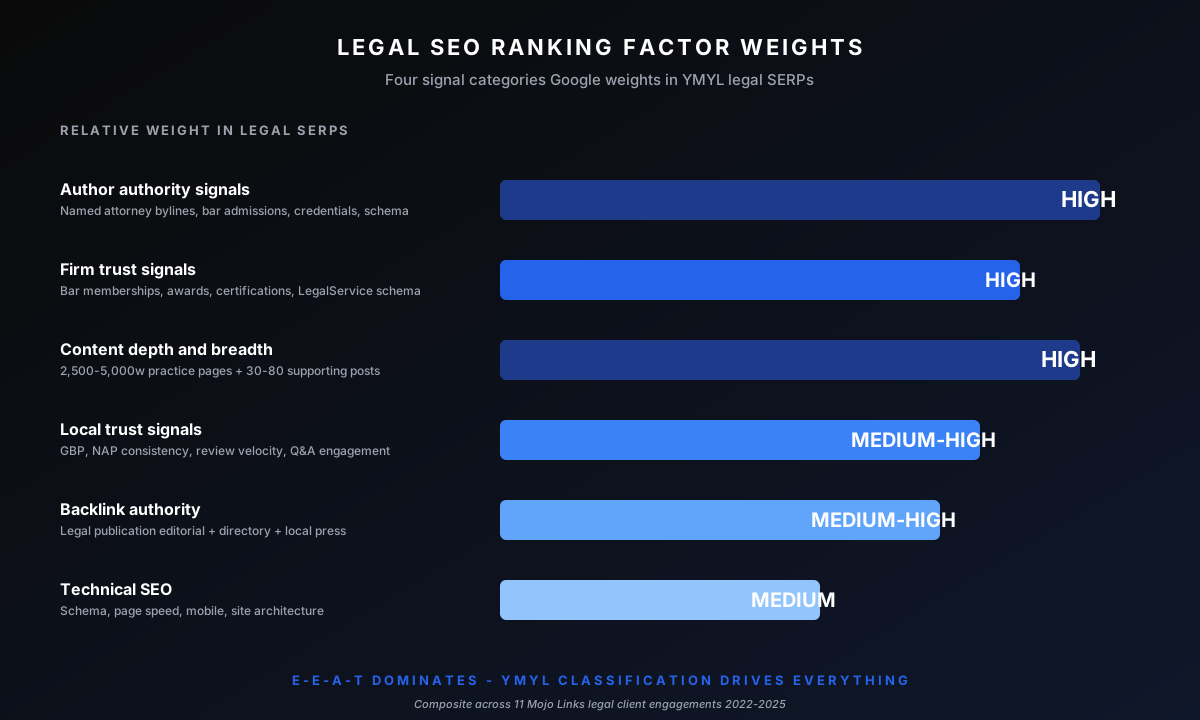
The factors that move legal rankings cluster into six areas. They reinforce each other, which is why piecemeal legal SEO rarely works. You move all six or you move none.
Content and Practice-Area Pages
Content is the foundation, and for legal that means a dedicated, genuinely useful page for every practice area and sub-service. Each page answers the searcher's question directly, demonstrates real expertise, and connects to related services.
Templated pages with the city name swapped out do not rank anymore. A motorcycle-accident page and a truck-accident page are different statutes, different fears, different searchers. Write them that way.
This is where a content roadmap earns its keep, mapping every practice area, sub-service, and supporting question into one architecture before a word gets written. That architecture is a silo structure.
Every practice-area page has to carry the same load. The strongest ones share a short list of components.
A direct answer to the core query. The page opens with what the searcher asked, not the firm history.
Named attorney attribution. A credentialed author, because Google scores legal pages on demonstrated expertise.
Jurisdiction and statute specifics. Detail that proves the page was written for this area, not spun from a template.
Outcomes within bar rules. Real results framed inside your state's advertising restrictions.
Links to related services. A divorce page that connects to custody, support, and mediation keeps the cluster tight.
E-E-A-T and Attorney Authority
Legal is the category where experience, expertise, authoritativeness, and trust matter most. Google wants to see that a real, credentialed attorney stands behind the content. Anonymous or ghostwritten pages start at a disadvantage no amount of keyword work overcomes.
Building it is concrete work, not a vibe. Attach attorneys to the practice areas they actually handle, link bios to bar profiles and published work, and keep the firm's details identical everywhere a machine reads them.
The payoff is durability. Authority built on real expertise survives the algorithm updates that wipe out sites leaning on thin content and bought links. It is the slowest signal to build and the hardest for a competitor to copy, which is exactly why it holds.
Named attorney authorship. Bylines, bios, and credentials on every substantive page.
Bar admissions and recognitions. Real, verifiable signals of standing.
Citations and consistent NAP. The firm's name, address, and phone matching everywhere a machine reads them.
Genuine reviews. Recent, specific, and answered.
Backlinks and Legal Citations
Backlinks remain one of the strongest off-page signals, and legal is a slow, high-trust niche where authority compounds over time rather than overnight.
For legal, the links that count come from a short list of real sources.
Legal directories. Justia, Avvo, and FindLaw profiles search engines already trust.
Bar associations and legal-aid bodies. Membership and referral pages with genuine authority.
Local sponsorships and partnerships. The kind a real practice in a real city actually has.
Digital PR and expert commentary. Attorney quotes in legal and local press, earned not bought.
A single link from a respected legal publication outweighs fifty from generic web directories. Anchor text matters as much as the source: lean on branded and naked-URL anchors, use exact-match commercial anchors sparingly, and you avoid handing Google the pattern it penalizes.
Anyone who promises you a thousand links a month is selling the exact spam profile that gets legal sites penalized. Editorial link campaigns that earn relevant placements are a different sport entirely.
Technical SEO and Schema
Technical SEO makes the rest of the work legible to search engines. Crawlability, site speed, mobile rendering, structured data, and a clean internal-link structure decide whether your content gets indexed and understood.
LegalService and Attorney schema tell Google what the practice does and who works there. FAQPage schema earns the expandable answers under the listing. A six-layer technical audit surfaces the orphan pages, redirect chains, and missing markup that quietly cap rankings.
Most legal sites fall into one of three patterns: a page-builder template running slow with no schema, an aging WordPress install carrying orphan pages and a broken redirect map, or a beautiful custom build with no on-page SEO at all. Each needs a different fix list, and a generic checklist misses all three.
Local SEO and Google Business Profile
Local SEO is where most legal searches convert, so the Google Business Profile is not optional. Reviews carry real weight: Clio's Legal Trends Report tracks how clients find and hire lawyers, and a firm's online reputation runs through every step of that journey.
For multi-office practices, each location needs its own profile, its own location page, and consistent citations. Inconsistent citations confuse the algorithm and split your ranking signals across listings that should be one.
Review velocity and recency matter as much as the star count. A steady flow of recent reviews beats a pile of old five-star ratings, and 74% of consumers in the same BrightLocal survey weighed reviews from the last three months most heavily. Category choice counts too: a firm filed under the exact practice-area category outranks one filed under a generic label.
Multi-location practices face a harder version of the same problem. Each office competes in its own local pack, so a firm with five offices runs five local campaigns in parallel, not one. Skip a location and a competitor owns that city by default.
Most legal searches now carry an implicit "near me," and Google localizes the results whether or not the searcher types it. That makes the radius around each office the real battleground, and a complete, active profile is what wins it.
Keyword and Intent Mapping
Keyword research for legal separates money intent from research intent. "Car accident lawyer" is a client ready to call. "What to do after a car accident" is someone earlier in the journey you capture and nurture. A real keyword map assigns every term to a page and a stage, so nothing cannibalizes and nothing gets missed.
Three query types each deserve their own page. Money terms with a city modifier, near-me variants Google localizes automatically, and question terms that feed both the top of the funnel and the AI answers. Map each deliberately or they compete with each other for the same slot.
Legal SEO Across Practice Areas
Difficulty and intent shift sharply by practice area, and the strategy has to shift with them. Treating personal injury and estate planning the same way wastes budget on both.
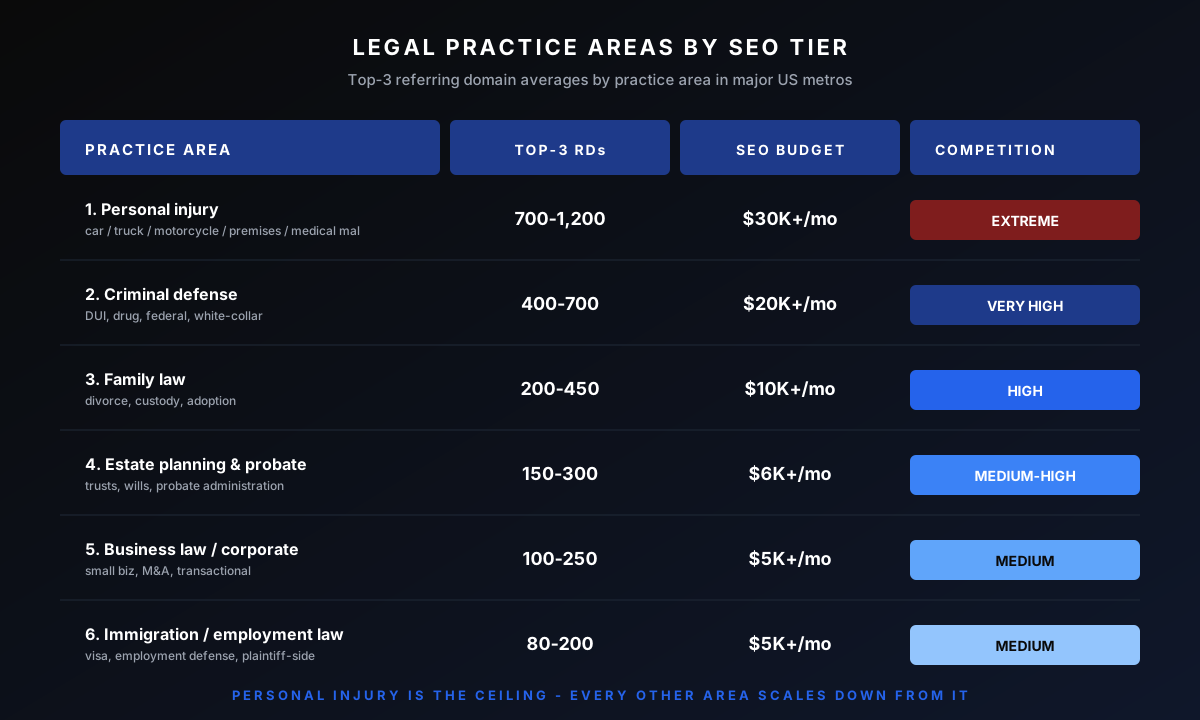
The hyper-competitive end is personal injury, criminal defense, and family law, where national agencies and seven-figure budgets fight over every term. Estate planning, immigration, and business law sit lower on the difficulty curve, where a focused practice can win faster with less spend.
Personal injury. The most contested legal vertical in search. Expect a long build and a real link budget.
Criminal defense. High intent, high local competition, heavy reliance on reviews and trust signals.
Family law. Emotional, question-heavy searches that reward deep content and local presence.
Estate planning and business law. Lower difficulty, strong content leverage, faster wins for a focused practice.
Immigration. Multilingual and multi-jurisdiction angles open gaps national firms leave uncovered.
The breadth is exactly why a practice cannot rely on a single homepage. Each area needs its own depth, and a multi-area firm needs the engagement structure that builds them in sequence. That sequence, phase by phase, is the law firm SEO engagement, and the same discipline carries into search campaigns for healthcare practices and other regulated verticals.
The strategic move is to win the winnable areas first. Bank rankings and revenue in estate planning or business law while the personal-injury build compounds in the background. Early wins fund the long fight, and they prove the program works before the hardest terms move.
Legal SEO and AI Search
AI answer engines now sit above the blue links for many legal queries, and they cite the practices that already rank. Google's AI Overviews, ChatGPT, and Perplexity pull from the same signals legal SEO builds: clear answers, structured content, named expertise, and consistent citations.
The practical work overlaps with everything above. Lead each page and FAQ with a direct, extractable answer. Keep entity data clean, so the practice name, locations, and practice areas line up everywhere a machine reads them. Earn the reviews and mentions that feed credibility. Do the SEO right and AI visibility mostly follows.
Reviews matter here too, not just for the map pack. BrightLocal's survey put AI tools at 45% usage as a discovery surface, climbing fast from a year earlier. The practices an AI engine names are the ones that already rank, already carry clean structure, and already have the reviews to back the recommendation.
How Long Legal SEO Takes
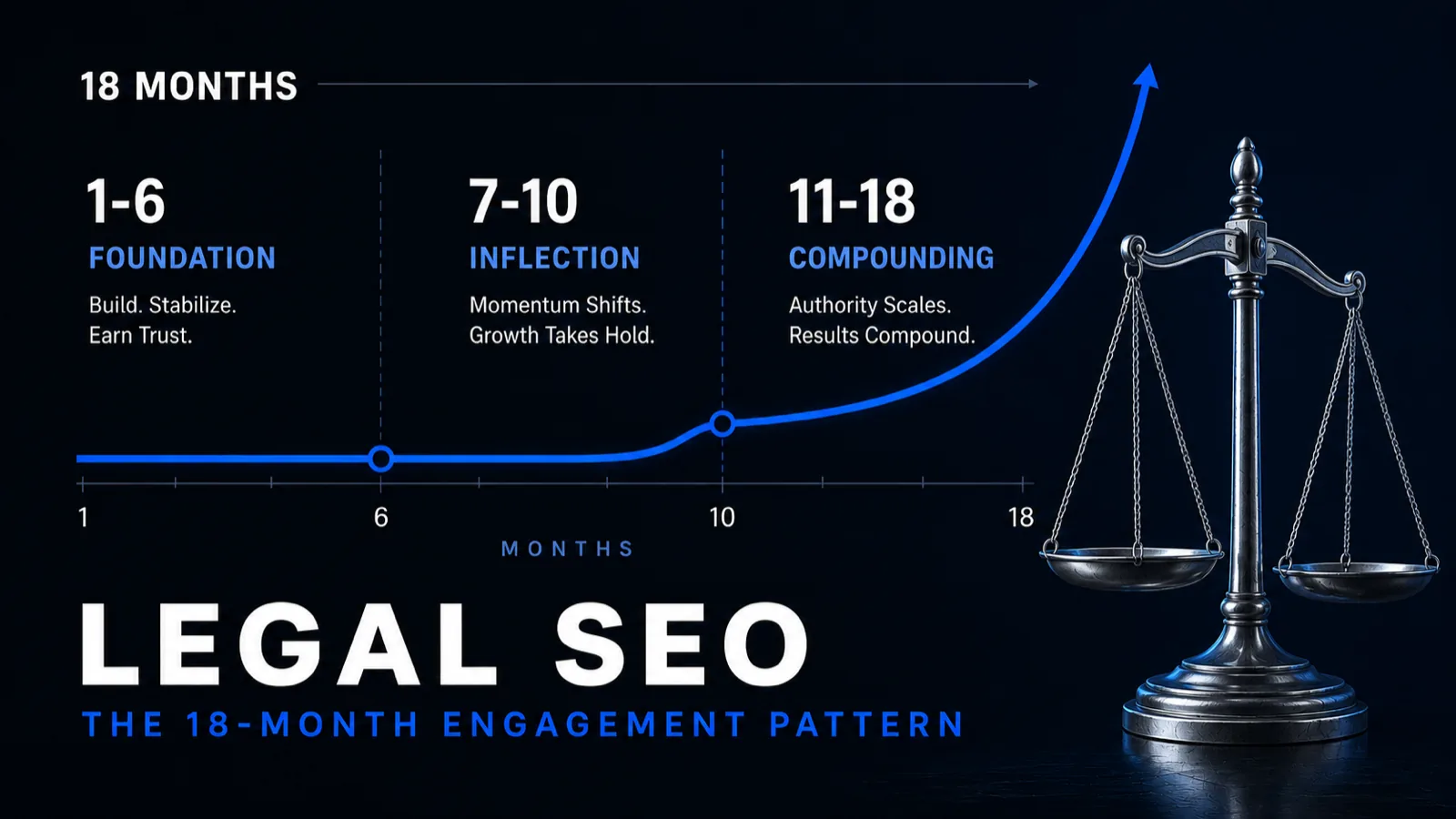
Legal SEO is a long game measured in quarters, not weeks. Long-tail practice-area terms can move within a few months. Competitive head terms take the better part of a year of consistent content and authority work before they hold.
I have watched this curve on real legal work. During my time at Paradox Marketing I led the topical and technical SEO on Sprintlaw, an online law firm operating across .com.au, .co.uk, and .co.nz. Traffic stayed flat for months, then broke out and kept compounding past the end of the engagement. That shape, and the month-by-month engagement behind it, is documented in the law firm SEO playbook.
The lag is the hardest part to sit through. For the first few months the work looks like spending with no return: audits, fixes, content that has not ranked yet. Then the architecture crosses a threshold and the same pages that sat flat start compounding. Practices that quit in month four never see the curve they paid to build.
A rough timeline sets the expectation.
Months 1-3. Audits, technical fixes, and architecture. Indexing improves before rankings do.
Months 4-6. The first long-tail practice-area rankings climb into striking distance.
Months 7-12. Topical authority crosses over and competitive terms start to hold.
Month 12 and beyond. Rankings compound and defend themselves as the content library matures.
Common Legal SEO Mistakes
Most legal sites are not failing for exotic reasons. They are making the same handful of mistakes, and each one is fixable.
One page for every practice area. A single "practice areas" page signals depth in none of them. Google ranks the practice as a generalist.
Templated location pages. The same copy with the city swapped out reads as thin to Google and to the reader.
Buying cheap links in bulk. The fastest way to trade a ranking problem for a penalty.
Ignoring the Google Business Profile. The map pack is where local legal searches convert, and it is left half-built on most sites.
No named attorney behind the content. In a YMYL category, anonymous pages forfeit the trust signal that matters most.
Chasing head terms on day one. Fighting "personal injury lawyer" before winning the long tail burns budget with nothing to show.
Fix these and most practices climb before a single new piece of content ships. The foundation was leaking the whole time.
Choosing a Legal SEO Approach
The first choice is in-house, freelancer, or agency, and it comes down to honesty about capacity. A practice can manage its Google Business Profile and reviews in-house. Practice-area architecture, technical audits, and editorial link building usually need specialist execution.
In-house. Works for profile and review management; rarely covers the technical and link work that moves competitive terms.
Freelancer. Affordable and flexible, but capacity caps how much can rank at once.
Agency or senior strategist. The full stack, at a retainer that has to be justified by results, not activity.
Whoever you pick, judge them on transparency and proof, not guarantees. Anyone who guarantees a number-one ranking is lying to you, because no one controls Google's algorithm. Ask who does the work, what the link profile looks like, and whether they can show reporting tied to consultations rather than raw traffic.
Watch for the named-operator dodge. The founder is on the website and the sales call, then the account quietly moves to a junior you never meet again. Watch for thousand-link packages, locked contracts with no deliverable schedule, and reporting that hides behind jargon. Each one is a tell that you are buying activity, not outcomes.
If you would rather pressure-test your current standing first, SEO consulting or a personalized growth audit will show you where your rankings, links, and content gaps actually sit before you commit a budget.
Frequently Asked Questions
What Is The Difference Between Legal SEO and Law Firm SEO?
They describe the same discipline at different scopes. Legal SEO is the broad practice of ranking any legal site, covering the ranking factors and rules across all practice areas. Law firm SEO usually refers to the firm-level engagement: how a specific firm's campaign runs month by month.
How Long Does Legal SEO Take To Work?
Long-tail practice-area terms can move within a few months. Competitive head terms generally take most of a year of consistent content, technical, and authority work before rankings hold. Legal is a slower, more contested vertical than most.
Is Legal SEO Worth It for a Small Practice?
Often yes, because a focused practice can win less-competitive practice areas and local searches that national firms ignore. The key is picking winnable terms rather than fighting personal-injury head terms against seven-figure budgets on day one.
Does Google Treat Legal Sites Differently?
Yes. Legal is a YMYL category, so Google applies stricter expertise and trust standards. Named attorney authorship, accurate content, and credible citations matter more here than in lower-stakes verticals.
What Is The Most Important Legal SEO Ranking Factor?
There is no single factor, but for local legal searches a well-optimized Google Business Profile, consistent citations, and genuine reviews win the map pack first. Content quality and backlinks then decide the competitive organic rankings above and around it.
Work with Mojo Links
I run these engagements myself, which means I take a limited number of practices at a time and will not take two that compete in the same market. If you want a read on where your rankings, links, and content gaps actually stand, start with a free video review and we will map the path from there, while the practice-area terms you want are still winnable.

About Bart Magera
Bart Magera is the founder of Mojo Links. Ten years across YMYL verticals (legal, medical, finance, supplements, crypto, gambling). Trained under Koray Tuğberk Gübür's Topical Authority framework. Author of two SEO books and international speaker.
Want this kind of analysis on your site?
Get a free video walkthrough within 48 hours covering technical health, backlinks, content gaps, and AI visibility.
Related posts
Keep reading on adjacent topics.
- SEO
 Bart Magera9 min read
Brand Mentions for SEO: Linked, Unlinked, and AI Citations
Most SEO budgets still treat a mention without a link as a failed pitch. That math is out of date. The same editorial naming that builds your entity in Google now decides whether AI engines name you in answers. Here is the value model behind linked, unlinked, and AI-cited mentions, and the three lanes for earning more of them.
- SEO
 Bart Magera12 min read
AI Visibility Tools: 9 Trackers Ranked and Compared
Nine AI visibility tools, one yardstick: engines covered, what gets measured, competitor tracking, and price. Every page-one comparison of these trackers is written by a vendor ranking its own product first. This one is not. Here is where each tool fits, from a $29 entry plan to enterprise quotes, and the one thing none of them can do.
- SEO
 Bart Magera10 min read
ChatGPT Brand Mentions: How To Track and Earn Them
When a buyer asks ChatGPT for the best option in a category, it names a few brands inside the answer. Those ChatGPT brand mentions, not the linked citations beneath them, are what get you recommended. Here is how to track them and how to earn them.