

Law Firm SEO: The Complete Guide for Attorneys
Listen to this article
Browser-native voice. No account required.
Most law firms are not losing to better lawyers. They are losing to the firm three spots above them, the one a prospect calls before your name ever loads.
That prospect had a case worth five figures. They will never know your firm existed. Law firm SEO is the work that puts you in front of them first and holds the position, built on the legal SEO ranking factors that decide these searches and the 18-month engagement that gets a firm there.
What Is Law Firm SEO?
Law firm SEO is the practice of earning organic visibility for a firm across Google search, the local map pack, and AI answer engines, so prospective clients find the firm at the moment of need. It combines practice-area content, local optimization, technical health, and authoritative backlinks into one compounding system.
It is not a one-time fix. A law firm SEO program is a structured engagement that builds relevance and authority over months, then defends the position once it ranks. The entity is a system, not a setting you toggle on.
Why Do Law Firms Need SEO?
Because the buying decision starts in search, and organic visibility converts the best traffic a firm can get. Clio's Legal Trends research tracks how clients find and hire lawyers, and the shift toward researching firms online is exactly why the competition for those rankings is fierce.
Paid clicks stop the day the budget stops. Rankings you earn keep working. A personal-injury firm that owns "motorcycle accident lawyer" in its city collects qualified intent every week without paying per click.
The economics compound in your favor. A ranked page carries no per-click cost, so as it climbs, your cost per acquired client falls. A competitor still paying for every ad click watches theirs hold flat.
There is also a trust dimension. Legal is a YMYL category, where Google holds results to a higher bar for expertise and credibility. That bar rewards firms that publish real attorney-authored content and punishes thin, templated pages. The same trust bar shapes accountant SEO, where financial work is held to an equally high standard.
Here is the part that should bother you. The firm ranking above you today is not standing still. Every month their pages age into more authority, pull more links, and bank the reviews that make the next climb steeper. Authority compounds, so the gap widens while you decide whether to start.
How Law Firm SEO Is Different
Legal search is more competitive, more local, and more trust-sensitive than almost any other vertical. Three forces make it its own discipline.
Practice-area complexity comes first. A firm with seven practice areas across three offices is not one SEO target, it is twenty-one. Each practice-area page in each location competes against specialists who do nothing else, none more so than in personal injury.
That fragmentation is why generic law firm marketing packages fail. Twenty-one targets need twenty-one answers, and a single homepage stuffed with practice areas signals depth in none of them. Google reads the firm as a generalist and ranks it like one.
Local intent comes second, and it is brutal. The map pack has three spots. Three. If your firm is not in them, three competitors are, and they are fielding the calls you never see. Legal SEO is zero-sum in a way most verticals never feel: there is one first place per query, per city, and someone is already standing in yours.
Trust comes third. Reviews, attorney credentials, and citation consistency feed both the algorithm and the human reading the result. Get them wrong and rankings stall no matter how much content you ship. For the factor-by-factor breakdown across every practice type, the legal SEO operations guide goes deeper than this firm-level view.
Law Firm SEO Ranking Factors
The factors that move legal rankings cluster into five areas, and they apply to how legal SEO works across practice areas generally. Work them in this order on every engagement, because each one earns the next.
Content and Practice-Area Pages
Content is the foundation, and for law firms that means a dedicated, genuinely useful page for every practice area and sub-service. Each page has to answer the searcher's question directly, demonstrate the firm's expertise, and connect to related services through internal links.
Templated pages with the city name swapped out do not rank anymore. A motorcycle-accident page and a truck-accident page are different cases, different statutes, different searcher fears. Write them that way.
This is where a topical map earns its keep, mapping every practice area, sub-service, and supporting question into one architecture before a word gets written.
Every practice-area page has to carry the same load. The strongest ones share a short list of components.
A direct answer to the core query. The page opens with what the searcher asked, not the firm's founding story.
Named attorney attribution. A credentialed author, because Google scores legal pages on demonstrated expertise.
Jurisdiction and statute specifics. The detail that proves the page was written for this practice area, not spun from a template.
Case results within bar rules. Real outcomes, framed inside your state's advertising restrictions.
Links to related services. A divorce page that connects to custody, support, and mediation keeps the cluster tight.
Match the page to intent, too. A "best DUI lawyer" search wants proof and comparison. A "what is the penalty for a second DUI" search wants the answer first and a soft path to a consultation second. Same practice area, different page.
Backlinks and Off-Page Authority
Backlinks remain one of the strongest off-page signals, and legal is no exception. Authority is the slow lever here: it accrues across months of editorial coverage and citations, and it is the part of the engagement that compounds long after the early technical fixes land.
For law firms, the links that count come from legal directories, bar associations, local sponsorships, and genuine editorial coverage. Quality and relevance beat volume. A single link from a respected legal publication outweighs fifty from generic web directories.
Anyone who promises you a thousand links a month is selling the exact spam profile that gets law firms penalized. The safe route is editorial link-building campaigns with a 120-day replacement guarantee, which is a different sport entirely.
The placements that move legal rankings come from a short list of real sources.
Legal directories. Justia, Avvo, and FindLaw profiles search engines already trust.
Bar associations and legal-aid bodies. Membership and referral pages with genuine authority.
Local sponsorships and partnerships. The kind a real firm in a real city actually has.
Digital PR and expert commentary. Attorney quotes in legal and local press, earned not bought.
Anchor text matters as much as the source. A natural profile leans on branded and naked-URL anchors, with exact-match commercial anchors used sparingly. Over-optimize the anchors and you hand Google the exact pattern it penalizes.
Technical SEO and Site Architecture
Technical SEO makes the rest of the work legible to search engines. Crawlability, site speed, mobile rendering, structured data, and a clean internal-link structure decide whether your content gets indexed and understood.
Law firm sites accumulate technical debt fast: orphaned location pages, duplicate practice-area templates, redirect chains from the last three redesigns. A technical audit surfaces every revenue-impacting issue in one pass before you spend a dollar on content.
Three site patterns cover most law firm audits. A page-builder template running slow with no schema. An aging WordPress install carrying thirty orphan pages and a broken redirect map. A beautiful custom build with no on-page SEO at all. Each needs a different fix list.
Schema is the lever most firms skip. LegalService and Attorney markup tell Google what the firm does and who practices there, and FAQPage markup earns the expandable answers that show under the listing. Pair that with Core Web Vitals inside Google's thresholds and the site stops fighting itself.
Local SEO and Google Business Profile
Local SEO is where most legal searches convert, so the Google Business Profile is not optional. Reviews carry real weight, and a steady flow of recent, credible reviews on a complete profile is what turns map-pack visibility into signed clients.
For multi-office firms, each location needs its own profile, its own location page, and consistent name-address-phone citations across the web. Inconsistent citations confuse the algorithm and split your ranking signals.
Review velocity and recency carry weight too. A steady flow of recent reviews beats a pile of old five-star ratings, and 74% of consumers in the same BrightLocal survey weighed reviews from the last three months most heavily. Category choice matters as well: a firm filed under the precise practice-area category outranks one filed under a generic "lawyer" label.
Keyword Research and Intent Mapping
Keyword research for law firms separates money intent from research intent. "Car accident lawyer" is a client ready to call. "What to do after a car accident" is someone earlier in the journey who you capture and nurture.
A real keyword map assigns every term to a page and a funnel stage, so nothing cannibalizes and nothing gets missed. Sound familiar? It is the practice-area architecture problem again, viewed from the query side.
Three query types deserve their own pages. Money terms ("dui lawyer" plus the city), near-me variants Google localizes automatically, and question terms ("how long does a divorce take") that feed the top of the funnel and the AI answers. Map each to a page and a stage, or they cannibalize each other.
The 18-Month Law Firm SEO Engagement
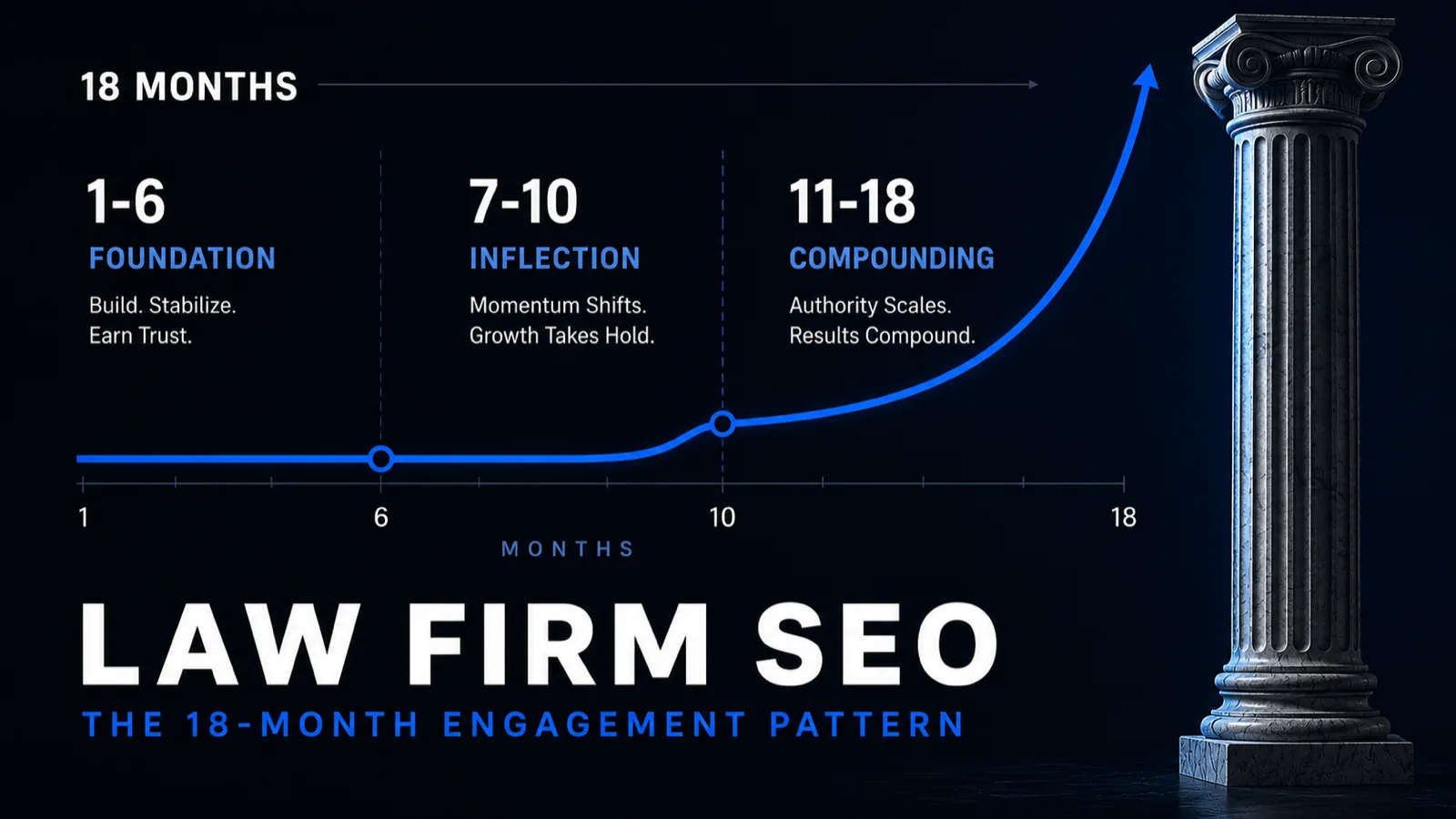
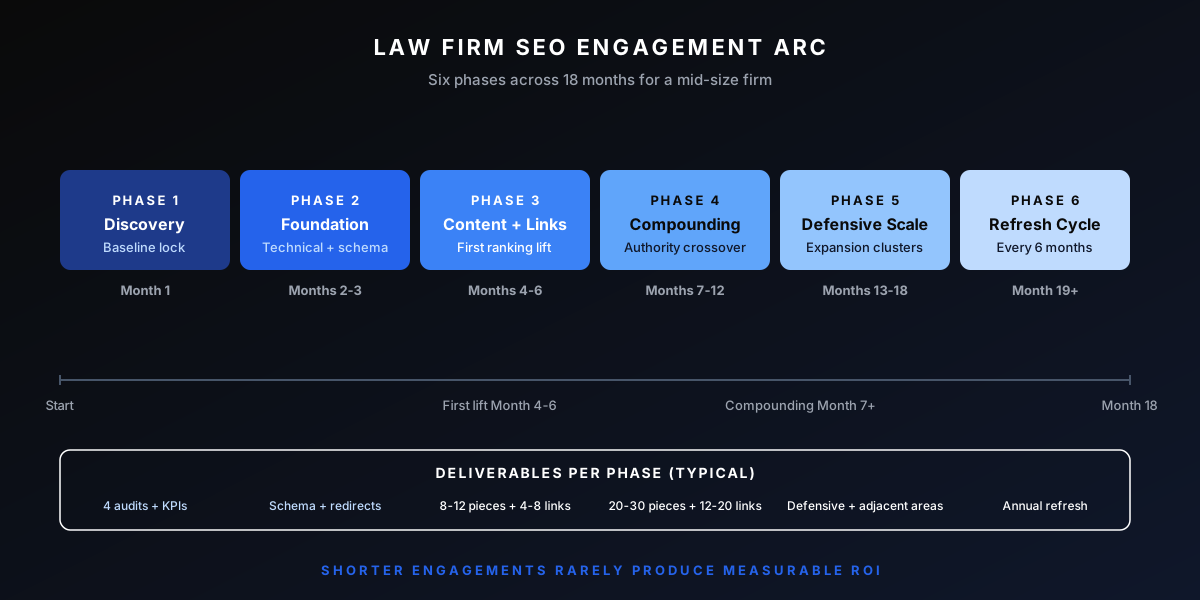
A law firm SEO engagement reaches a clear inflection point around month seven, then compounds through month eighteen. The first six months build the foundation, the middle stretch breaks momentum loose, and the back half turns rankings into sustained lead flow.
The math favors whoever starts first. Claiming an open practice-area term is cheap. Overtaking a competitor who has owned it for two years is a longer fight and a bigger budget. Every month you wait moves that term from the first list to the second.
I learned this shape on real recovery work. During my time at Paradox Marketing I led the topical and technical SEO on Sprintlaw, an online law firm operating across .com.au, .co.uk, and .co.nz. Link acquisition was not in scope. The work was hreflang architecture, practice-area pillars, brand voice, internal linking, and a rebuilt knowledge base. That .co.uk footprint is where link building for UK businesses earns its keep, since British rankings turn on publishers a real reader trusts.
The traffic stayed flat through February, broke out in March, and kept compounding past the end of the engagement. That curve is not unusual. It is what a correctly sequenced legal program looks like.
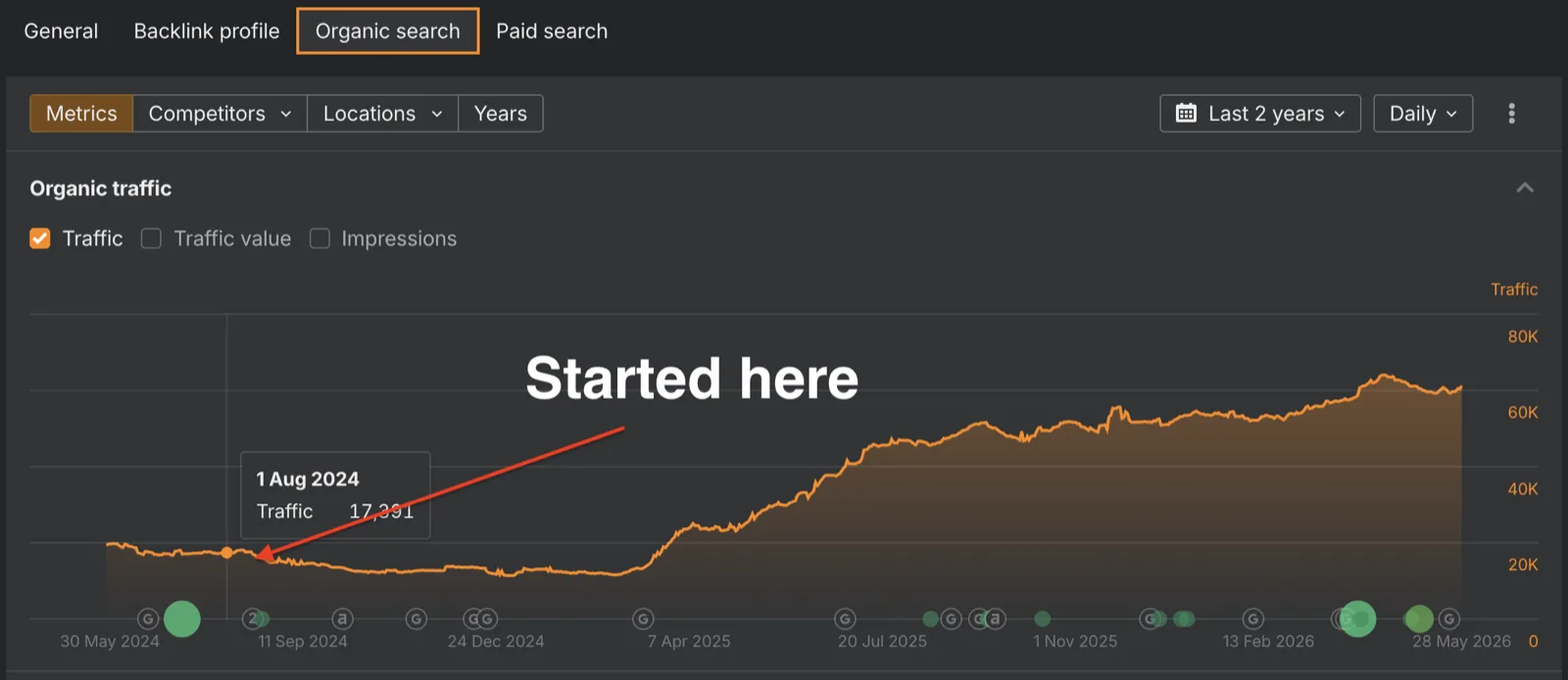
Sprintlaw.com.au organic traffic, Ahrefs. The flat band through February 2025 is the topical authority lag. The March 2025 breakout is the threshold crossing, and the climb continued after the engagement closed.
Foundation (months 1-6)
The first phase is audits and architecture. Four audits (technical, content, backlink, local) plus a locked baseline of the KPIs to measure against. Then schema, content pruning, crawl-budget cleanup, a redirect map, and the practice-area structure.
Nothing here spikes rankings overnight. The point is to stop the site leaking authority and give every later piece of content a clean foundation to stand on.
This is also where the practice-area architecture gets locked. Every page published over the next year sits inside the structure decided here, so getting the hub-and-cluster layout right now saves a rebuild later.
Inflection (months 7-10)
This is where momentum shifts. Cluster content goes live across practice areas, editorial links start landing where they are in scope, and the first long-tail rankings climb into striking distance.
Concretely, that is eight to twelve cluster pieces shipped, four to eight editorial links placed where in scope, and Google Business Profile signals tuned across every office.
The firm usually feels it here first: more qualified calls, better-fit cases, the occasional ranking that jumps a page in a week. That is the system catching.
Compounding (months 11-18)
The back half is where authority scales and results compound. Twenty to thirty cluster pieces, multi-location expansion, conversion tuning on the pages that already rank, and defensive monitoring on the backlink profile.
The adjacent-area expansion starts here too. A personal-injury firm adds workers compensation. A family firm adds estate planning. Each new area ranks faster because the domain already carries authority on the parent vertical.
By month eighteen the firm is not chasing rankings, it is defending them and expanding into adjacent practice areas. Growth becomes the default state rather than the goal.
Measuring Law Firm SEO Results
A law firm SEO program is measured on leads and rankings, not vanity traffic. Report five partner-facing KPIs every month so the marketing director can defend the spend to the managing partner.
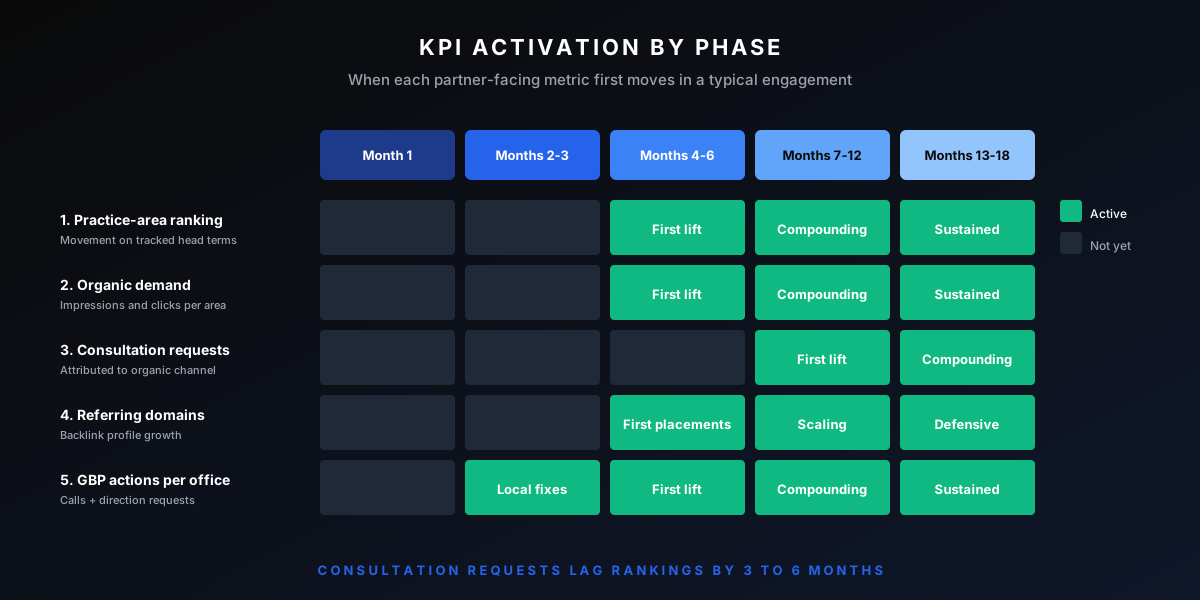
Practice-area keyword movement. Position changes on the terms tied to revenue, segmented by practice area.
Organic impressions and clicks. Demand captured per practice area, not a single sitewide number.
Qualified consultations from organic. Form fills and calls attributed to organic search, the metric that actually matters.
Referring-domain growth. New, relevant linking domains earned over the period.
Google Business Profile actions. Calls and direction requests per office location.
Cadence matters as much as the metrics. Report monthly against the locked baseline, so every number is a delta the partner can act on, not a snapshot with no reference point. A report that cannot show movement against where the firm started is decoration.
Revenue first, rankings second, traffic last. A page that ranks number one for a term no client ever searches is a trophy, not a result.
Law Firm SEO vs PPC
SEO and PPC solve different problems, and the strongest firms run both. PPC buys instant visibility at the top of the page and stops the moment you pause the budget. SEO compounds, costs nothing per click once it ranks, and earns trust that ads cannot buy.
For most firms, the practical play is running PPC for immediate lead flow while SEO builds, then shifting budget toward organic as rankings mature. The two are not rivals. They are a short game and a long game played at the same time.
Run the math over eighteen months and the split shifts. Early on, PPC carries the lead flow while organic is still compounding. By the back half, the ranked pages do the heavy lifting and the ad budget can narrow to the highest-intent terms.
Law Firm SEO and AI Search
AI answer engines now sit above the blue links for many legal queries, and they cite the firms that already rank. Google's AI Overviews, ChatGPT, and Perplexity pull from the same signals law firm SEO builds: clear answers, structured content, named expertise, and consistent citations across the web.
The practical work overlaps with everything above. Lead each page and FAQ with a direct, extractable answer. Keep entity data clean, so the firm name, locations, and practice areas line up everywhere a machine reads them. Earn the reviews and mentions that feed credibility, since AI tools are now a discovery surface used by 45% of consumers in the BrightLocal survey.
Firms that treat AI search as a separate project usually miss. The ones getting cited are the ones that did the structural work, then formatted it so a model can lift the answer cleanly. Do the SEO right and AI visibility mostly follows.
How To Choose a Law Firm SEO Partner
Choose a partner on transparency, relevance, and proof, not on guarantees. Anyone who guarantees a number-one ranking is lying to you, because no one controls Google's algorithm.
Ask three questions. Who actually does the work, a senior strategist or a junior passing it to an offshore team? What does the link profile look like, editorial placements or a spam farm that gets you penalized? And can they show you reporting tied to leads, not just traffic charts? The same vetting decides who runs link building in Australia, where local agencies and offshore resellers pitch the same brief.
Watch for the red flags. Thousand-link packages, locked-in twelve-month contracts with no deliverable schedule, and reporting that hides behind jargon. Mojo Links built Mojo Links' monthly SEO program around the opposite of all three: direct strategist access, editorial links, and KPI reporting a CFO can read.
One more test. Ask to see a sample monthly report from a current client, names redacted. A partner-grade report ties spend to consultation requests and ranking movement by practice area. If all they can show is a traffic line going up and to the right, they are selling activity, not outcomes.
Watch the named-operator dodge, too. The founder is on the website and the sales call, then the account quietly moves to a junior you never meet again. Ask who signs off on the strategy each month, and get the answer in writing before the contract starts.
The same discipline carries across regulated verticals. If your firm sits adjacent to healthcare marketing, the healthcare SEO engagement follows an almost identical recovery curve under the same YMYL rules.
Frequently Asked Questions
How Much Does Law Firm SEO Cost?
Law firm SEO typically runs as a monthly retainer scaled to the firm's competitiveness, number of practice areas, and locations. A single-office practice in a mid-size market invests very differently from a multi-location firm in a major metro. Mojo Links structures this across three monthly tiers, Growth, Scale, and Dominate, which scale backlink volume and content output to the firm's competitiveness. Scope drives price, not a flat menu rate.
How Long Does Law Firm SEO Take To Work?
Most legal engagements reach a visible inflection point around month seven, with meaningful lead flow compounding from months eleven to eighteen. The first six months build the technical and content foundation, so early progress shows in indexing and long-tail rankings before it shows in case volume.
Is Law Firm SEO Worth It?
For most firms, yes, because organic search converts qualified intent at a higher rate than paid channels and keeps working after the spend levels off. The exception is a brand-new firm needing cases this month, where paid search should lead while SEO builds underneath it.
Can a Law Firm Do SEO In-House?
A firm can handle local profile management and basic content in-house, but practice-area architecture, technical audits, and editorial link building usually need specialist execution. Most firms keep reviews and intake in-house and hand the technical and authority work to a partner.
What Is The Most Important Law Firm SEO Ranking Factor?
There is no single factor, but for local legal searches the combination of a well-optimized Google Business Profile, consistent citations, and genuine reviews wins the map pack first. Content and backlinks then decide the competitive organic rankings above and around it.
Work with Mojo Links
I run these engagements myself, which means I take a limited number of firms at a time, and I will not take two that compete in the same market. If you want a read on where your rankings, links, and content gaps actually stand, start with a free personalized audit and we will map the 18-month path from there, while the practice-area terms you want are still winnable.

About Bart Magera
Bart Magera is the founder of Mojo Links. Ten years across YMYL verticals (legal, medical, finance, supplements, crypto, gambling). Trained under Koray Tuğberk Gübür's Topical Authority framework. Author of two SEO books and international speaker.
Want this kind of analysis on your site?
Get a free video walkthrough within 48 hours covering technical health, backlinks, content gaps, and AI visibility.
Related posts
Keep reading on adjacent topics.
- SEO
 Bart Magera9 min read
Brand Mentions for SEO: Linked, Unlinked, and AI Citations
Most SEO budgets still treat a mention without a link as a failed pitch. That math is out of date. The same editorial naming that builds your entity in Google now decides whether AI engines name you in answers. Here is the value model behind linked, unlinked, and AI-cited mentions, and the three lanes for earning more of them.
- SEO
 Bart Magera12 min read
AI Visibility Tools: 9 Trackers Ranked and Compared
Nine AI visibility tools, one yardstick: engines covered, what gets measured, competitor tracking, and price. Every page-one comparison of these trackers is written by a vendor ranking its own product first. This one is not. Here is where each tool fits, from a $29 entry plan to enterprise quotes, and the one thing none of them can do.
- SEO
 Bart Magera10 min read
ChatGPT Brand Mentions: How To Track and Earn Them
When a buyer asks ChatGPT for the best option in a category, it names a few brands inside the answer. Those ChatGPT brand mentions, not the linked citations beneath them, are what get you recommended. Here is how to track them and how to earn them.