
Link Building Timeline: How Long Until Backlinks Move Rankings
Listen to this article
Browser-native voice. No account required.
"When will I see results?" is the most common question on every onboarding call. The honest answer is layered. There is a Google-indexation lag, a scoring lag, and a ranking-stability lag stacked on top of each other. Most agencies under-promise on the timeline and then either over-deliver (great) or get fired in month four (bad). This is the operational timeline framework Mojo Links sets during scoping so expectations match what the system actually does.
How Long Does It Take for a New Backlink To Move Rankings?
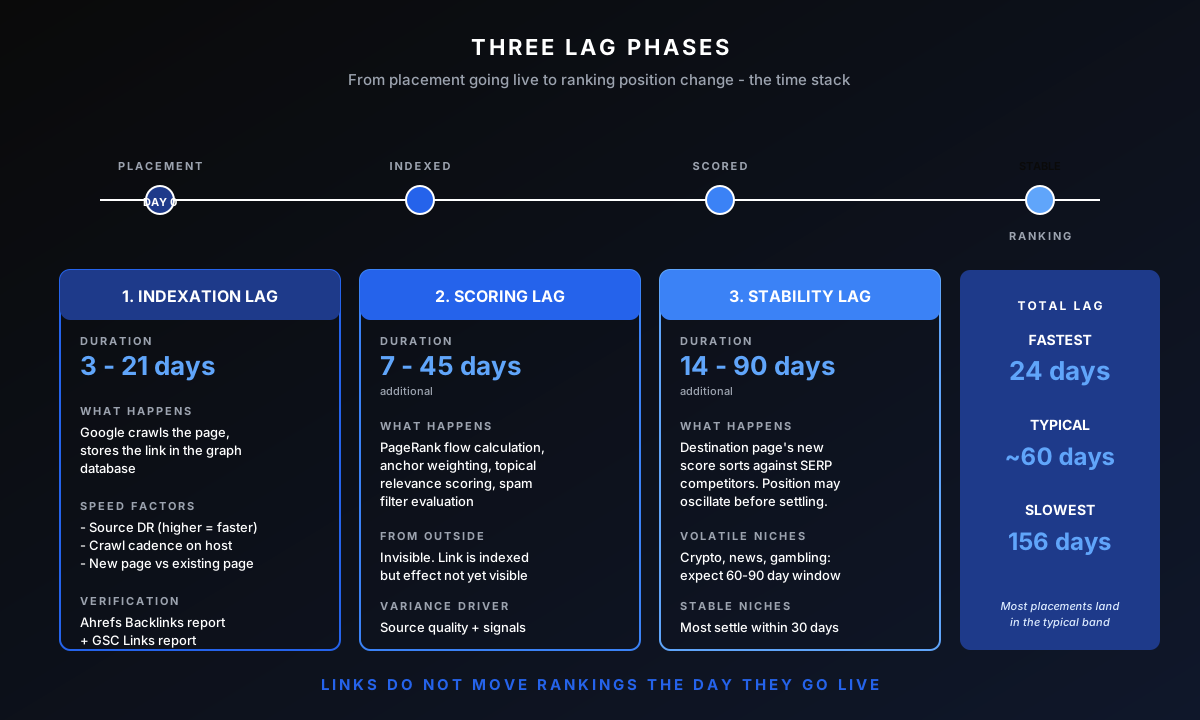
Three sequential lags govern the timeline. Indexation lag (Google crawls and stores the new link): 3-21 days. Scoring lag (Google evaluates and weights the link against your ranking score): 7-45 days additional. Ranking-stability lag (the new score settles into a stable position): 14-90 days additional. Total: 24 days at the fastest, 156 days at the slowest.
The variance is driven by source authority, page indexation patterns, and ranking-position volatility. New placements on high-DR fast-crawled publications show up faster; placements on low-DR slow-crawled domains can sit in limbo for weeks. An Ahrefs study on how long pages take to rank found most top-ranking pages are over a year old, which sets expectations for how long the full curve runs. The mechanism connects to how Google evaluates backlinks.
What Are The Three Lag Phases?
Phase 1: Indexation Lag (3-21 Days)
Google's crawler discovers the new page (or re-crawls an existing page with the new link), fetches the HTML, and adds the link to the link graph database. High-DR sources with frequent crawl cadence land in 3-7 days. Low-DR sources can take 14-21 days. Monitor indexation via the Ahrefs "Backlinks" report and Google Search Console "Links" report; the link is "indexed" once it appears in either source.
Phase 2: Scoring Lag (7-45 Days Additional)
Once indexed, Google runs the link through PageRank-style flow calculation, anchor-text weighting, topical relevance scoring, and spam-detection filters. The score gets applied to the destination page's overall ranking score. This phase is invisible from outside; the link is in the database but its effect is not yet visible in rankings.
Phase 3: Ranking-Stability Lag (14-90 Days Additional)
The destination page's score has shifted, but the SERP itself has to re-sort. Other ranking signals (engagement metrics, content freshness, competitor changes) interact with the new score. The page may oscillate up and down before settling at a stable new position. Most stabilisation lands within 30 days, but volatile niches (crypto, news, gambling) can take 60-90 days.
How Does Keyword Difficulty Change The Timeline?
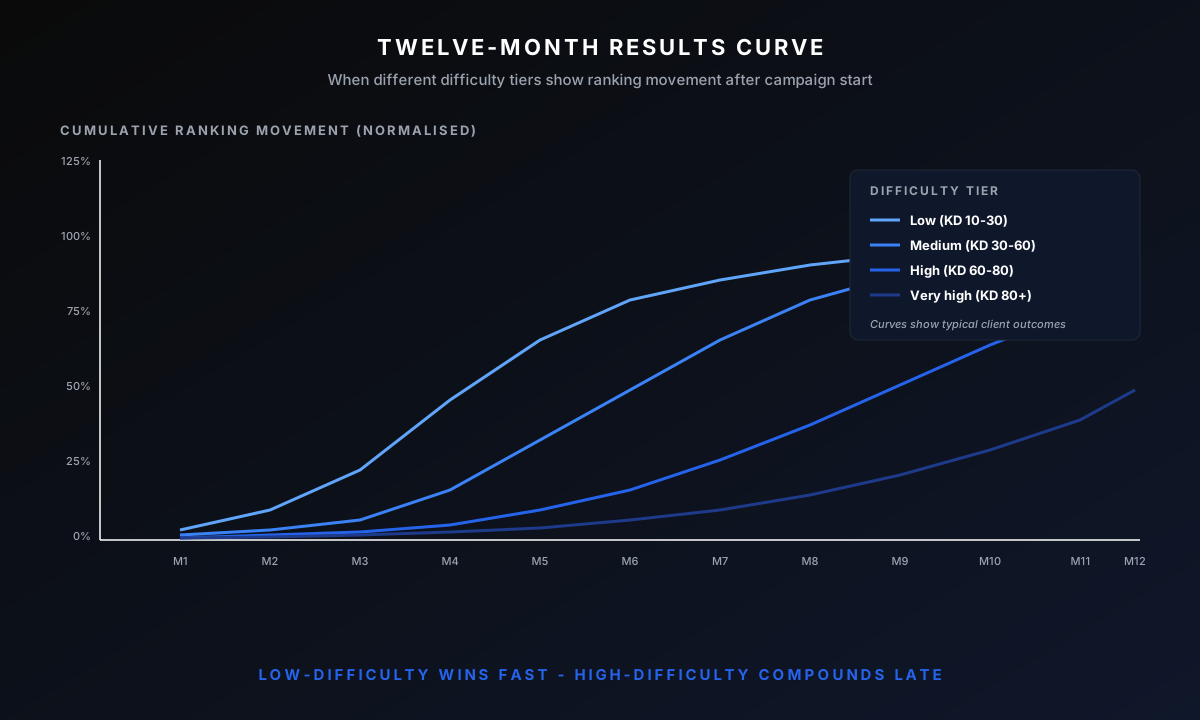
Difficulty tier governs the realistic ranking-movement window.
Low Difficulty (KD 10-30)
4-12 weeks from first new placements to measurable position changes. Most movement concentrates between weeks 4-8. Sites in lower-competition niches see fast results because the SERP responds to small signal changes.
Medium Difficulty (KD 30-60)
8-20 weeks. The default expectation for most B2B SaaS, mid-tier e-commerce, and unregulated services. Movement is gradual; expect incremental position improvements rather than dramatic jumps.
High Difficulty (KD 60-80)
14-26 weeks. Competitive niches where top-10 pages all have substantial backlink profiles. Movement requires sustained acquisition; a single quarter of links rarely shows results.
Very High Difficulty (KD 80+)
20-40+ weeks. Tier-1 commercial queries in regulated verticals. The SERP is dominated by domains with 500+ referring domains. Realistic movement requires 12-18 months of sustained acquisition at Aggressive or Enterprise budget tier.
When Do The First Measurable Wins Typically Arrive?
Three milestones land on most engagements at predictable intervals from kickoff.
Month 1: Indexation Milestones
New placements appearing in Ahrefs and GSC. Referring domain count visibly increasing. No ranking movement yet on competitive keywords; some movement possible on long-tail low-difficulty queries.
Months 2-3: Long-Tail Wins
Long-tail keywords (KD 10-30) start showing position improvements. These are not the keywords a brand usually cares about most, but they validate that the acquisition is producing signal. Organic clicks on long-tail terms typically increase 8-15% by month 3.
Months 4-6: Mid-Tier Wins
Medium-difficulty target keywords (KD 30-60) start moving. Position changes are usually 5-15 spots upward on individual keywords; total organic sessions increase 15-40% depending on the keyword set.
Months 7-12: High-Difficulty Wins + Plateau
High-difficulty competitive keywords start moving. Total organic traffic typically lands at 1.5-3x the baseline for properly-scoped Growth or Aggressive campaigns. Some plateau is normal; further movement requires continued acquisition.
Why Does Google Sometimes Ignore New Links Entirely?
Three reasons show up in audits.
Source quality fails the spam-detection filter. Google indexed the link but discounted it. The link exists in the database but contributes zero to ranking. Catch this during quarterly audit by comparing acquired placements to ranking outcomes.
Source topical relevance is too low. The link is technically counted but reweighted near zero because the source niche has no semantic match to the destination topic.
Anchor text triggers over-optimisation flag. Exact-match commercial anchors above 15% of the profile trigger algorithmic discount. The link exists but contributes negative or zero to ranking. The framework for evaluating this sits in the anchor text guide.
Why Do Rankings Sometimes Drop Before They Improve?
Temporary dips during ranking re-sorting are normal. When a destination page's authority increases, Google may re-evaluate its overall positioning across multiple keywords. The page might move up on its primary keyword but temporarily down on a secondary keyword as the SERP re-sorts. Most dips resolve within 4-8 weeks.
Persistent drops after new placements indicate something has gone wrong. Common causes: anchor text over-optimisation, sudden burst of low-quality links triggering velocity flags, or new links from sources later identified as part of a discounted network. The diagnostic workflow connects to the broader audit framework.
How Long Until Link Building ROI Shows in Revenue?
ROI realisation lags ranking movement by 30-90 days because organic sessions need to flow through the conversion funnel. The full math is documented in the link building budget post. Most engagements see ROI break-even at month 8-14 for Growth-tier campaigns and month 10-18 for Aggressive-tier campaigns in regulated verticals.
How Did Mojo Links Arrive at These Timeline Estimates?
The phase-lag bands above come from placement data tracked at weekly granularity across our engagements. The ranges reflect typical outcomes. Outliers exist - the debexpert.com engagement saw a tier-1 PR placement move a target keyword 28 positions in 11 days - but the bands above exclude that kind of acceleration to keep expectations honest.
Frequently Asked Questions About Link Building Timeline
Why Does My Agency Say Results Take 6 Months When Other Agencies Promise 30 Days?
Agencies that promise 30-day results are either operating in non-competitive niches where movement is trivial, or selling unsustainable tactics that produce short-term gains followed by penalties. Six months is realistic for most competitive niches and matches the actual timeline of the underlying Google systems.
Can You Speed Up The Indexation Phase?
Marginally. Submitting the new pages via Google Search Console can shave 2-7 days off indexation lag. Adding social shares and submitting URLs to indexing tools can help slightly. The scoring and stability phases cannot be accelerated.
Do All Links Produce Ranking Lift, Just at Different Speeds?
No. About 15-25% of placed links contribute zero or negative ranking impact regardless of timeline. This is normal. Campaign success depends on the 75-85% of links that do contribute, not on every individual link working.
What Is The Longest You Would Wait for Ranking Movement Before Declaring a Campaign Failed?
12 weeks for low-difficulty keywords. 24 weeks for high-difficulty. 36 weeks for very-high-difficulty regulated-vertical campaigns. Beyond those windows, something else is wrong (technical SEO blocking, content quality, profile toxicity) and the issue needs diagnosis before more link investment.
Should I Expect Linear Ranking Movement, or Jumps?
Mostly incremental with occasional jumps. A single high-DR placement on a topically-relevant page can produce a 5-10 position jump in one week. Most movement is incremental, with 1-3 positions per week being normal during active phases.
Want Us To Scope Your Link Building Campaign Timeline?
Every link building program kickoff includes a timeline expectation document tailored to your difficulty tier, vertical, and budget. The document covers each phase milestone and the metrics we will use to validate progress. Book a slot to discuss your campaign.

About Bart Magera
Bart Magera is the founder of Mojo Links. Ten years across YMYL verticals (legal, medical, finance, supplements, crypto, gambling). Trained under Koray Tuğberk Gübür's Topical Authority framework. Author of two SEO books and international speaker.
Want this kind of analysis on your site?
Get a free video walkthrough within 48 hours covering technical health, backlinks, content gaps, and AI visibility.
Related posts
Keep reading on adjacent topics.
- Link Building
 Bart Magera10 min read
Contextual Backlinks: What They Are, Why They Win, and How To Earn Them
A contextual backlink sits inside the body of an article, surrounded by relevant text, not in a footer or author bio. That placement is what gives it weight. Here is what contextual backlinks are, what makes one high quality, how to earn them, and how to spot the cheap fakes.
- Link Building
 Bart Magera12 min read
What Is White Hat Link Building? Techniques That Work in 2026
The Problem: Why Most Link Building Fails Your SEO You wrote great content. It’s relevant. It’s useful. It even has infographics. But guess what? Crickets. Nobody’s linking. Google’s not ranking. And your “ultimate guide” is buried somewhere on page 7 under a recipe blog and a…
- Link Building
 Bart Magera10 min read
Tiered Link Building: How It Works and How To Do It Safely
Tiered link building layers weaker links behind your strongest ones to pass more authority to your money pages. Here is how the pyramid works, how to build one, which links are worth tiering, the risk SpamBrain introduced, and the lower-risk path I use on client sites.