

Link Building Budget: How To Plan Spend by Vertical and Campaign Tier
Listen to this article
Browser-native voice. No account required.
Most link-building budgets are set the wrong way. The marketing director gets a number from their CFO ("spend up to $5K per month"), then asks an agency or in-house team to make that number work. The reverse should be true: scope the required outcome, then back-solve for the budget that produces it. This post is the budget framework Mojo Links uses to plan engagements and the math that determines whether your number is realistic for your vertical.
How Do You Calculate a Realistic Link Building Budget?
The right starting point is the gap between your current backlink profile and the top-3 competitor average. A site with 80 referring domains competing for keywords where the top three average 320 RDs needs 240 net new RDs to close the gap. At a typical cost-per-link of $250-800 in mid-tier campaigns, that gap costs $60K-192K over 12-18 months.
Detailed vertical benchmarks live in the backlink count benchmarks, and Siege Media's link building cost study puts realistic per-link pricing behind the same math. The figures above are the operational starting point. Budget less than the gap requires and rankings will not move.
What Does Each Link Building Budget Tier Actually Buy?
Three tiers cover most operational scenarios. The structure mirrors the Mojo Links Monthly SEO service tiers (Growth, Scale, Dominate) and the typical scope at each level.
Starter: $3-5k Per Month
8 placements per month from contextually relevant publishers. Suitable for sites building their organic foundation: founder-led startups, small B2B sites, niche e-commerce. Includes semantic-SEO foundation work, schema implementation, and monthly reporting. The full Growth tier sits alongside content and technical-SEO scope in the Monthly SEO service.
Growth: $8-15k Per Month
12 placements per month plus a 12-asset content cadence and entity-optimization buildout (20-30 properties). Suitable for Series A/B companies scaling SEO as a primary acquisition channel. The default tier for most mid-market brands. Includes semantic content network buildout, AI visibility optimization, competitor monitoring, and weekly updates.
Aggressive: $20-35k Per Month
20+ placements per month plus full semantic-architecture buildout, entity-web (50+ properties), and multilingual support. Required for regulated verticals where competitor top-3 average hundreds of referring domains. Mid-market and enterprise teams in competitive niches, including international SEO scope.
Enterprise: $50k+ Per Month
60+ placements per month. DR 60-90+ sources. UR 45+ typical. Required when target keywords have top-3 competitors averaging 500+ referring domains. Cost-per-link $1,200-4,000+. ROI 5-12x when run by an agency with vertical-specific publisher reach. Below $50K, the math does not scale to the placement volume required.
How Does Vertical Multiply The Budget Floor?
Regulated verticals (legal, medical, finance, crypto, supplements, gambling) demand 3-5x the backlink investment of unregulated B2B for the same ranking outcome. The reason: top-3 competitors in regulated SERPs average 380-820 referring domains versus 85-290 for local services or e-commerce.
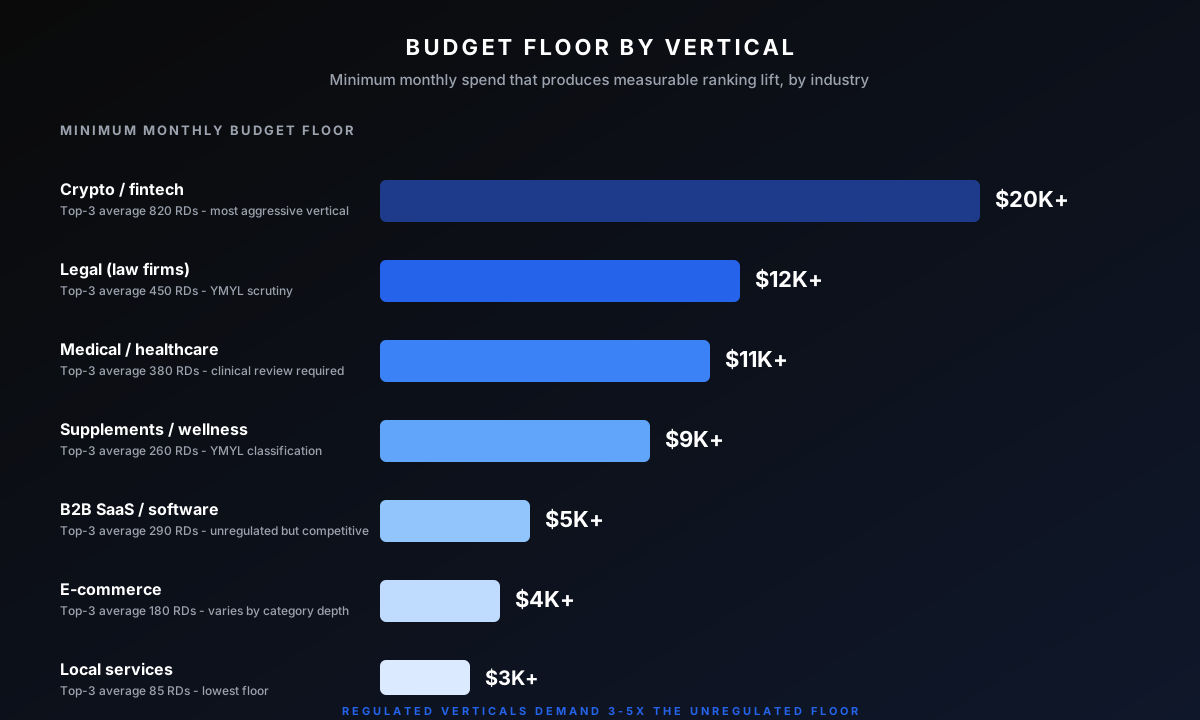
A vertical-aware budget floor: $3K monthly is realistic for unregulated B2B SaaS. The same target ranking position in legal or medical requires $10K-15K monthly. Crypto and finance demand $15K-25K monthly as the realistic floor. Vertical adjustment is one of the most common budget-planning mistakes. Detailed benchmarks sit in the Link Building Operations Guide.
Where Does Link Building Budget Actually Get Spent?
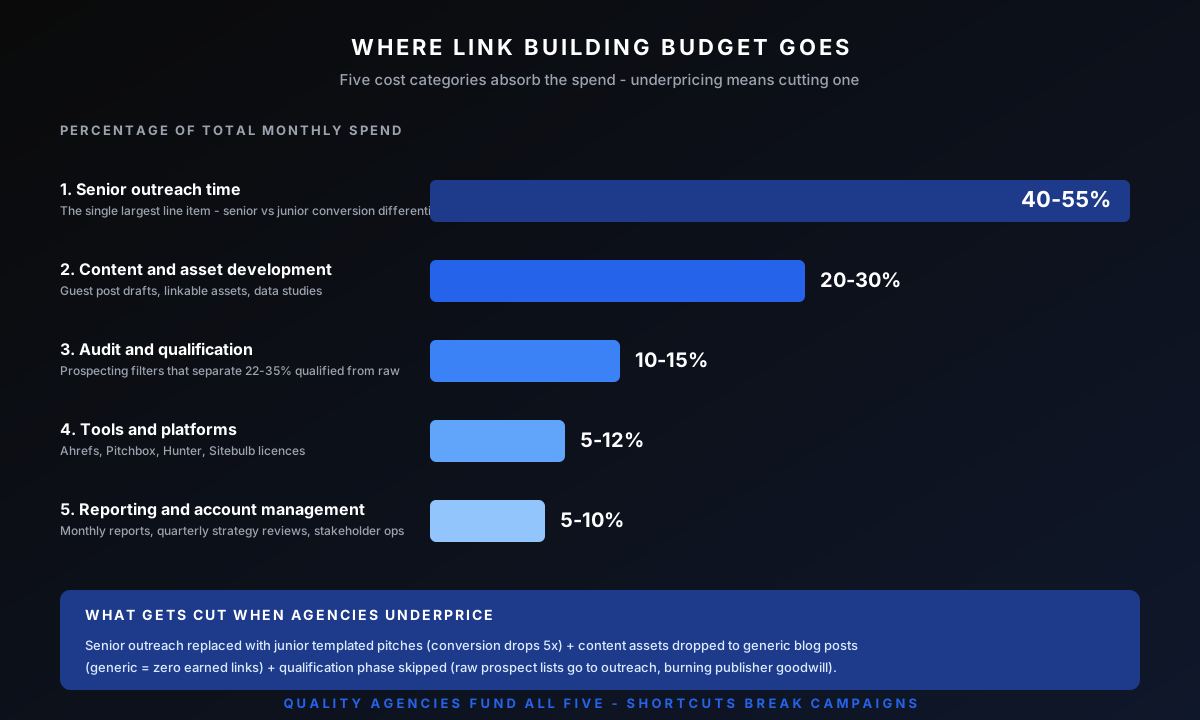
Five cost categories absorb most of the spend. Agencies that underprice usually skimp on one or two; quality agencies fund all five.
Senior Outreach Time
40-55% of total budget. The single largest line item. Junior outreach analysts produce templated pitches that convert at 1-3%. Senior outreach time produces 8-15% conversion. The cost difference between $30/hour and $80/hour outreach pays back through reply rates.
Content and Asset Development
20-30% of total budget. Guest post drafts, linkable assets, data study production. Generic content costs $50-150 per piece and earns zero links. Quality content costs $300-1,500 per piece and earns 5-20 links over 12 months.
Tools and Platforms
5-12% of total budget. Ahrefs, Semrush, Pitchbox, Hunter, Sitebulb. Covered in detail in the link building tools breakdown.
Prospect Qualification and Audit
10-15% of total budget. The qualification phase that separates 22-35% qualified prospects from raw candidates. Skipping this drops conversion rates in half.
Reporting and Account Management
5-10% of total budget. Monthly reporting, quarterly strategy reviews, stakeholder communication. Some agencies bundle this into outreach overhead; the line item exists either way.
When Does in-House Outperform Agency?
The break-even depends on monthly placement volume and the maturity of in-house SEO. Three signals favour in-house build-out.
Existing senior SEO leadership. If you already have a director-level SEO running technical and on-page work, adding link building to their team's scope is cheaper than agency at sustained volume.
Established publisher relationships. Brands with strong PR functions already have editor contacts at relevant publications. In-house can use those existing relationships; agencies build them from scratch.
Specialised vertical knowledge that is hard to outsource. Internal legal, medical, or financial expertise that agency teams cannot replicate quickly. The break-even shifts toward in-house when the knowledge premium is high.
Two signals favour agency. First, ramp speed under 6 months. Building an in-house team takes 4-9 months; agencies can produce placements within 6-8 weeks. Second, regulated-vertical access. Specialist agencies maintain publisher lists that take 18-24 months to build cold. The full in-house-vs-agency analysis sits in the Link Building Operations Guide.
Where Does Link Building Budget Get Wasted?
Five common failure patterns.
Buying cheap links. Below $150 per placement, you are buying junior outreach with templated pitches, or paid-placement schemes Google discounts within 6-18 months.
Over-paying for tier-1 PR without follow-up reclamation. A single tier-1 placement is valuable; the secondary backlink wave that follows it is where most of the ROI sits, and ignoring reclamation wastes that wave entirely.
Scaling acquisition before audit. Building 30 new links onto a profile with existing toxicity wastes 50% of the spend on links that get algorithmically discounted.
Demanding exact-match anchors. Over-optimised anchor profiles get flagged, link equity drops, and budget produces less ranking lift.
Skipping QA on confirmed placements. 6-9% of placements need rework. Skipping QA means paying for placements that go live with wrong anchors or sponsored markup. The full failure inventory sits in the common link-building mistakes post.
How Long Until Link Building Budget Shows ROI?
Plan for 8 to 26 weeks for first measurable ranking movement on competitive keywords. Lower-difficulty queries move in 4 to 12 weeks. High-difficulty queries can take 16 to 30 weeks. ROI realisation typically lands at 8-14 months after campaign start for most non-regulated verticals; 14-22 months for regulated verticals where competitor profiles are deeper.
Plan budget for at least 12 months of sustained acquisition. Short campaigns under 6 months rarely produce measurable ROI in competitive niches. The cost-per-link and time-to-results tradeoffs are documented in the link building statistics for 2026.
How Did Mojo Links Arrive at These Budget Bands?
The three-tier model mirrors our Monthly SEO service catalog. Tier scope is documented on the /services/monthly-seo/ page. The structure exists because semantic SEO, content, technical fixes, and link acquisition reinforce each other under one plan rather than being delivered as separate silos.
Frequently Asked Questions About Link Building Budget
Can a $500 Monthly Budget Produce Ranking Lift?
Almost never for sites in competitive verticals. At that budget level, you can afford 1-2 low-tier placements monthly, which produces no measurable ranking movement. $500 monthly works only for very low-competition local services.
What Does a $1,000 Monthly Link Building Budget Actually Buy?
Below Growth-tier scope, agencies and freelancers cannot fund qualification properly. Templated outreach to low-DR sources produces placements but does not move competitive rankings.
Is Link Building Cost The Same in 2026 as in 2023?
Cost-per-link has increased 15-25% across 2023-2025 for two reasons. First, AI-generated content saturation made publishers more selective about which guest posts they accept. Second, editorial-team labour costs rose across most major publications. Mojo Links adjusts budget bands annually to reflect these changes.
Should You Pay Per Link or Per Month?
Per month for sustained campaigns. Per link only for short-term tactical placements. Monthly retainers align agency incentives with program quality; pay-per-link encourages volume-over-quality on the agency side.
What Is The Minimum 12-Month Budget That Produces Meaningful Results?
$36K total spend across 12 months ($3K monthly Starter tier) is the realistic floor for measurable organic revenue lift in moderately competitive niches. Below this floor, the math does not produce ROI worth tracking.
Want Us To Scope Your Link Building Budget?
Budget scoping is part of every managed campaign kickoff. We analyse the competitor profile gap, vertical multiplier, and timeline requirement to land on a budget that aligns with your ranking targets. Book a slot to discuss your campaign.

About Bart Magera
Bart Magera is the founder of Mojo Links. Ten years across YMYL verticals (legal, medical, finance, supplements, crypto, gambling). Trained under Koray Tuğberk Gübür's Topical Authority framework. Author of two SEO books and international speaker.
Want this kind of analysis on your site?
Get a free video walkthrough within 48 hours covering technical health, backlinks, content gaps, and AI visibility.
Related posts
Keep reading on adjacent topics.
- Link Building
 Bart Magera10 min read
Contextual Backlinks: What They Are, Why They Win, and How To Earn Them
A contextual backlink sits inside the body of an article, surrounded by relevant text, not in a footer or author bio. That placement is what gives it weight. Here is what contextual backlinks are, what makes one high quality, how to earn them, and how to spot the cheap fakes.
- Link Building
 Bart Magera12 min read
What Is White Hat Link Building? Techniques That Work in 2026
The Problem: Why Most Link Building Fails Your SEO You wrote great content. It’s relevant. It’s useful. It even has infographics. But guess what? Crickets. Nobody’s linking. Google’s not ranking. And your “ultimate guide” is buried somewhere on page 7 under a recipe blog and a…
- Link Building
 Bart Magera10 min read
Tiered Link Building: How It Works and How To Do It Safely
Tiered link building layers weaker links behind your strongest ones to pass more authority to your money pages. Here is how the pyramid works, how to build one, which links are worth tiering, the risk SpamBrain introduced, and the lower-risk path I use on client sites.