Link Building Tools: The Best Tools for Every Campaign Stage
Listen to this article
Browser-native voice. No account required.
Most "best link building tools" articles are affiliate-commission roundups. The writer gets paid for every signup they refer, so they recommend ten tools when most teams need three. This post covers the stack Mojo Links actually runs on real campaigns. Some tools are paid. Most are paid because the free alternatives waste more agency time than the licence costs. Here is what to use, what to skip, and why.
What Tools Do You Actually Need for Link Building in 2026?
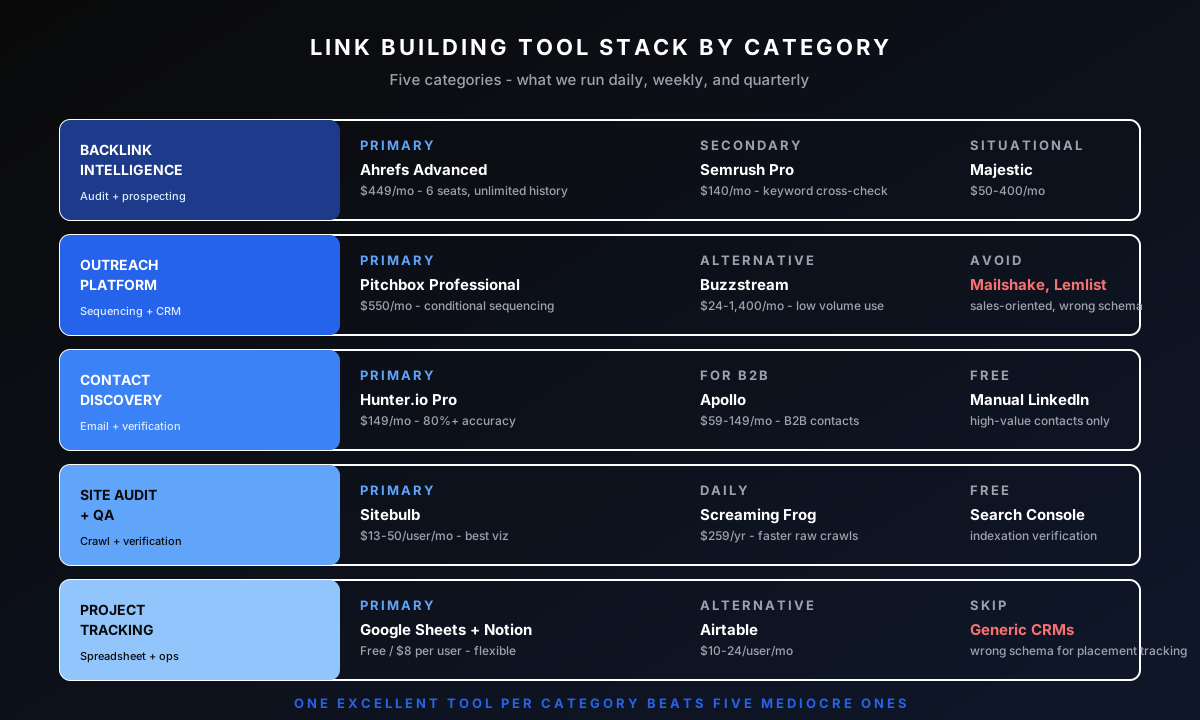
Five categories cover the operational stack: backlink and competitor intelligence, outreach and CRM, contact discovery, site auditing, and project tracking. One excellent tool per category beats five mediocre ones. The total cost for a properly equipped team lands at $400 to $900 per month per active operator.
Tool choice ties directly to the workflow phases covered in the operations guide. Each phase has a primary tool requirement. Phase 1 (audit) needs intelligence tools. Phase 4 (outreach) needs CRM and contact tools. Phase 5 (QA) needs site-audit tools.
Which Backlink Intelligence Tool Should You Buy?
Three credible options: Ahrefs, Semrush, and Majestic. Use Ahrefs as the primary and Semrush as a secondary verification source for keyword data. Majestic has the best historical link data but a weaker interface for daily use.
For a head-to-head of these tools specifically for analyzing a rival's links, see the backlink checker tools comparison.
Ahrefs (primary)
$129-1,499 per month. The Standard plan ($249) covers most agency workflows: Site Explorer, Content Explorer, broken-backlink reports, organic competitor analysis, rank tracking. Mojo Links runs on the Advanced plan ($449) because the export volume on Standard hits the ceiling within a week of any sizeable audit. The Advanced plan unlocks unlimited backlink history and 6 user seats.
Semrush (secondary)
$140-500 per month. One Pro seat ($140) covers keyword data verification and competitor traffic analysis. Semrush's SERP intelligence is stronger than Ahrefs in some niches. Running both gives a check on data accuracy when single-tool numbers look suspicious.
Majestic (situational)
$50-400 per month. Best for historical link decay analysis and trust-flow scoring on old domains. Add it when running large audits on aged sites. Skip it for new sites and standard campaigns.
Which Outreach Platform Should You Buy?
Two credible options: Pitchbox and Buzzstream. Pitchbox is the primary for the link-building outreach. Buzzstream is reasonable at lower volumes.
Pitchbox (primary)
$295-1,000 per month. The conditional-logic sequencing handles complex follow-up cycles across 10+ active campaigns without managing manual queues. Integration with Hunter and Ahrefs reduces context-switching. The Professional plan ($550) covers a 2-3 person outreach team.
Buzzstream (alternative)
$24-1,400 per month. Cheaper at low volumes (under 200 active prospects). Less sophisticated sequencing. It fits solo operators and in-house teams just starting outreach work, not established agencies.
Cold-Email Tools To Avoid
Mailshake, Lemlist, Reply.io. These are sales-oriented cold-email tools, not link-building tools. They lack the prospect-tracking schema that link-building campaigns require (target URL per prospect, anchor preference, publisher history). Force-fitting them to link building wastes more hours than it saves licence cost.
Which Contact Discovery Tools Work?
Three options: Hunter.io, Apollo, and manual LinkedIn outreach. Hunter is the daily workhorse.
Hunter.io
$49-499 per month. Email pattern discovery, verification, and domain searches. Integrates with Pitchbox for one-click prospect enrichment. The Pro plan ($149) covers most agency volumes. Hunter's data accuracy is consistently above 80% on first-attempt verifications, well above the alternatives Mojo Links has tested.
Apollo
$59-149 per month. Better for B2B sales prospects than editorial contacts. It sees occasional use for digital PR campaigns where the target journalist works at a larger publication with a discoverable Apollo profile.
Manual LinkedIn
Free, but expensive in time. Useful for high-value editorial contacts where automated tools fail. Use manual LinkedIn for tier-1 digital PR contacts and avoid it for bulk outreach.
Which Site Audit and QA Tools Matter?
Two complementary tools: Sitebulb for technical audits, Screaming Frog as the daily crawler.
Sitebulb
$13-50 per user per month. Best technical audit visualisation Mojo Links has used. The crawl reports surface broken links, redirect chains, and index issues that affect link-building campaigns. Run Sitebulb on every new site audit.
Screaming Frog
$259 per year. The default daily crawler for verification work. Faster than Sitebulb on raw crawls, weaker on report visualisation. Free up to 500 URLs.
Both tools support the placement QA phase covered in the end-to-end workflow. Without one of them, the 24-hour QA pass becomes a manual click-through that scales badly.
Which Tools Are Overrated for Link Building?
Five tools routinely recommended in roundups that rarely earn a place in a working stack.
NinjaOutreach. Smaller community than Pitchbox or Buzzstream. The interface is dated. Skip.
LinkResearchTools. Aggressive marketing, dated dashboards, and the toxic-link scoring overflags by 6-8x. Inclusion in audit workflows produces over-disavow disasters.
Respona. Newer entrant; the AI personalisation features produce templated openers journalists detect immediately. Conversion rates in Mojo Links' testing sit below Pitchbox.
LinkAssistant (SEO PowerSuite). Desktop software model in a SaaS world. Crawl quality is uneven.
Generic Chrome extensions that promise to "find any backlink instantly". None of them match Ahrefs or Semrush coverage. Mojo Links tests them quarterly to stay open to alternatives; they continue to fall short. The reasoning behind tool choice ties back to the broader link building operations guide.
What Are The Best Free Link Building Tools?
You can run a real link-building baseline on free tools, especially for prospecting, monitoring, and QA. The ceiling is throughput, not capability: free tools take more manual time per prospect, which is the trade you accept to skip the licence cost.
Google Search Console. Your own backlink and performance data, straight from Google and free.
Ahrefs Webmaster Tools. Free backlink and site-audit data for any site you can verify.
Ahrefs free Backlink Checker. The top 100 backlinks and referring domains for any URL, no account needed.
Google Alerts. Catches unlinked brand mentions, the trigger for link reclamation.
Wayback Machine. Finds dead pages and old resource lists for broken link building.
Screaming Frog (free tier). Crawls up to 500 URLs for placement QA and internal-link checks.
Hunter free tier. A small monthly allowance of email lookups for low-volume outreach.
Most of these have a free Google-account or verification gate, not a paywall. For the free-versus-paid trade specifically on competitor analysis, see the free backlink checkers comparison. Free tools get a new campaign moving; the paid stack is what makes it scale.
What Is The Total Monthly Tool Cost for a Working Link-Building Team?
Minimum viable stack for solo or two-person teams: $400-550 per month. Comfortable agency stack for 2-4 person teams: $700-1,100 per month. Enterprise agency stack for 5+ person teams: $1,800-3,500 per month.
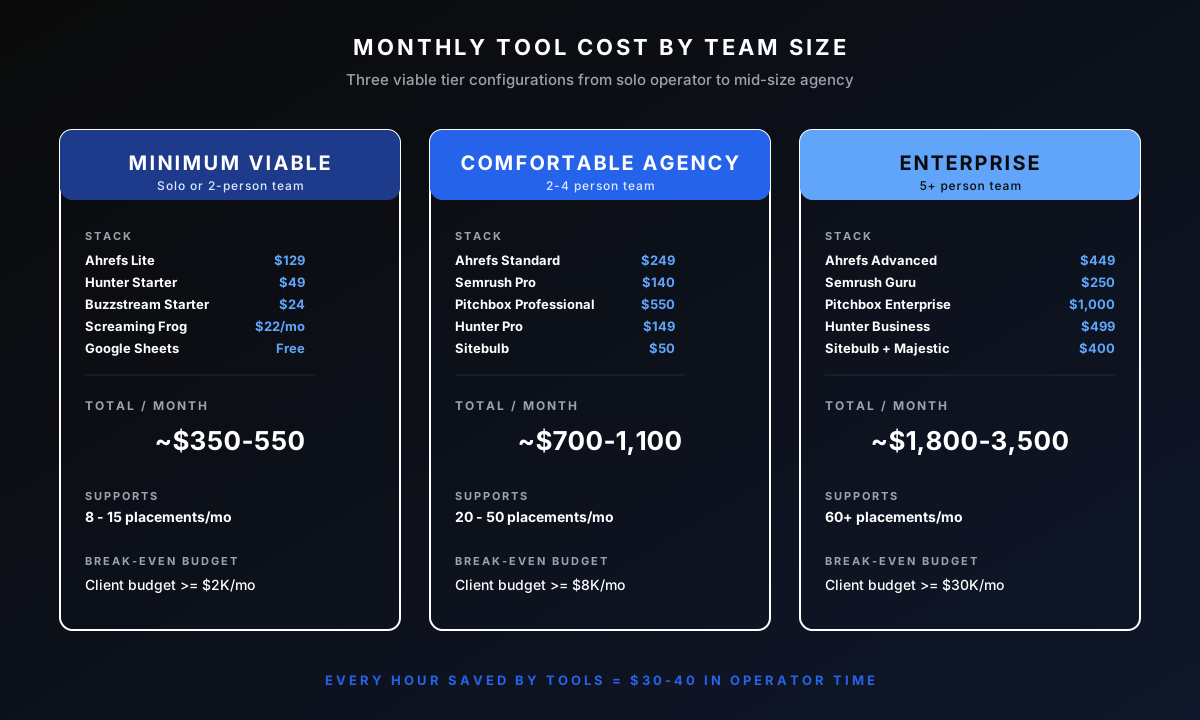
The cost is justified by time savings. A junior outreach analyst earns $50K-70K loaded; every hour the tool stack saves them is worth $30-40. A tool that costs $500 per month but saves the team 20 hours per month pays back at over 1.5x.
How Did Mojo Links Arrive at This Tool Stack?
We have tested every tool listed here under live conditions across our campaigns since 2022. Tools that produced consistent value across multiple operators got included. Tools that scored well in one operator's hands but failed in another's got dropped. The stack above is what survived three years of agency stress-testing, not a list compiled from vendor research pages.
Frequently Asked Questions About Link-Building Tools
Can You Do Link Building Without Paid Tools?
Partially. Google Search Console, manual Google searches, and Wayback Machine give a working free baseline. Conversion rates drop 30-50% versus the full stack because prospect qualification takes longer and contact verification fails more often. For campaigns below $2,000 monthly budget, free tools can work; above that, the paid stack pays back through saved hours.
Should You Use AI Tools for Link-Building Outreach?
Carefully. AI-generated openers convert below 2% in Mojo Links' tests, because editors detect templated language. AI for prospect summarisation and asset drafting works fine. AI for the actual outreach copy fails.
What Is The Minimum Monthly Tool Budget That Produces Results?
$350 per month covers Ahrefs Lite ($129), Hunter Starter ($49), and Buzzstream Starter ($24) plus a few minor utilities. That stack supports 1 active operator running 8-15 placements per month.
Do You Need a Separate Rank Tracker?
Ahrefs and Semrush both include rank tracking sufficient for link-building campaigns. Dedicated tools (Nightwatch, ProRankTracker, AccuRanker) are overkill for link work, useful for technical SEO operators tracking thousands of keywords.
Which Tools Have The Highest Churn in The Stack over The Past 3 Years?
Three tools came and went: BuzzSumo (used for content prospecting in 2022, replaced by Ahrefs Content Explorer), LinkResearchTools (used briefly in 2022, abandoned after over-disavow incidents), and Mailshake (used briefly in 2023, replaced by Pitchbox once volume grew).
Want Us To Run Link Building so You Do Not Have To Buy These Tools?
Our campaign-based link building runs the full tool stack above on every client engagement. Clients see the deliverables; we absorb the licence costs. Book a slot to discuss what your campaign would look like.

About Bart Magera
Bart Magera is the founder of Mojo Links. Ten years across YMYL verticals (legal, medical, finance, supplements, crypto, gambling). Trained under Koray Tuğberk Gübür's Topical Authority framework. Author of two SEO books and international speaker.
Want this kind of analysis on your site?
Get a free video walkthrough within 48 hours covering technical health, backlinks, content gaps, and AI visibility.
Related posts
Keep reading on adjacent topics.
- Link Building
 Bart Magera10 min read
Contextual Backlinks: What They Are, Why They Win, and How To Earn Them
A contextual backlink sits inside the body of an article, surrounded by relevant text, not in a footer or author bio. That placement is what gives it weight. Here is what contextual backlinks are, what makes one high quality, how to earn them, and how to spot the cheap fakes.
- Link Building
 Bart Magera12 min read
What Is White Hat Link Building? Techniques That Work in 2026
The Problem: Why Most Link Building Fails Your SEO You wrote great content. It’s relevant. It’s useful. It even has infographics. But guess what? Crickets. Nobody’s linking. Google’s not ranking. And your “ultimate guide” is buried somewhere on page 7 under a recipe blog and a…
- Link Building
 Bart Magera10 min read
Tiered Link Building: How It Works and How To Do It Safely
Tiered link building layers weaker links behind your strongest ones to pass more authority to your money pages. Here is how the pyramid works, how to build one, which links are worth tiering, the risk SpamBrain introduced, and the lower-risk path I use on client sites.