

PBN Link Building: Risks, Penalties, and How To Spot Networks
Listen to this article
Browser-native voice. No account required.
PBNs (private blog networks) were the breakout SEO tactic of 2013-2015. They produced fast rankings for cheap. They stopped working consistently around 2018. They were dead by 2022. And yet a sizeable resale market still sells them to unsuspecting buyers in 2026, often disguised as "high-DR niche placements" or "premium guest posts on aged domains." This post is the explainer Mojo Links gives whenever someone asks why the agency will not build them a PBN. Skip the tactic. Spot the resellers. The same expired-domain networks powered the lower tiers of tiered link building.
What Is a Private Blog Network?
A private blog network is a collection of websites owned and operated by one person or organisation for the explicit purpose of placing outbound links to a target site. The network operator usually buys expired domains (especially ones with existing backlink profiles), restores them to look like legitimate publications, and uses them to pass authority to the target. The operator hides ownership through privacy registration, distributed hosting, and theme variation, trying to make the network look like a collection of independent publishers.
PBNs are a black-hat tactic. Google's guidance on qualifying outbound links requires paid and sponsored links to be marked rel=sponsored or nofollow, which is exactly the disclosure PBNs are built to dodge. Mojo Links does not build them, does not buy from them, and flags them during backlink audits when they show up in audited profiles.
Why Did PBNs Work in 2013-2015?
Three reasons that no longer hold.
First, Google's ownership-detection systems were primitive. Buying ten expired domains, registering each through a different privacy service, and hosting them on different IPs was enough to look distinct from outside. The network operated for 12-24 months before patterns surfaced.
Second, link authority signals dominated the ranking system. Topical relevance and content quality were weaker filters in 2013-2015. A network of low-quality but high-DR sites could pass measurable ranking benefit to a target page even when the network content was thin.
Third, the penalty cost was bounded. Manual actions existed but Google issued them less aggressively than today. A network that got caught could rebuild with new domains within weeks.
Why Did PBNs Stop Working?
Three shifts in Google's systems between 2016 and 2024 changed the math.
Improved Ownership Detection
Google's link-spam team built systems that identify shared hosting patterns, registration patterns, theme template fingerprints, content footprints (the same writer recycling phrasing across sites), and link-out behaviour (sites linking only to one external target). Modern PBN networks get identified within 6-18 months regardless of how careful the operator is.
Topical Relevance Reweighting
Even when a PBN site is not identified as part of a network, its lack of topical authority and editorial signals limits how much ranking benefit it can pass. The niche relevance framework applies to every backlink; PBN sites usually fail topical relevance because they cover everything generically.
Algorithmic Discounting
When Google identifies a PBN, it usually does not issue a manual action. It silently discounts the links. The target site does not know its rankings dropped because of detected PBN links until they audit the profile. Most buyers never run the audit and never connect the cause.
What Does a Modern PBN Look Like?
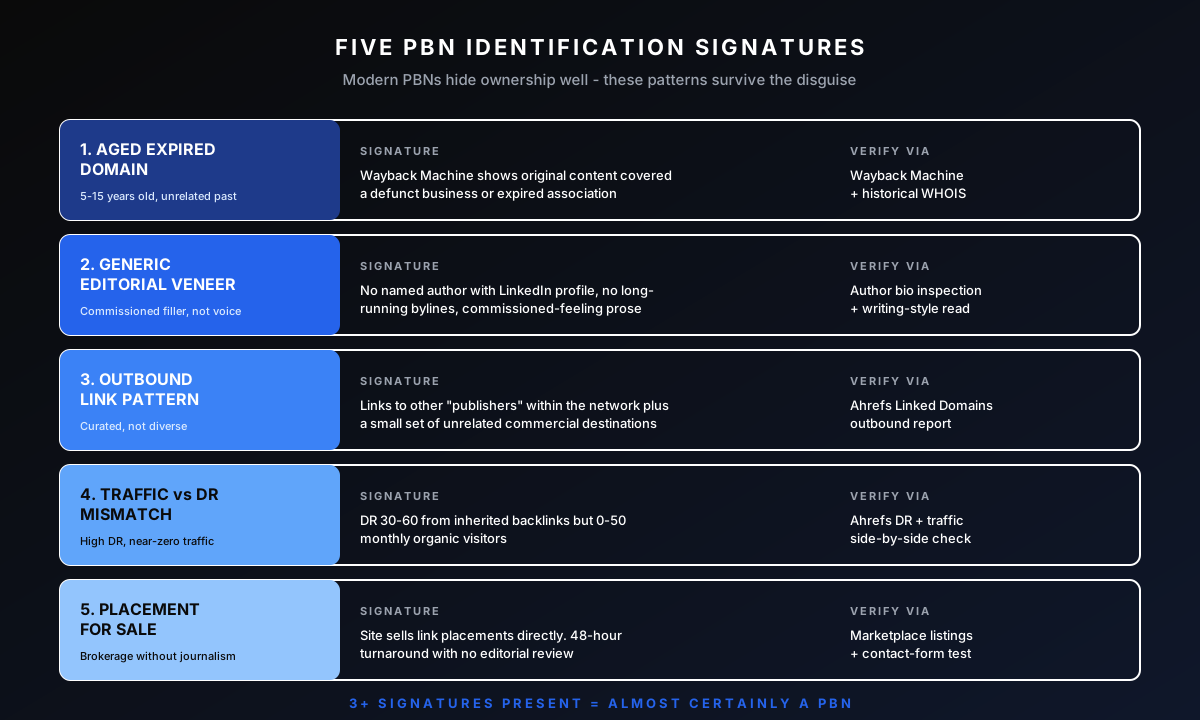
Sophisticated 2026 PBNs avoid the easy detection patterns of 2018 networks. Five characteristics still identify them.
Aged Expired Domains
Domains 5-15 years old, originally for unrelated purposes (defunct local businesses, abandoned blogs, expired association sites), purchased at auction. Wayback Machine shows the original content had no relationship to the current niche.
Generic Editorial Veneer
The current content is well-written but generic. No named author with a discoverable LinkedIn profile. No long-running author bylines. No editorial voice; the writing reads as commissioned filler.
Outbound Link Pattern
The site links to other "publishers" within the same network plus a handful of unrelated commercial destinations. Real publishers link to a wide range of relevant sources; PBN sites link to a curated set defined by which clients are paying that quarter.
Traffic vs DR Mismatch
DR shows 30-60 from the inherited backlink profile. Actual organic traffic is 0-50 monthly visitors. Real publishers at DR 40+ get 1,000-50,000+ monthly visitors; PBN sites do not because their content is not designed to rank, just to host links.
Placement Availability Without Journalism
The site sells link placements directly, often through marketplace platforms. Real publishers earn editorial links; PBN sites broker them. If you can buy a link placement in 48 hours with no editorial review, you are looking at a PBN.
How Do PBN Resellers Disguise Their Inventory?
Four common disguises sold to buyers in 2026.
"High-DR niche placements". The seller emphasises DR 50+ across the inventory but does not mention traffic, editorial standards, or ownership pattern. Investigate the inventory using the five characteristics above.
"Premium guest posts on aged domains". The aged-domain part is the tell. Legitimate publishers care about editorial quality more than age. Aged-domain emphasis means the seller knows you should care about the domain itself, which means the domain itself is the product (a PBN).
"Curated link-building service" with no transparent sourcing. Legitimate agencies (like Mojo Links) source links through editorial outreach to publishers they name. PBN resellers obscure the source domain until after purchase.
Marketplace platforms with bulk-buy options. Any platform that lets you buy 50 placements at $30-100 each is selling PBN inventory. Real editorial placements at quality publications cost $250-1,500 and require negotiation. The economic difference is documented in the link building budget guide.
What Happens If You Buy from a PBN?
Three realistic outcomes.
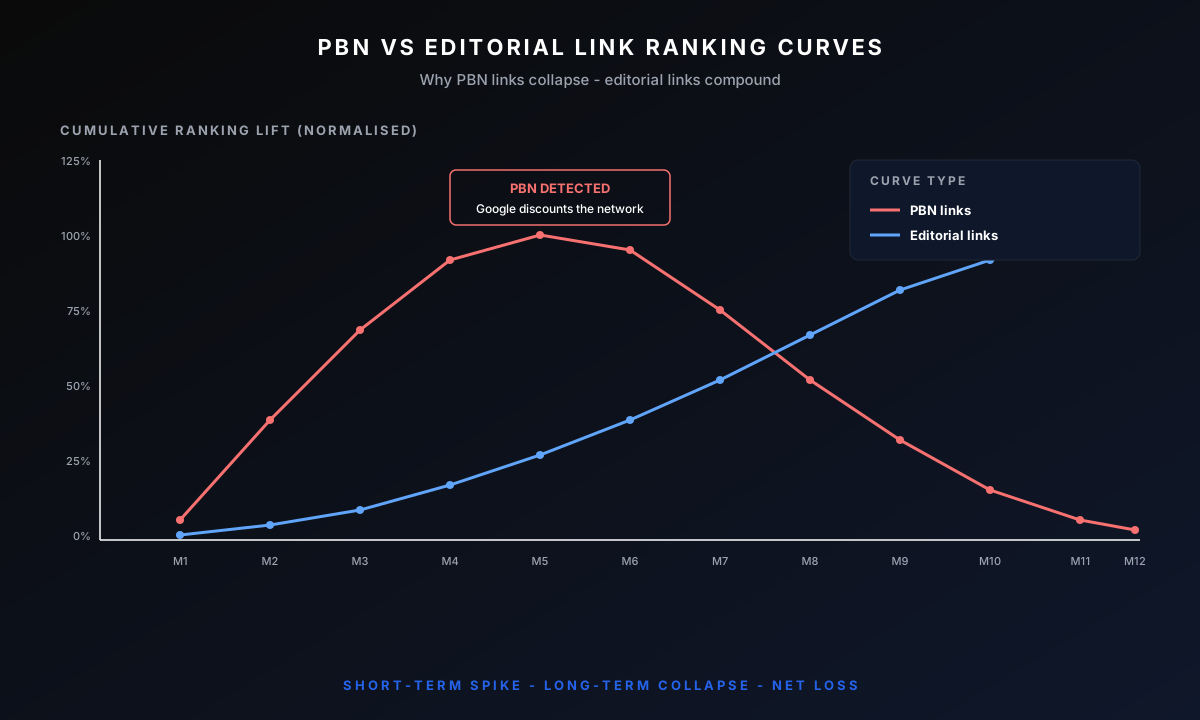
Short-term ranking lift followed by silent decline. The links pass authority for 2-6 months while Google evaluates the network. Once the network is identified, the links get algorithmically discounted. Rankings return to baseline or below. Most buyers attribute the decline to "algorithm updates" without realising the links they bought are the cause.
No movement at all. If Google has already identified the network, the links contribute nothing. The buyer paid $30-100 per link for zero ranking benefit. This is the most common outcome in 2026.
Manual action triggering site-wide penalty. Rare but possible for buyers who scale aggressively (200+ PBN links over 12 months). Recovery requires disavow + reconsideration request and 6-12 months of cleanup work. The remediation workflow connects to the disavow guide.
What Should You Do If You Have PBN Links in Your Existing Profile?
Three-step remediation.
Identify the network. Use the five characteristics above to score suspected PBN sources during audit. Most sites with PBN history have 5-30 confirmed PBN links, sometimes more.
Disavow the identified domains. Add to the disavow file using domain-level entries. Do not bother with removal outreach; PBN operators rarely respond and removing one link does not change the network footprint.
Replace with legitimate editorial acquisition. Disavowing PBN links removes their (already discounted) contribution; the legitimate replacement restores acquisition pace and produces actual ranking benefit.
How Did Mojo Links Arrive at This PBN Position?
We tested PBN tactics on two internal sites in 2018 before committing to a no-PBN policy. Both internal tests produced 6-month ranking gains followed by 12-18 month declines. The math did not work even on our own sites with full operator control. All campaign work has been PBN-free since 2019. Every audit since includes PBN identification as a standard step.
Frequently Asked Questions About PBN Link Building
Can a Small Carefully-Run PBN Still Work in 2026?
Probably not. The detection systems work on small networks too. Carefully-run might extend the working window from 6 months to 12 months but does not change the eventual outcome.
Are All "aged Domain" Placements PBN?
No. A legitimate aged publication with continuous editorial operation since founding is not a PBN. The distinction is whether the current operator built the editorial voice or bought it. The Wayback Machine usually reveals the difference.
Can I Tell If My Agency Is Using PBNs Without My Knowledge?
Yes. Pull the last 6 months of acquired backlinks via Ahrefs. Apply the five-characteristic test to each new source. Five or more failing the test indicates likely PBN use by your agency. Ask them about the sourcing; their response (transparent answer vs deflection) tells you the rest.
What About "PBN-Free" Guarantees from Agencies?
Worth asking for in contract language but not always meaningful. Some agencies guarantee "PBN-free" while still using lower-quality bulk-placement marketplaces that are functionally PBNs without the technical label.
Should You Ever Pay for Any Link?
Yes, with disclosure. Sponsored placements with rel=sponsored attribution are permitted under Google's policy and pass no PageRank, which is fine for brand-building purposes. The line is whether the link is meant to pass ranking credit without disclosure.
Want Us To Check Your Profile for PBN Exposure?
PBN identification is one phase of every managed campaign onboarding audit. We score each existing referring domain against the five-characteristic framework above and produce a remediation list. Book a slot to discuss your profile.

About Bart Magera
Bart Magera is the founder of Mojo Links. Ten years across YMYL verticals (legal, medical, finance, supplements, crypto, gambling). Trained under Koray Tuğberk Gübür's Topical Authority framework. Author of two SEO books and international speaker.
Want this kind of analysis on your site?
Get a free video walkthrough within 48 hours covering technical health, backlinks, content gaps, and AI visibility.
Related posts
Keep reading on adjacent topics.
- Link Building
 Bart Magera10 min read
Contextual Backlinks: What They Are, Why They Win, and How To Earn Them
A contextual backlink sits inside the body of an article, surrounded by relevant text, not in a footer or author bio. That placement is what gives it weight. Here is what contextual backlinks are, what makes one high quality, how to earn them, and how to spot the cheap fakes.
- Link Building
 Bart Magera12 min read
What Is White Hat Link Building? Techniques That Work in 2026
The Problem: Why Most Link Building Fails Your SEO You wrote great content. It’s relevant. It’s useful. It even has infographics. But guess what? Crickets. Nobody’s linking. Google’s not ranking. And your “ultimate guide” is buried somewhere on page 7 under a recipe blog and a…
- Link Building
 Bart Magera10 min read
Tiered Link Building: How It Works and How To Do It Safely
Tiered link building layers weaker links behind your strongest ones to pass more authority to your money pages. Here is how the pyramid works, how to build one, which links are worth tiering, the risk SpamBrain introduced, and the lower-risk path I use on client sites.