
Broken Link Building: What It Is and How To Do It Right
Listen to this article
Browser-native voice. No account required.
The web breaks every day. Resource pages list dead URLs. Tutorials cite tools that shut down. Statistics articles point to studies that have moved or vanished. Every broken link is a backlink opportunity for the team that finds it first and builds a better replacement. Run well in resource-heavy niches, it converts better than every cold-outreach tactic except unlinked mention reclamation. This guide walks through the full workflow.
This post is the operational version of the playbook. Not theory.
What Is Broken Link Building?
Broken link building is the practice of identifying dead resources on the web that still have inbound backlinks, building a replacement asset on your own site, then contacting the webmasters of every linking page to suggest your replacement as the new reference. The tactic exploits the fact that webmasters fix broken outbound links when prompted, because broken links hurt user experience and SEO trust.
It is one of eight tactics covered in detail in the full link building program. It works because everyone benefits: the webmaster fixes a real issue, the reader gets a working resource, and the brand earns an editorial backlink with strong topical context.
Why Is Broken Link Building Effective in 2026?
Three reasons. First, you are pitching value, not asking for a favour. The webmaster has a problem (broken link), and you are offering a solution (working replacement). Second, the inbound link to the dead resource already exists. You are not creating a new placement opportunity from scratch. You are inheriting one. Third, the editorial intent that placed the original link is identical to the intent for your replacement. If they linked to a calculator, they will accept a better calculator.
Conversion rates land between 5 and 12% on properly qualified prospects in Mojo Links' 2024-2025 outreach data. That beats most cold tactics. The catch: volume requirements are high. Expect 200 to 400 outreach emails to land 10 to 20 confirmed replacements. Tooling and discipline matter more than creativity. The full tactic comparison sits in the manual link building guide.
How Does The Broken Link Building Workflow Run End-To-End?
Six phases run in order. Find dead pages with inbound links. Qualify the dead pages for replacement potential. Build the replacement asset. Verify the inbound links are still live. Pitch the webmasters in batches. QA the confirmed placements within 24 hours of going live.
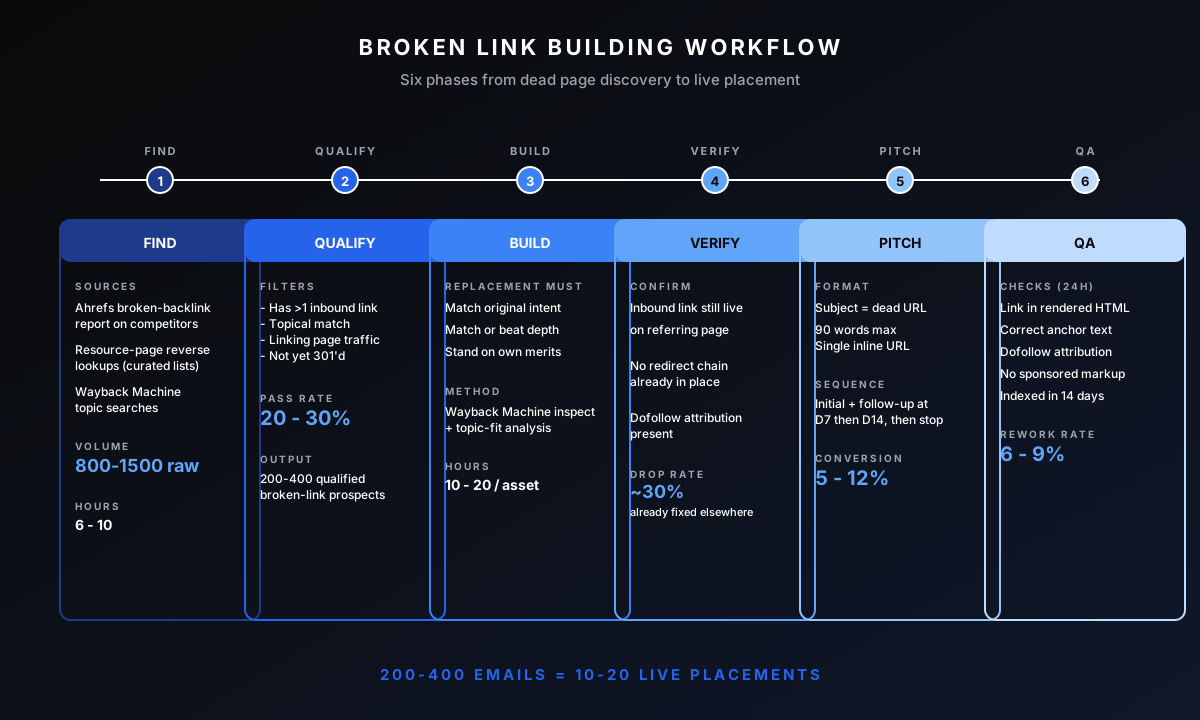
Skip any phase and the math breaks. Skip qualification and you build assets for dead pages no one will accept replacements for. Skip verification and you pitch links that died with the original page. Skip QA and 6-9% of confirmed placements go live with wrong anchors or sponsored markup.
How Do You Find Broken Links Worth Pursuing?
Three sources produce the bulk of usable prospects.
Ahrefs Broken-Backlink Report on Competitors
Pull each top competitor's domain through Ahrefs Site Explorer. The "Broken backlinks" report surfaces every external URL that points to a dead competitor page. Filter for relevance: same niche, decent referring page traffic, dofollow attribution. Export to spreadsheet for scoring.
Resource-Page Reverse Lookup
Search Google for "best [niche] resources" or "[niche] tools" using site operators. Pull each resource page through the Ahrefs URL Inspector. Outbound link checker tools (or the manual Chrome devtools network tab) identify dead destinations. Resource pages are the highest-quality source of broken-link prospects because they are intentionally curated.
Topic-Specific Wayback Machine Searches
The Internet Archive Wayback Machine indexes web history. For a known dead resource on your topic, search the archive for pages that linked to it. The technique scales poorly but produces high-quality prospects when other sources are exhausted.
How Do You Build a Replacement Asset?
The replacement must do three things. Match the original's intent (if the dead page was a calculator, your replacement is a calculator). Match or exceed the depth (if the dead page was 3,000 words, yours is 3,000+). Stand alone editorially (your replacement must be linkable on its own merits, because the webmaster may inspect it and reject if it looks thin).
Use the Wayback Machine to inspect the dead page if it ever existed. The historical snapshot shows what the original covered, what the editor presumably valued, and what the replacement needs to match or beat. The audit is the same one to run when planning niche-relevant backlink acquisition: editorial fit determines whether the pitch succeeds.
How Do You Pitch The Webmaster?
A working broken-link pitch has four parts. Subject line referencing the specific dead URL (not "broken link on your site"). Two-sentence opening identifying the dead link by exact page URL and anchor text. One sentence explaining you have a replacement. A single in-line URL to the replacement, no attachments. Sign-off with your name and role. No more than 90 words.
Sequencing matters. Send the initial pitch. Wait 7 days. Send a single short follow-up referencing the original. Wait 14 days. Move the prospect to the 90-day cool-off list. Three sends maximum per prospect. Pitchbox works well for sequencing because the conditional logic handles re-engagement automatically.
Personalisation matters. Mention the specific page the broken link sits on by title. Reference one other piece of content on the site to prove you read it. Templated openers convert at 1-3%. Personalised openers convert at 8-12% in Mojo Links' 2024 outreach dataset.
What Is The Conversion Rate of Broken Link Building?
5 to 12% from qualified prospect to live placement, against the 200-400 emails per 10-20 placements range. Cost per placement, including senior outreach time, lands at $180 to $420 on most engagements. Cheaper than guest posts, more expensive than unlinked mention reclamation.
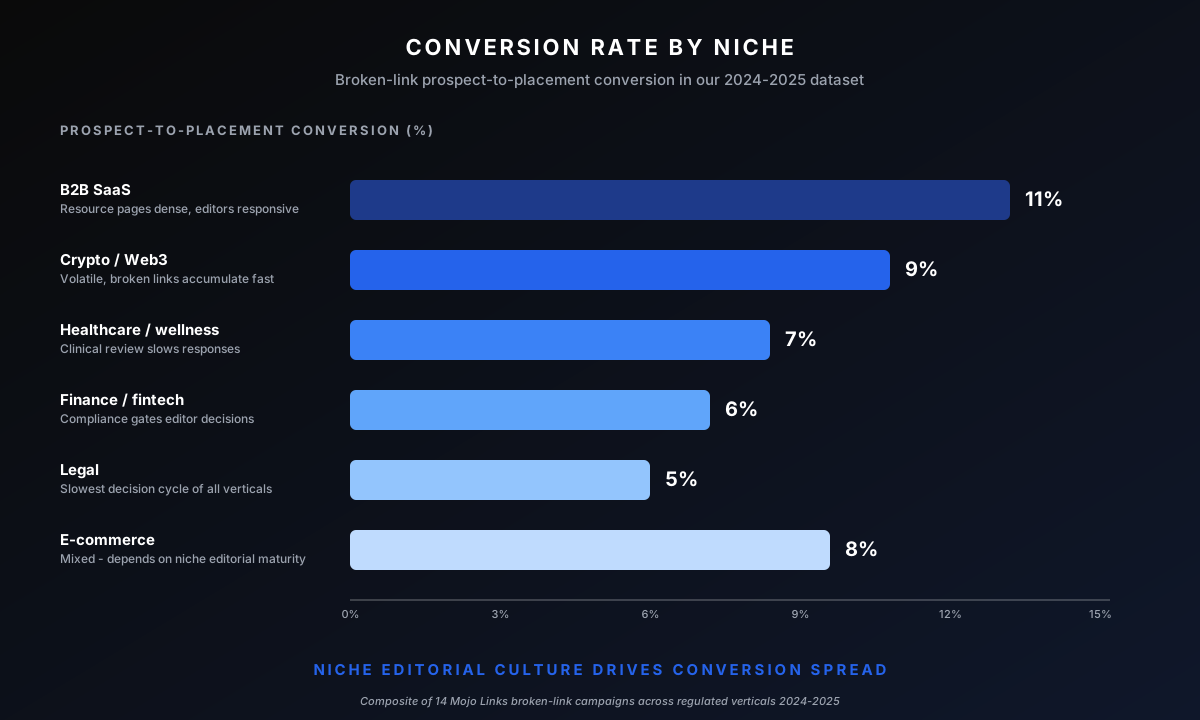
Conversion varies sharply by niche. Resource-page outreach in B2B SaaS converts at 9-12%. The same outreach in legal converts at 4-6% because legal webmasters move slowly. Crypto converts at 7-10% because volatility means broken links accumulate fast and editors welcome fixes. The vertical-specific data lives in the 2026 link building statistics.
What Mistakes Ruin a Broken Link Building Campaign?
Five common mistakes account for most failed campaigns.
Pitching dead pages with no inbound links. The Ahrefs report shows broken pages plus referring pages. If the broken page has zero referring domains there is no link to inherit. New operators often skip the referring-page check and waste hours.
Building thin replacement assets. A 600-word blog post is not a viable replacement for a 4,000-word definitive guide. Webmasters reject mismatches.
Ignoring redirect chains. The dead page may already be redirecting somewhere. If the redirect lands on an active replacement, you are too late. Verify with Chrome devtools network tab before pitching.
Sending bulk identical pitches. Personalisation is the single largest predictor of reply rate in Mojo Links' campaign data. Templated blasts get filtered as spam by mid-2020s mail providers regardless of warm-up.
Skipping QA after placement. 6 to 9% of confirmed placements go live with wrong anchor, sponsored markup, or paragraph rewrites that remove the link's context. The QA pass is the same one that applies across every tactic in the end-to-end link building workflow.
How Did Mojo Links Develop This Broken Link Methodology?
The workflow above is the consolidated output of 14 broken-link campaigns in regulated verticals 2022-2025. We tracked pitch templates, conversion by niche, time per phase, and rework rates. The numbers in this post are the empirical ranges from that dataset. They are not industry averages from public studies. They are what our team has actually produced under real campaign constraints.
Frequently Asked Questions About Broken Link Building
How Long Does a Broken Link Campaign Take To Deliver Placements?
Plan for 4 to 8 weeks from prospecting to first live placement. Most placements concentrate in weeks 3-6 once outreach sequences run their full follow-up cycles. Long-tail placements continue arriving through week 12.
What Is The Difference Between Broken Link Building and Link Reclamation?
Broken link building targets dead pages on third-party sites. Link reclamation targets dead pages on your own site (lost backlinks), or unlinked brand mentions, or 404 errors that previously had links. Adjacent disciplines that share workflow components.
Can You Automate Broken Link Building?
Partially. Prospecting and verification can run through tools. Personalisation and editorial judgement cannot. Fully automated broken-link tools produce 1-3% conversion rates. Human-personalised pitches produce 8-12%. The math always favours personalisation despite the time cost.
Does The Replacement Asset Have To Be Brand New?
No. An existing high-quality asset on the site works if it matches the dead page's intent and depth. The same asset can be re-pitched to broken-link prospects across multiple niches when relevance allows.
What Is The Maximum Scale for Broken Link Building Per Site?
Realistic ceiling is 8 to 15 placements per month per campaign team for sustained quality. Above 15 the qualification rate drops and rework rate climbs. For higher volumes, layer in additional tactics rather than scaling broken-link work further.
Want Us To Run a Broken Link Campaign for Your Site?
Broken link campaigns are one of the standard tactics inside our managed link building. Most engagements run 2 to 4 broken-link cycles per quarter alongside guest posting and digital PR. Book a slot to scope your campaign.

About Bart Magera
Bart Magera is the founder of Mojo Links. Ten years across YMYL verticals (legal, medical, finance, supplements, crypto, gambling). Trained under Koray Tuğberk Gübür's Topical Authority framework. Author of two SEO books and international speaker.
Want this kind of analysis on your site?
Get a free video walkthrough within 48 hours covering technical health, backlinks, content gaps, and AI visibility.
Related posts
Keep reading on adjacent topics.
- Link Building
 Bart Magera10 min read
Contextual Backlinks: What They Are, Why They Win, and How To Earn Them
A contextual backlink sits inside the body of an article, surrounded by relevant text, not in a footer or author bio. That placement is what gives it weight. Here is what contextual backlinks are, what makes one high quality, how to earn them, and how to spot the cheap fakes.
- Link Building
 Bart Magera12 min read
What Is White Hat Link Building? Techniques That Work in 2026
The Problem: Why Most Link Building Fails Your SEO You wrote great content. It’s relevant. It’s useful. It even has infographics. But guess what? Crickets. Nobody’s linking. Google’s not ranking. And your “ultimate guide” is buried somewhere on page 7 under a recipe blog and a…
- Link Building
 Bart Magera10 min read
Tiered Link Building: How It Works and How To Do It Safely
Tiered link building layers weaker links behind your strongest ones to pass more authority to your money pages. Here is how the pyramid works, how to build one, which links are worth tiering, the risk SpamBrain introduced, and the lower-risk path I use on client sites.