

Link Schemes: What Google's Policy Actually Prohibits
Listen to this article
Browser-native voice. No account required.
Google's link-scheme policy is deliberately broad. The text gives Google room to interpret tactics case-by-case rather than committing to specific bright lines. This is the agency-grade interpretation: which tactics are clear violations, which sit in the grey zone, and which patterns actually trigger manual action versus algorithmic discount. Use it to evaluate your own profile and pressure-test agency proposals.
What Does Google's Link-Scheme Policy Actually Say?
Google's Spam Policies on link schemes prohibit "any links intended to manipulate PageRank or a site's ranking in Google search results." The policy lists buying or selling links that pass ranking credit, excessive link exchanges, large-scale article marketing or guest posting campaigns with keyword-rich anchor text, using automated programs or services to create links, and requiring a link as part of a Terms of Service contract.
The policy is intentionally broad because Google wants the latitude to act against new tactics without rewriting policy each time. The interpretation that matters is operational: what actually triggers action in 2026.
Which Link Tactics Are Clear Policy Violations?
Five tactics are unambiguously prohibited.
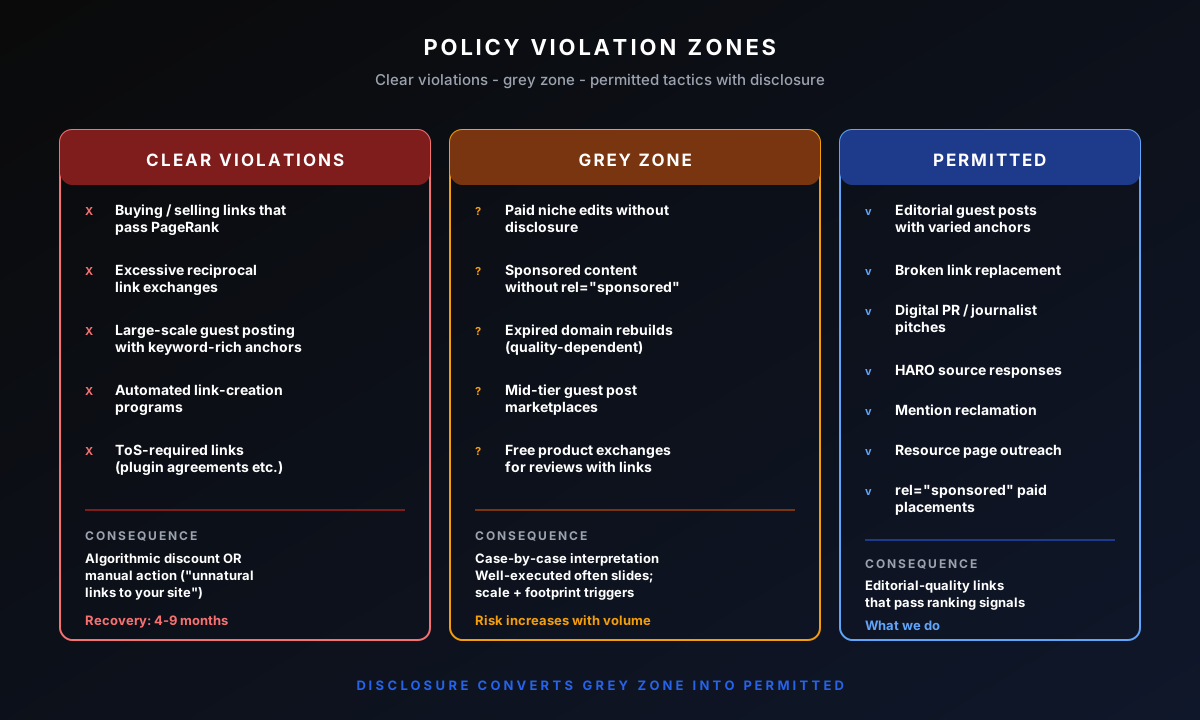
Buying or Selling Links That Pass PageRank
The most direct violation. Buying a link with a rel="follow" attribute (or no rel attribute) intended to pass ranking credit is a clear violation. The fix is rel="sponsored" or rel="nofollow" on paid placements. The line is whether the payment is disclosed to Google via the rel attribute, not whether payment occurred.
Excessive Reciprocal Link Exchanges
A few mutual links between collaborators is normal. Building extensive reciprocal patterns across a network (Site A links to B, B to A, both to C, C to both) triggers detection. Google has identified reciprocal patterns since the 2012 Penguin update, and the detection systems, now powered by Google SpamBrain, have only improved.
Large-Scale Guest Posting with Keyword-Rich Anchors
Mass guest posting where every post uses the same exact-match commercial anchor pointing to the same destination page. The line is "large-scale" plus "keyword-rich anchor text" together. Editorial guest posts with varied anchors are not the violation. The framework for anchor distribution sits in the anchor text guide.
Automated Link-Creation Programs
Tools that auto-comment on blogs, auto-submit to directories, or auto-place links via XML-RPC. These produce footprints Google detects easily. The tactic worked in 2010-2013 and stopped working entirely by 2016. The best-known version of that footprint problem is the backlink pyramid tactic.
ToS-Required Links
Requiring a link to your site as part of free-trial agreements, software licences, plugin terms, or other contractual relationships. Common in WordPress plugin ecosystems through the early 2010s. Now a policy violation regardless of disclosure.
Which Tactics Sit in The Policy Grey Zone?
Five tactics where the policy is interpretable and Google's response varies by execution.
Paid Niche Edits Without Disclosure
Paying a publisher to add a link to an existing article. The publisher is a real editor making an editorial decision. The transaction is monetary. The disclosure is usually missing. Operationally Google often ignores well-executed niche edits at moderate volumes; the same tactic at scale triggers detection. The risk profile is documented in the guest posts vs niche edits comparison.
Sponsored Content Without Rel="sponsored"
Sponsored articles published on real publications without the rel attribute Google expects. The legal disclosure (FTC compliance) is often present; the technical disclosure (rel attribute) is missing. Google can treat the missing rel as a policy gap; in practice, well-executed sponsored content rarely gets flagged.
Expired Domain Rebuilds
Buying an expired domain, rebuilding the content, using it as a publisher. If the rebuild produces genuine editorial value, the tactic is in the grey zone rather than a clear violation. If the rebuild is thin and the domain functions as a PBN, it falls under the PBN violation pattern.
Mid-Tier Guest Post Marketplaces
Marketplaces selling guest posts at $50-200 on aged-domain publications with thin editorial standards. Some marketplace inventory is legitimate; most is functionally PBN with marketplace dressing. The case-by-case judgement depends on which specific publications you accept.
Free Product/service Exchanges for Reviews with Links
"Send us a free unit and we will review it with a link." The transaction is implicit. FTC compliance requires disclosure; Google's policy varies based on whether the review is editorially honest. The grey zone is wide here; well-disclosed exchanges with real reviews rarely trigger problems.
What Actually Triggers a Manual Action?
Three patterns produce manual actions more often than algorithmic discount.
Pattern 1: Volume + Obvious Manipulation
Several hundred new backlinks within a short window, mostly from network-footprint sources, mostly with exact-match commercial anchors, all targeting the same money page. The signature is the convergence of multiple violations. Algorithmic systems can discount any single signal; the combination flags the site for human review.
Pattern 2: Repeat-Offender Signal
A site previously sanctioned for manipulation, now showing similar new patterns. Google's ML systems weight prior history. A first-time site committing similar violations might get algorithmic discount; a repeat site gets manual action faster.
Pattern 3: Competitor Reports + Visible Evidence
Competitor spam reports through Google's feedback channels combined with publicly visible evidence (marketplace listings, advertising for paid placements, public PBN sales). Most spam reports are ignored, but reports with documented evidence often produce action. The defensive workflow sits in the negative SEO guide.
What Is The Difference Between Algorithmic Discount and Manual Action?
Two enforcement mechanisms with different consequences.
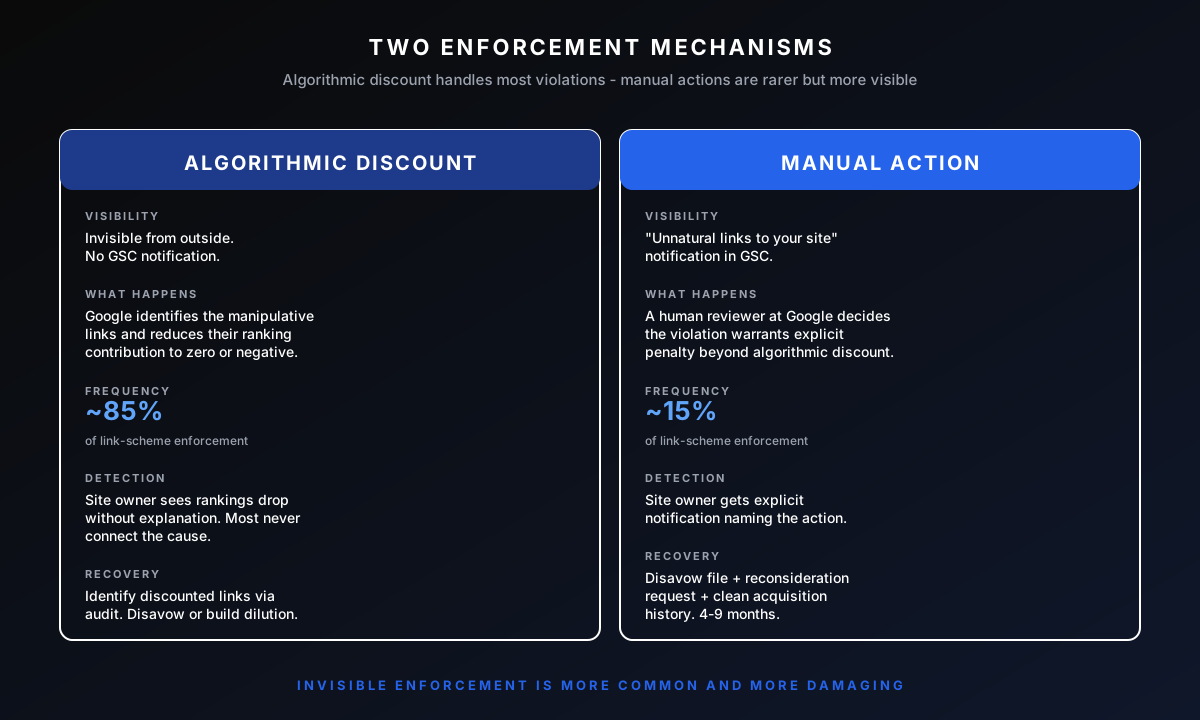
Algorithmic Discount
Invisible from outside. Google identifies the links and reduces their ranking contribution to zero or negative. The site owner does not get a notification. Rankings drop without explanation. Recovery requires identifying which links are discounted and either disavowing or building enough legitimate acquisition to overwhelm the discount. Most policy violations end in algorithmic discount, not manual action.
Manual Action
Visible in Search Console as "unnatural links to your site". A human reviewer at Google decided the violation warranted explicit penalty. The notification names the action type. Recovery requires disavow file + reconsideration request + clean acquisition history. Average recovery window is 4-9 months. Manual actions for link schemes are rare relative to total enforcement actions; algorithmic discount handles most cases.
How Do You Stay Compliant Without Overcautious Refusal?
Four practical rules that keep Mojo Links' campaigns out of trouble.
Use rel="sponsored" or rel="nofollow" on every paid placement. The disclosure converts a violation into a permitted tactic with reduced ranking benefit.
Maintain anchor diversity. Under 15% exact-match commercial anchors across the profile. Above 25% triggers spam-detection. Detailed targets in the guide to anchor text distribution.
Source variety. No single tactic over 60% of acquired links. No single publisher over 5% of placements. Footprint diversification.
Audit quarterly. Profile composition shifts faster than most operators track. A safe profile in January can be a flagged profile in June if acquisition mix changes.
How Did Mojo Links Arrive at This Policy Interpretation?
The interpretation evolved across campaigns and audit engagements where prior agencies had crossed lines. We tracked which patterns produced visible Google action, which slid through, and how recovery worked when action occurred. The framework above synthesises that empirical observation with Google's published policy. We update it whenever Google publishes meaningful policy clarification.
Frequently Asked Questions About Link Schemes
Are Guest Posts Considered Link Schemes?
No. Editorial guest posts with reasonable anchor variety are not violations. The policy specifically targets "large-scale article marketing or guest posting campaigns with keyword-rich anchor text." The "large-scale" + "keyword-rich anchor" together are the violation, not guest posts themselves.
Can You Legally Buy Backlinks?
Legally, yes. Under Google's policy, yes if the link uses rel="sponsored" attribution. The link passes no PageRank under that attribute, so the buyer rarely sees the placement as worth the cost. Most paid placements that look attractive to buyers violate the policy by omitting the rel attribute. Before spending money on placements, the guide to buying backlinks walks through the vetting that keeps you penalty-free.
What If You Bought Links Years Ago, Before The Policy Was Clear?
Older paid links discovered during audit get treated case-by-case. If the linking domain is still healthy and the link still appears editorial, leave it. If the linking domain has deteriorated, disavow during cleanup phase.
Does Google Really Penalise Sites for Link Schemes in 2026?
Yes, mostly via algorithmic discount rather than manual action. The discount is the more common enforcement, the less visible enforcement, and the more damaging enforcement (because operators do not know to remediate).
How Do You Tell If Your Previous Agency Violated Google's Link-Scheme Policy?
Audit the last 6 months of acquired links. Apply the violation patterns and grey-zone patterns above. If acquisition shows volume + footprint + anchor patterns matching the violations, your agency crossed lines. Disavow workflow follows. When it does, the free disavow.txt tool builds the upload-ready file.
Want Us To Audit Your Profile for Link-Scheme Exposure?
Policy-compliance audit is part of every link campaign onboarding. We score the existing profile against the framework above and produce a remediation list before scaling new acquisition. Book a slot to discuss your profile.

About Bart Magera
Bart Magera is the founder of Mojo Links. Ten years across YMYL verticals (legal, medical, finance, supplements, crypto, gambling). Trained under Koray Tuğberk Gübür's Topical Authority framework. Author of two SEO books and international speaker.
Want this kind of analysis on your site?
Get a free video walkthrough within 48 hours covering technical health, backlinks, content gaps, and AI visibility.
Related posts
Keep reading on adjacent topics.
- Link Building
 Bart Magera10 min read
Contextual Backlinks: What They Are, Why They Win, and How To Earn Them
A contextual backlink sits inside the body of an article, surrounded by relevant text, not in a footer or author bio. That placement is what gives it weight. Here is what contextual backlinks are, what makes one high quality, how to earn them, and how to spot the cheap fakes.
- Link Building
 Bart Magera12 min read
What Is White Hat Link Building? Techniques That Work in 2026
The Problem: Why Most Link Building Fails Your SEO You wrote great content. It’s relevant. It’s useful. It even has infographics. But guess what? Crickets. Nobody’s linking. Google’s not ranking. And your “ultimate guide” is buried somewhere on page 7 under a recipe blog and a…
- Link Building
 Bart Magera10 min read
Tiered Link Building: How It Works and How To Do It Safely
Tiered link building layers weaker links behind your strongest ones to pass more authority to your money pages. Here is how the pyramid works, how to build one, which links are worth tiering, the risk SpamBrain introduced, and the lower-risk path I use on client sites.